

Morning all, this is Tom Riley, and welcome back to this special edition of The Fast Charge, a British EV newsletter.
As you may have seen in The Times, I am publishing an impact assessment about how rising grid standing charges will impact drivers, businesses and the UK’s transition to electric vehicles.
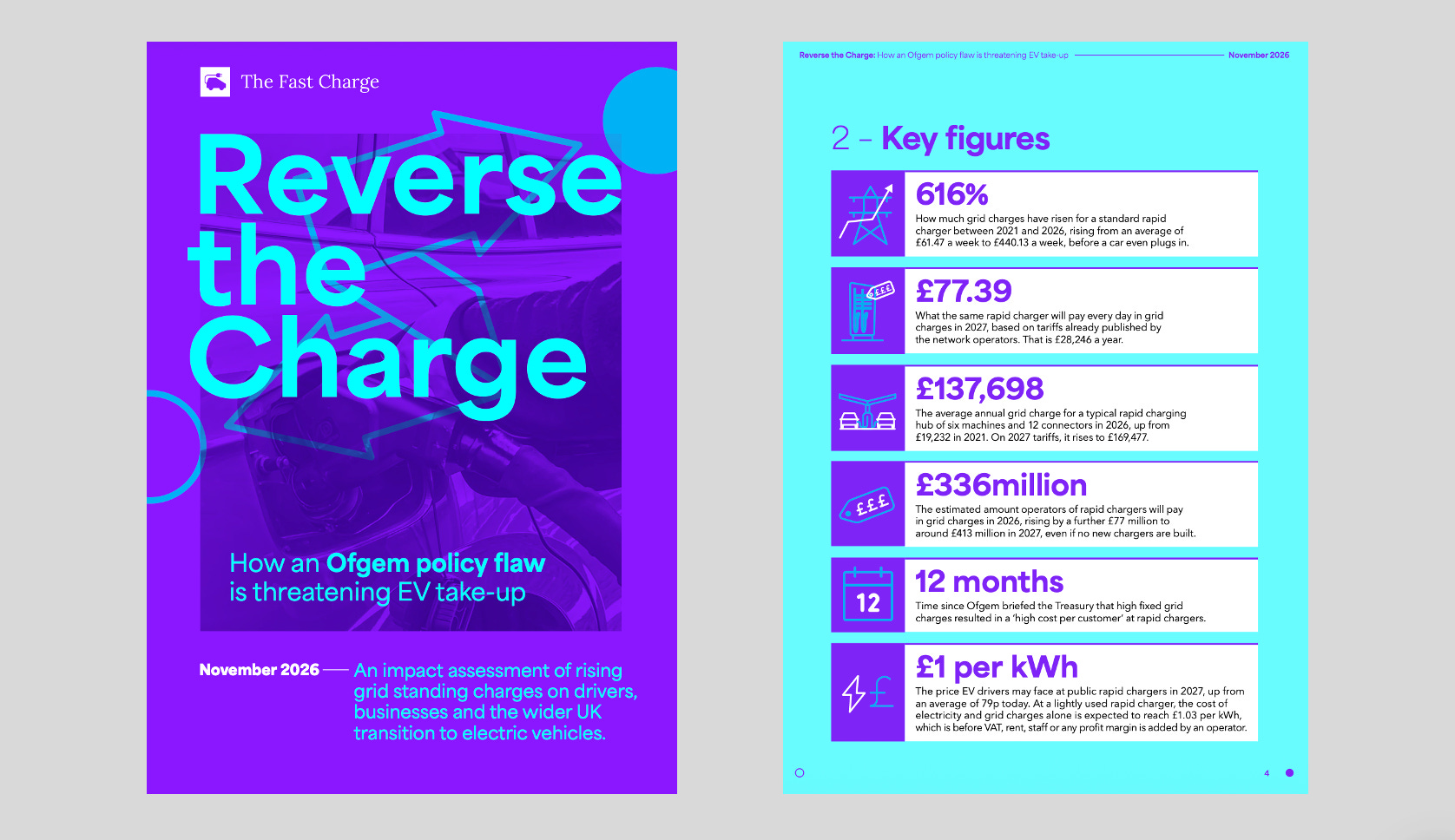
The assessment is based on average tariffs from eight GB distribution areas and the National Energy System Operator (NESO). To secure this data and understand it properly, I partnered with the charge point operator, Zest. All the data and information I used to develop this assessment and its findings are online. Including several documents I obtained from Ofgem.
I hope the publication today ruffles feathers and leads to a positive change for EV drivers - present and future - and alleviates some pressure in the EV sector, just before the UK Government turns the dial back on its ambition.
Without further ado, may I introduce The Fast Charge’s first-ever, full-fat report…
Reverse the Charge:
How an Ofgem policy flaw is threatening EV take-up
Headline… Without immediate action from Ofgem to reverse the effective ‘grid tax’ faced by UK EV charger operators, based on energy tariffs already published for 2027, my assessment concludes that £1 per kWh at rapid chargers could become commonplace next year. Either that, or we will see an increasing slowdown of new chargepoint installations and falling investment.
This is bad for drivers… Whether you have a driveway or not, and a third of households do not, rising grid standing charges are going to push up costs for public charging operators. In the assessment shared today, which is modelled on a standard rapid charger with two 100kW connectors – aka, at the very low end of power demand – I found the average weekly fixed grid charge for a single device in 2026 totals £440. This is the amount an operator pays whether a car plugs in or not.
Next year… the fixed cost to run that same charger will be £540.
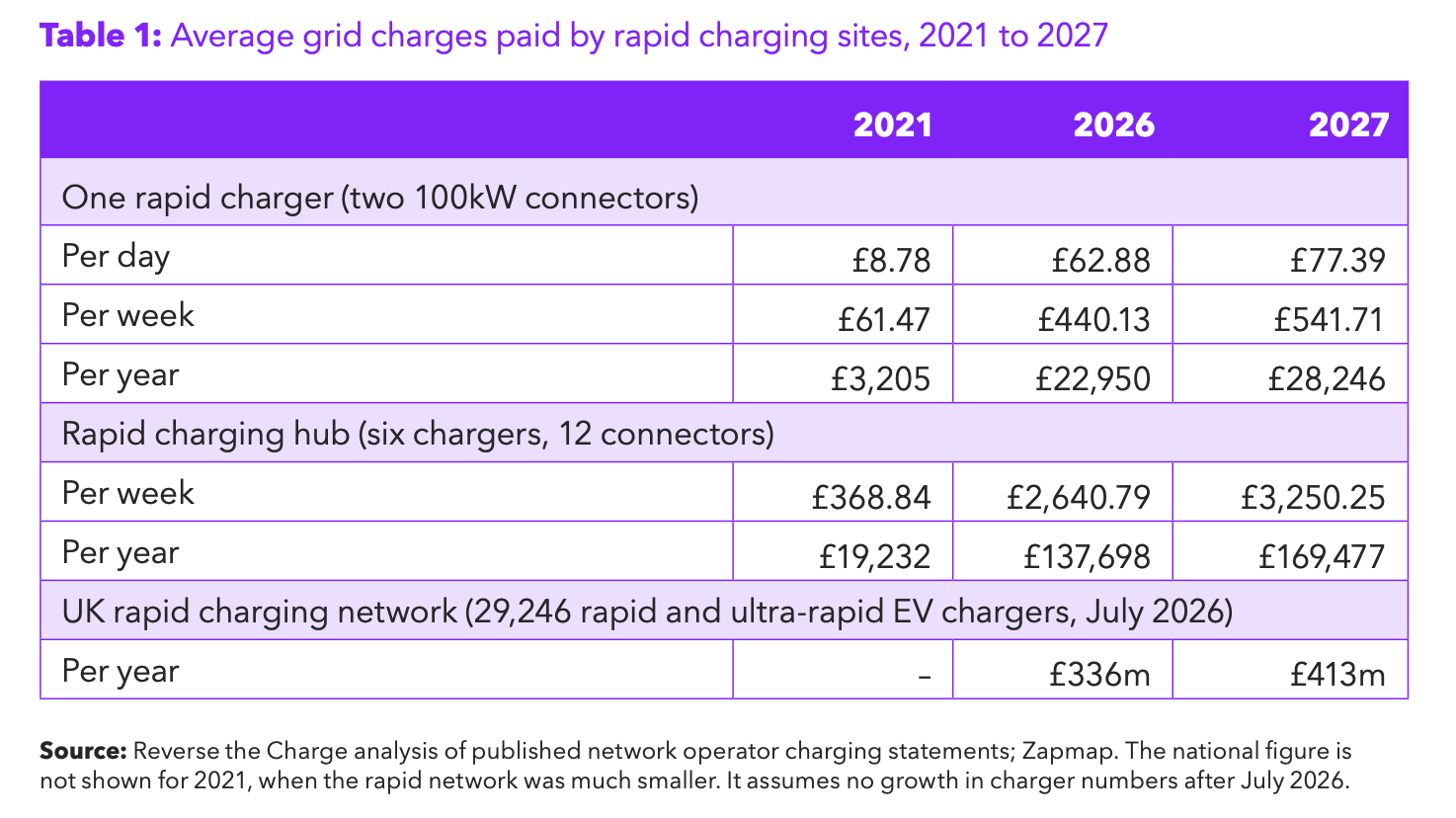
For context… in 2021, before Ofgem’s Targeted Charging Review took effect, it was £61.47. That’s a 616% rise in five years.
Why is this happening? It starts and ends with Ofgem. In 2019, the energy regulator ran a Targeted Charging Review. This review decided that fixed daily charges could be set by connection capacity, not consumption. That change was introduced in 2022, and in full in April 2023. In the years since, the charges have been rising. This is a problem if you build a rapid charger and have to wait years for the cars to use it.
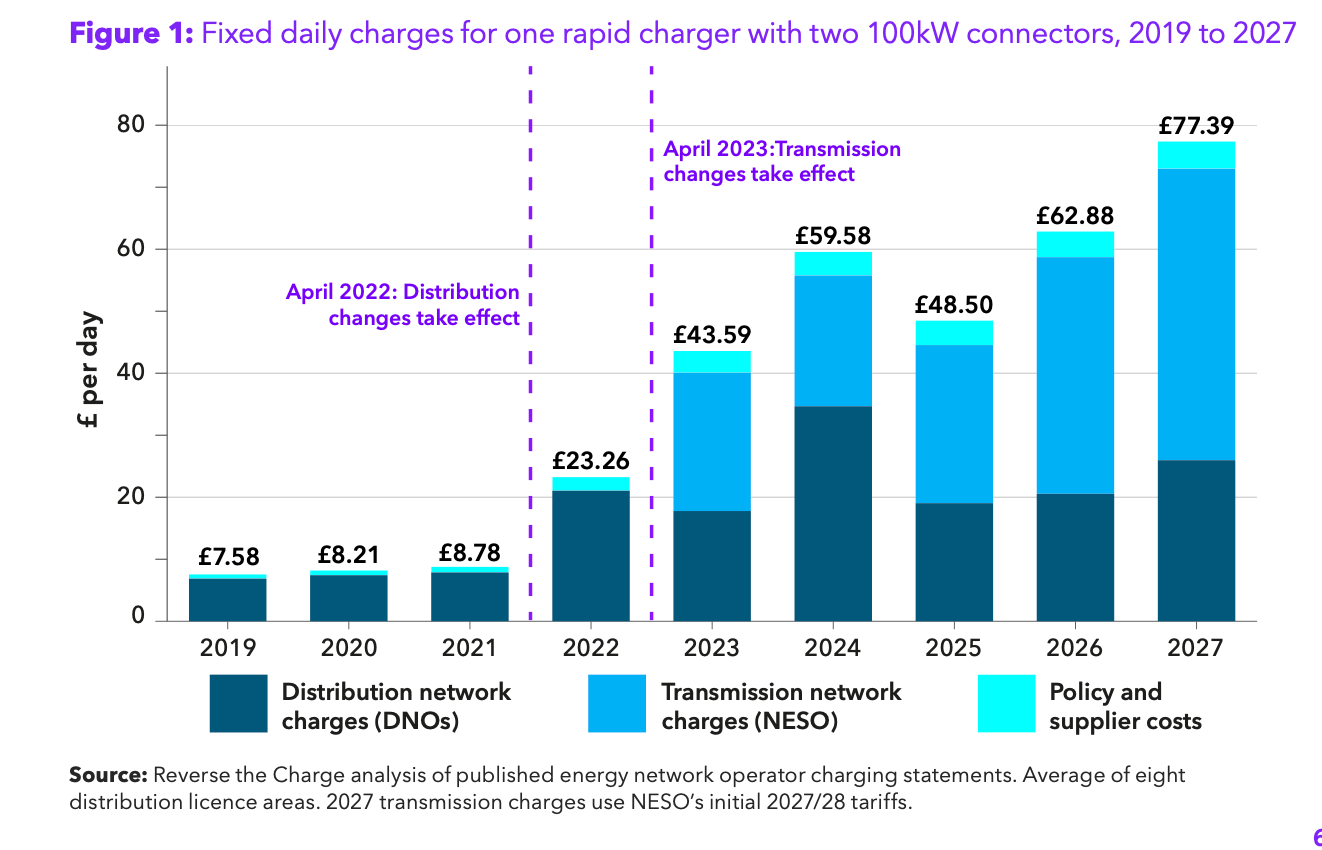
So, how do we get to £1? At a standard rapid charger selling around 100 kWh a day, which is about two or three visits, electricity and grid charges alone will cost £1.03 per kWh on 2027 tariffs. That’s before tax, rent, maintenance, payment fees, staffing, marketing, or God forbid any margin.
As of today… Zapmap puts the average PAYG rapid charging price at 82p (though it was 79p when we did the report).
This shows why networks increasingly focus on high utilisation sites. The more power you can sell a day, the less those grid charges impact you. But the reality is not every site is busy. Meaning, even if one charger is doing very well, its gains may be offset by a site making a loss. And, as I understand it, sites making a loss are common.
In the impact assessment… I used the single rapid charger model and scaled it up to demonstrate the impact.
For a six-device hub… The report found a 12-connector hub might pay £137,698 a year in 2026, rising to £169,477 in 2027. And when looking across the UK’s rapid network, based on Zapmap’s July figures, I estimate that operators could pay around £336m to the networks this year and £413m next, even if nobody built another charger.
And this is conservative. Remember, the calculation is based on a low-power rapid charger with a 232 kVA connection. For a few years now, ultra-rapid chargers have been installed that offer speeds up to 350kW (or beyond). And several of these devices often appear on the same sites. This means the amount paid to energy networks for fixed grid charges, I suspect, is far higher than anything I’ve estimated above.
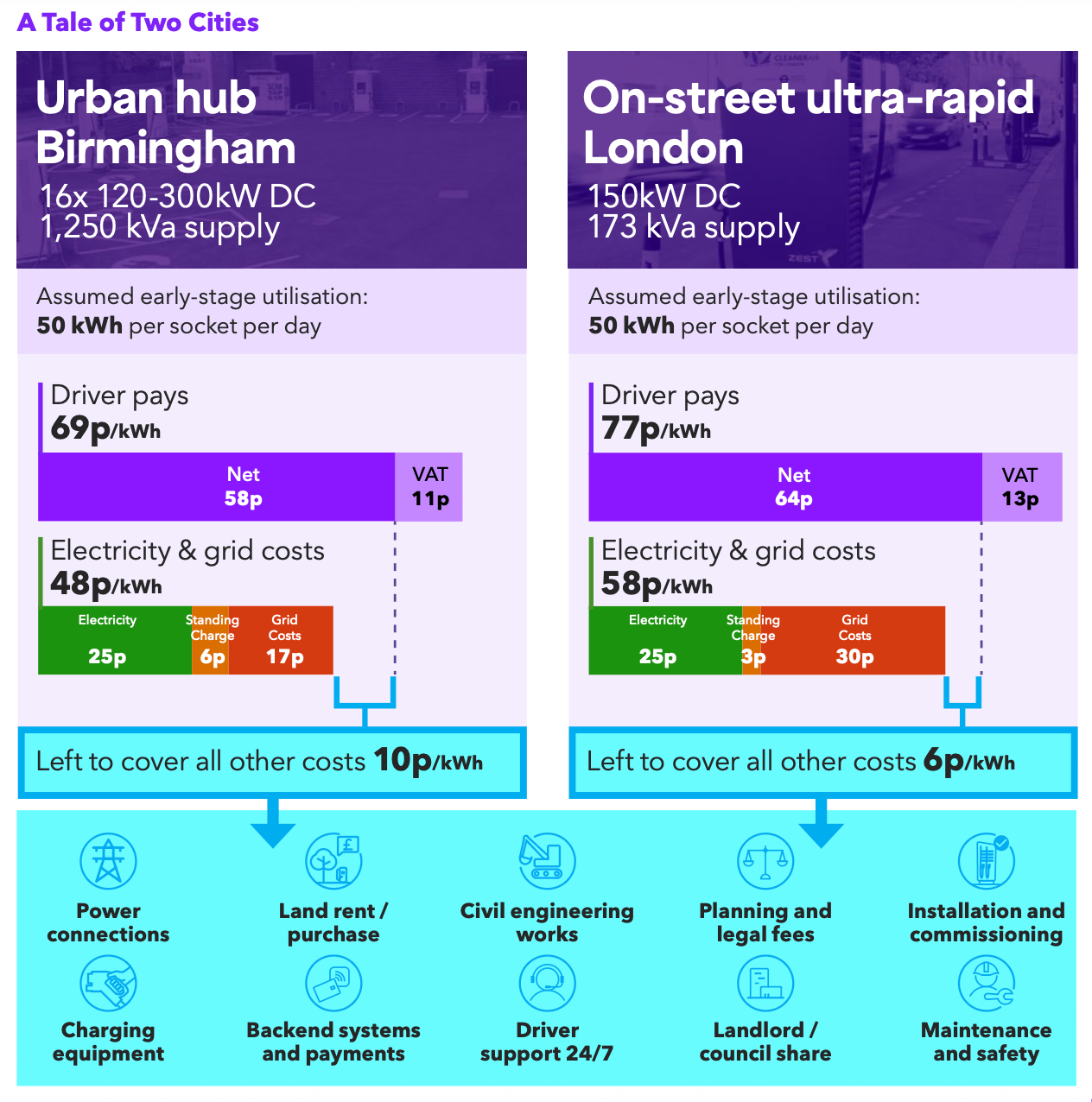
To demonstrate the point… Zest agreed to share a breakdown of two real sites. At a Birmingham hub, electricity and grid costs take 48p of the 58p a driver pays per kWh before VAT. At an on-street ultra-rapid in London, they take 58p of 64p. That leaves 10p and 6p respectively to cover maintenance, 24/7 support, rent and everything else.
And here we arrive at the real scandal. The very organisation designed to protect energy consumers has known about this issue and its negative impact for years. And despite sitting in industry groups with energy networks, still no action has been taken to remedy the situation, despite solutions being on the table.
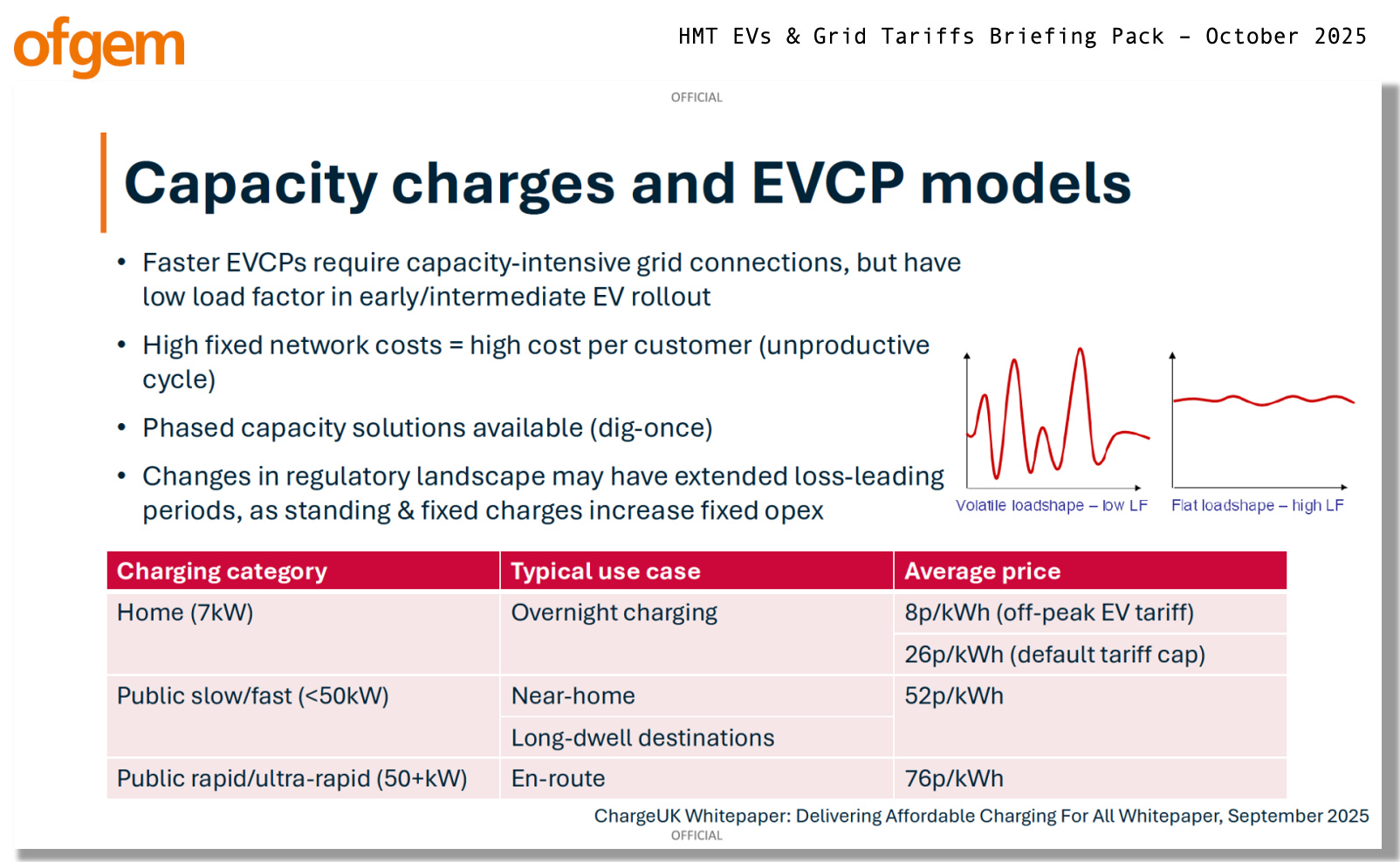
As part of writing this report, I submitted FOIs to Ofgem, NESO and DfT. Today, I have published all the documents I received. One slide deck I obtained from Ofgem was dated October 2025 and prepared for the Treasury. One slide in particularly gives a blunt assessment of the policy it has allowed to run wild:
“High fixed network costs = high cost per customer (unproductive cycle).”
It adds that regulatory changes “may have extended loss-leading periods” for operators. A version dated May 2026 repeats it word for word.
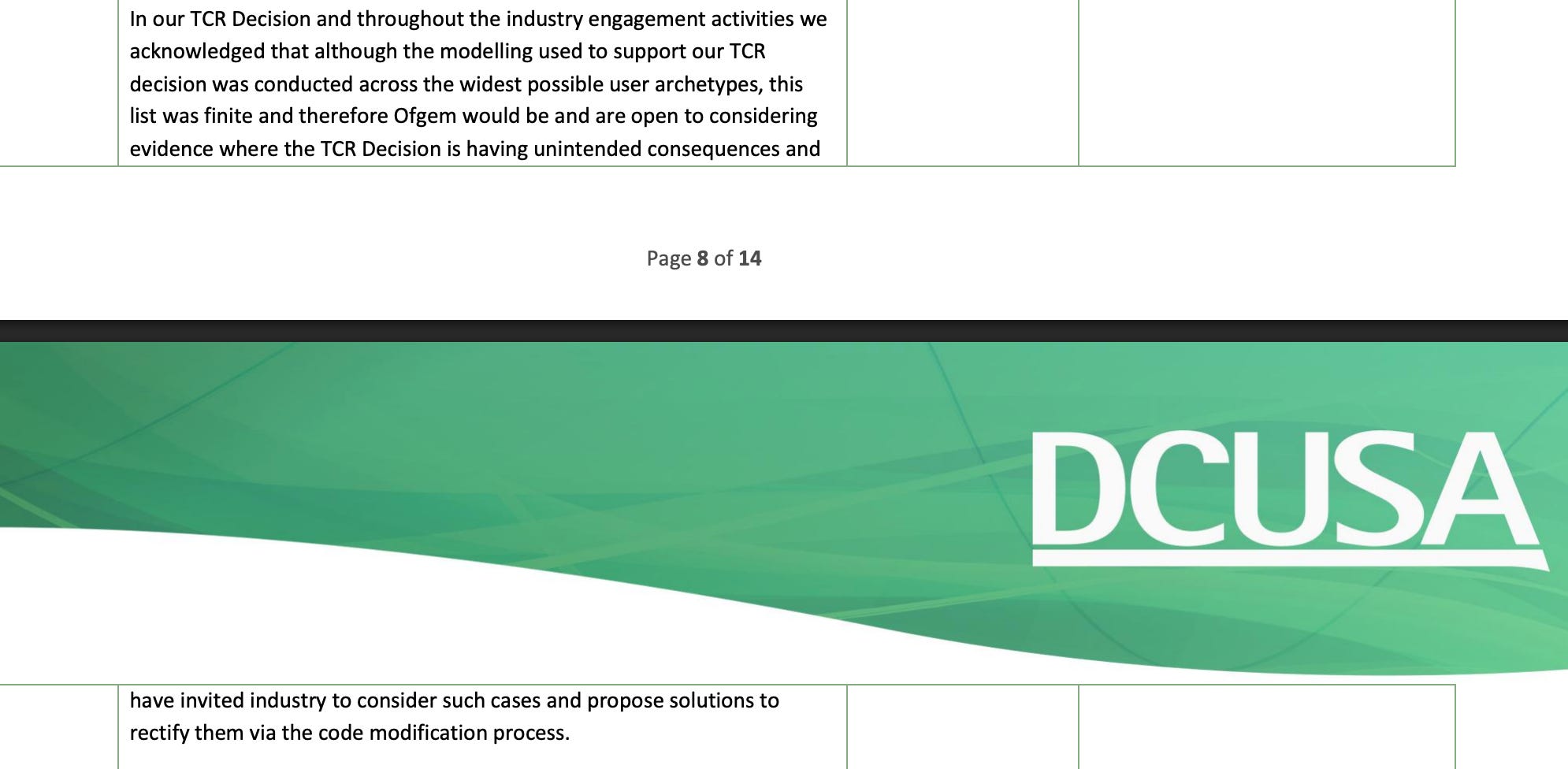
I asked Ofgem if they ever considered the impact on EV charging when the TCR Decision was made. They pointed me to an energy network working group (DCUSA) and its minutes. Within them, Ofgem acknowledged its TCR modelling covered a finite list of user types, and said it was open to considering evidence where the decision “is having unintended consequences”. When I asked NESO the same thing, they said it held no analysis at all.
Even the Government’s own review agrees action is needed… Philip New’s Cost of Public Charging Review, published on the same day as Budget 2026, found the TCR has had a “severe impact” on operators’ unit costs, and said Ofgem must “urgently address” it. Yet the Budget’s £100m went to lower-powered local chargers. There was nothing on grid charges.
Furthermore… The government review appears to have only considered distribution charges. Transmission charges appear to be absent, despite them making up a significant proportion of grid-related costs.
So, what’s the fix?
It already exists. A solution known as ‘DCP 420’ would let eligible sites drop to a lower residual band. Elsewhere, ‘DCP 454’ goes further, returning them to a consumption-based residual. Both have sat in DCUSA working groups for around three years. Both of these options could be mirrored for transmission charges as well.
The ask is therefore very simple. We don’t bill a café based on how many coffees it could make in a day; they are charged based on how many they sell. So why does Ofgem think it is fine for EV charging to billed on capacity? Maybe if they were being used all the time that would be fair. But right now it’s hurting operators, and I fear it will soon hurt EV drivers, and potentially prevent people switching. I urge the Chancellor, John Healey, and Energy Secretary, Miatta Fahnbulleh, to get a grip on this policy which is feudal in nature.
It’s time to Reverse the Charge.
Download the report, see the FOI documents, review the data, and find a press release at: reversethecharge.co.uk
Thank you 🙏
Btw… If you run a network and your grid charges look worse (or better) than my model I’d like to hear from you. Hit reply! I have a chat with Ofgem later this week.