

Hello, I’m Tom Riley, and welcome to a surprise edition of The Fast Charge, a British EV newsletter.
Why a surprise? On Friday afternoon, I received a table from the Department for Transport detailing which local authorities did and did not claim their capital allocations from the EV Pavement Channel Fund.
The headline is… 81 authorities applied to use the money available, which is really great news for cheaper charging access. However, 19 did not (with 11 of those being in London).
Full story and authority list below, exclusively obtained by this newsletter. Happy Monday!
🔥 Exclusive: Third of London councils snub the government’s £25m cable gully scheme
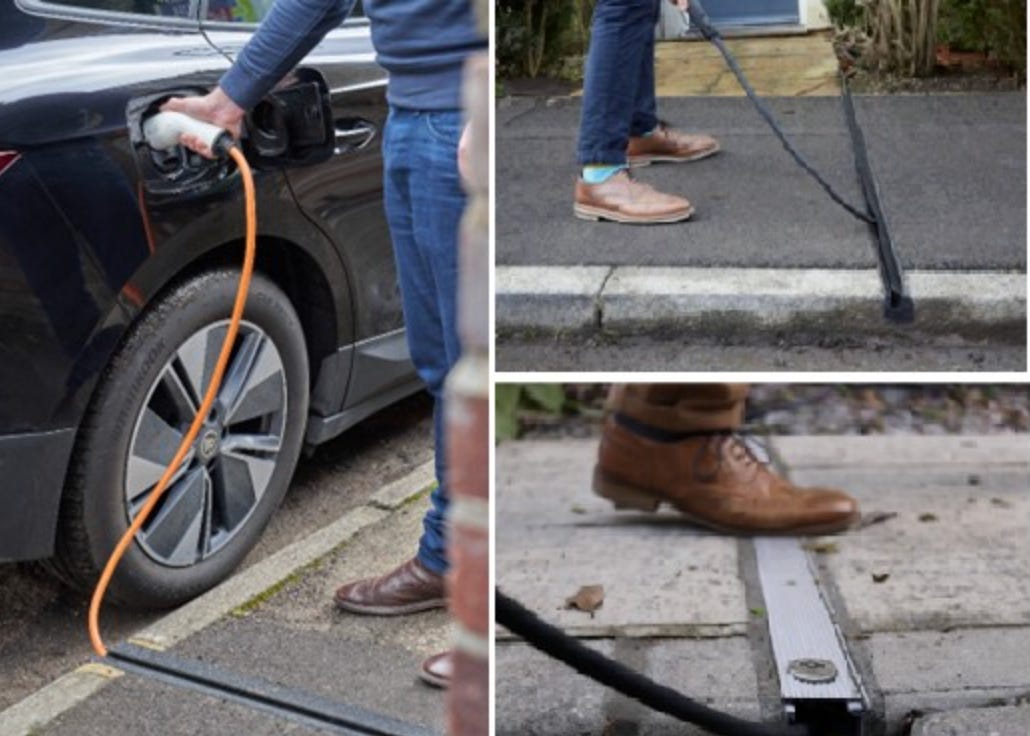
New data obtained by The Fast Charge reveals that one in five local authorities have declined to apply for the government’s flagship grant to expand cheaper home-style charging for electric vehicle owners without driveways.
The £25 million Electric Vehicle Pavement Channels Grant, launched earlier this year, was created to help councils roll out “cross pavement” cable channels. These channels allow residents without off street parking to run a charging cable safely through the pavement and use their own domestic electricity, which can be up to ten times cheaper than on-street public charging costs.
Every local authority in England was allocated capital to claim from the government’s fund, with an application deadline of 31 October 2025.
However, in response to a Freedom of Information request submitted by The Fast Charge, the Department for Transport confirmed that 19 authorities had not applied as of 3 December, leaving almost £3.2 million of the pot untouched.
A third of London is left out…
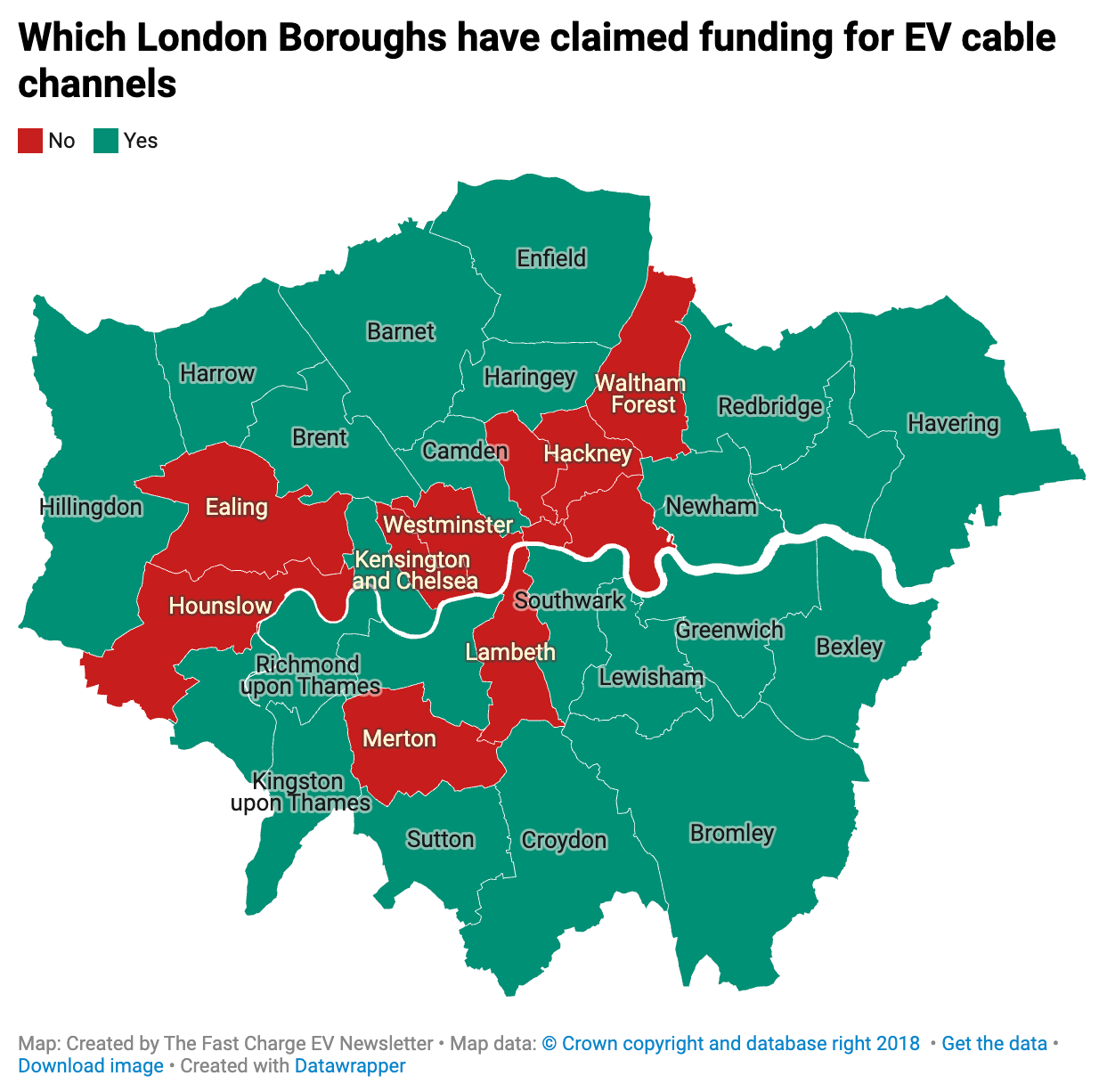
Of the councils that failed to apply, 11 were London boroughs (a third of all London boroughs). This means millions of residents in the capital, where off street parking is far scarcer than the national average, may miss the benefits entirely.
The boroughs that declined to take up the grant were:
City of London, Ealing, Hackney, Hounslow, Islington, Kensington & Chelsea, Lambeth, Merton, Tower Hamlets, Waltham Forest, and Westminster.
Across these boroughs, an estimated 75% of households lack access to off street parking, according to data from the RAC Foundation, which is far above the national average of around 40%. This means residents in these areas are effectively excluded from a scheme designed specifically for their needs, while neighbouring areas go ahead and deploy the technology. A new postcode lottery!
A scheme designed to cut bills
When it was launched, the government claimed the pavement channel scheme could help drivers save up to £1,500 a year compared with an equivalent petrol or diesel car. Transport Secretary Heidi Alexander said at the time:
“We are making it easier and cheaper to own an electric vehicle. We know access to charging is a barrier for people thinking of making the switch, so we are tackling that head on so that everyone - whether or not they have a driveway - can access the benefits of going electric.”
Non-London authorities also opted out…
Outside the capital, the councils that chose not to apply were:
Cornwall, Herefordshire, Kent, Leicester, Medway, Staffordshire, Wokingham, and Worcestershire.
Why are these councils reluctant?
It does feel strange that effectively 20% of councils are splitting from the rest. It is my understanding that many authorities were influenced by guidance issued earlier this year by London Councils, which highlighted concerns over:
Compatibility with existing public charging contracts
Accessibility for wheelchair users going over the channels
Restrictions in conservation areas and the impact on the streetscape
Potential liability or maintenance implications (especially long term).
Multiple local authorities cited this guidance in their internal deliberations, according to a source familiar with the process. However, I do wonder if these councils have considered the impact of not embracing cable channels. Aka, will we see more and more households relying on construction site style cable covers, which are arguably much bigger obstacles to contend with on pavements.
Industry reaction…
Michael Goulden, Director at Kerbo Charge, one of the companies providing pavement channel solutions, was overall positive about how many authorities had taken up the scheme. He told The Fast Charge:
“Although hundreds of thousands of Londoners will be disappointed that their local authority didn’t apply for funding that would reduce their cost of living, this is a marathon, not a sprint.
“The 11 London Councils that did not apply for this funding are not saying ‘no’, they’re saying ‘not yet’, and now they’ll be able to observe a succession of nearby cross-pavement charging trials so they can make their own decision when the time is right.”
Government response…
When asked about this data, a Department for Transport spokesperson told The Fast Charge:
“We’re powering up an EV revolution and supercharging our infrastructure. The £25m grant will make it easier and cheaper for thousands of residents without off-street parking to conveniently charge their vehicles at home.
“We’re working with councils up and down the country, building on the Local EV Infrastructure Fund, which is expected to deliver over 100,000 public chargepoints across England.”
✅ Yes list: Local authorities that applied to use the fund
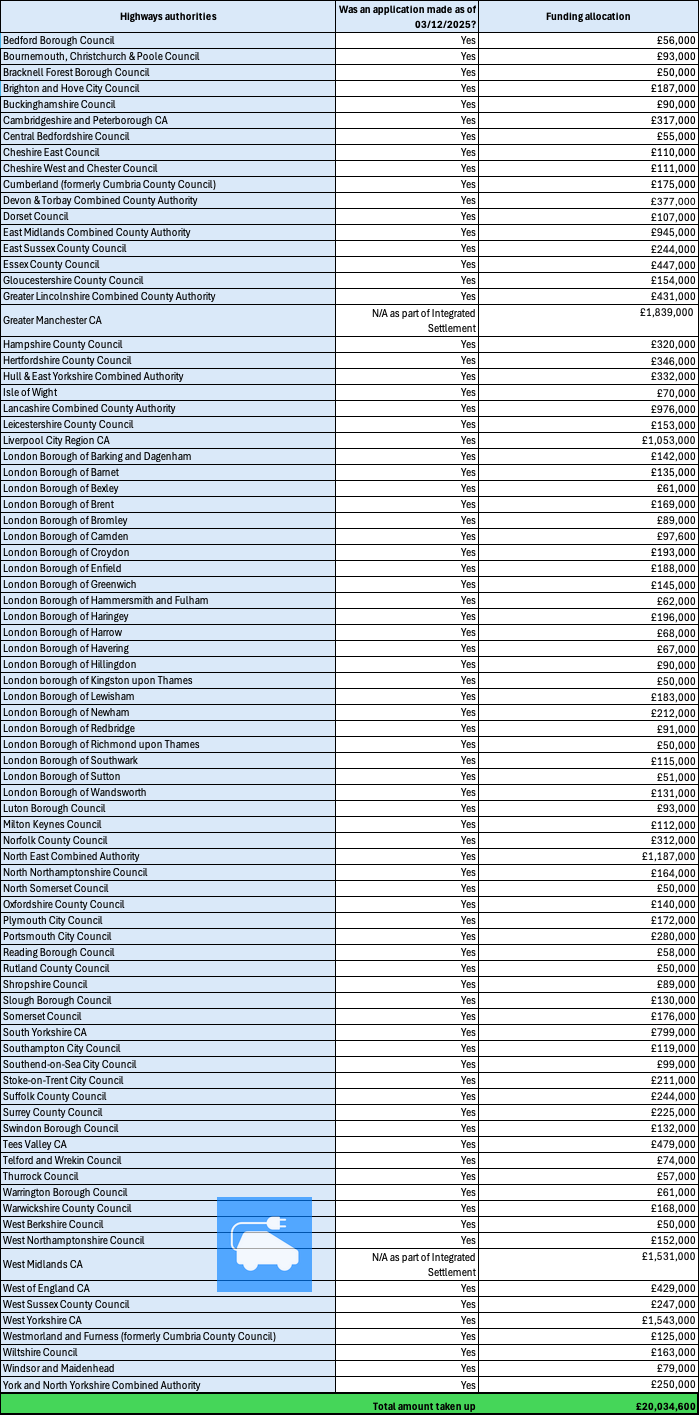
*Note: DfT says 81 authorities applied, though the above list, you will notice, has 83 names. That’s because it includes Greater Manchester and West Midlands Combined Authorities, which are in a separate settlement process for their allocations.
❌ No list: Local authorities that did NOT apply
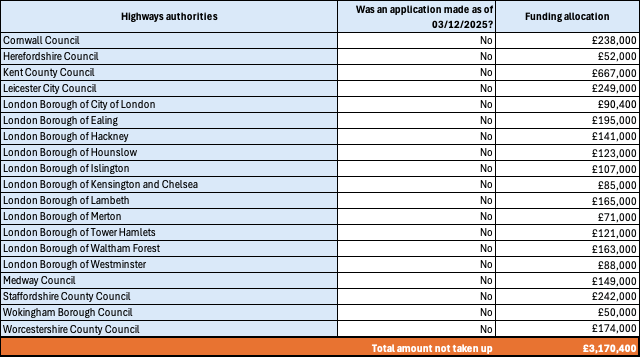
**You may also notice these two sums don’t equal £25 million. I’m not entirely sure why that is but if I were to guess perhaps it relates to a combination of administration cost and/or a buffer.
⚡️ That’s all for now. A further newsletter will be in your inbox later this week.
Strong piece of investigative journalism here. What jumped out is the misalignment between need and uptake, those 11 London boroughs with 75% non-driveway households are exactly where this subsidy should be most effective. The wheelchair accessibility concern feels like it could cut both ways, current makeshift cable covers probably create more obstacles than proper gullies would. Would love to see a follow-up tracking which councils that did apply actualy deploy the infrastructure fastest since uptake and implementation are two very different things.
I run a cable across the pavement encased in a soft rubber yellow and black protective sheath with shamfered sides to reduce trip hazard. For added visibility I put red and white road cones at each end, leaving enough space for a double buggy or wheelchair to pass. It’s worked for 5 years now without a hitch, but I would prefer to do it even more safely.