

Hello, I’m Tom Riley, and welcome back to The Fast Charge, a British EV newsletter.
Top stories in today’s edition... Five things I’ve learned about the upcoming autonomous vehicle trials in the UK (including what happens if you’re sick in the back seat). Plus, I ask DfT why Tesla was allowed to withhold five pages of lobbying.
Elsewhere... A new pro-EV campaign from DfT, fresh ZEV mandate pressure, and Trojan Energy is considering a sale.
As ever, if you have any comments or feedback, please reply to this email or message me on LinkedIn.
Five things I’ve learned about AVs in the UK
Before Christmas, I wrote that I was going to spend some time learning about Autonomous Vehicles, ahead of trials launching in the UK from this Spring. Well, folks, I’ve been busy networking, and here are five things I’ve learned from speaking to businesses and policymakers in the space:
1️⃣ Not all AVs are guaranteed to be EVs. Software being created could be applied to internal combustion engine vehicles as well. However, that scenario is most likely only going to be used with trucks and large vehicles. EVs will probably be the go-to for ‘AV taxis’ as they are easier to maintain at inner-city hubs. These hubs are likely going to be where a lot of jobs in the sector come from in the beginning, as the cars will need to be regularly cleaned, recharged, and serviced.
2️⃣ The taxi trial area may not be in central London. It’s thought by those planning to launch here that TfL and DfT may prefer a trial to happen in a part of London currently not well served by other transport links, such as the South East. In any case, London is just the beginning; these companies have grand plans for other UK cities.
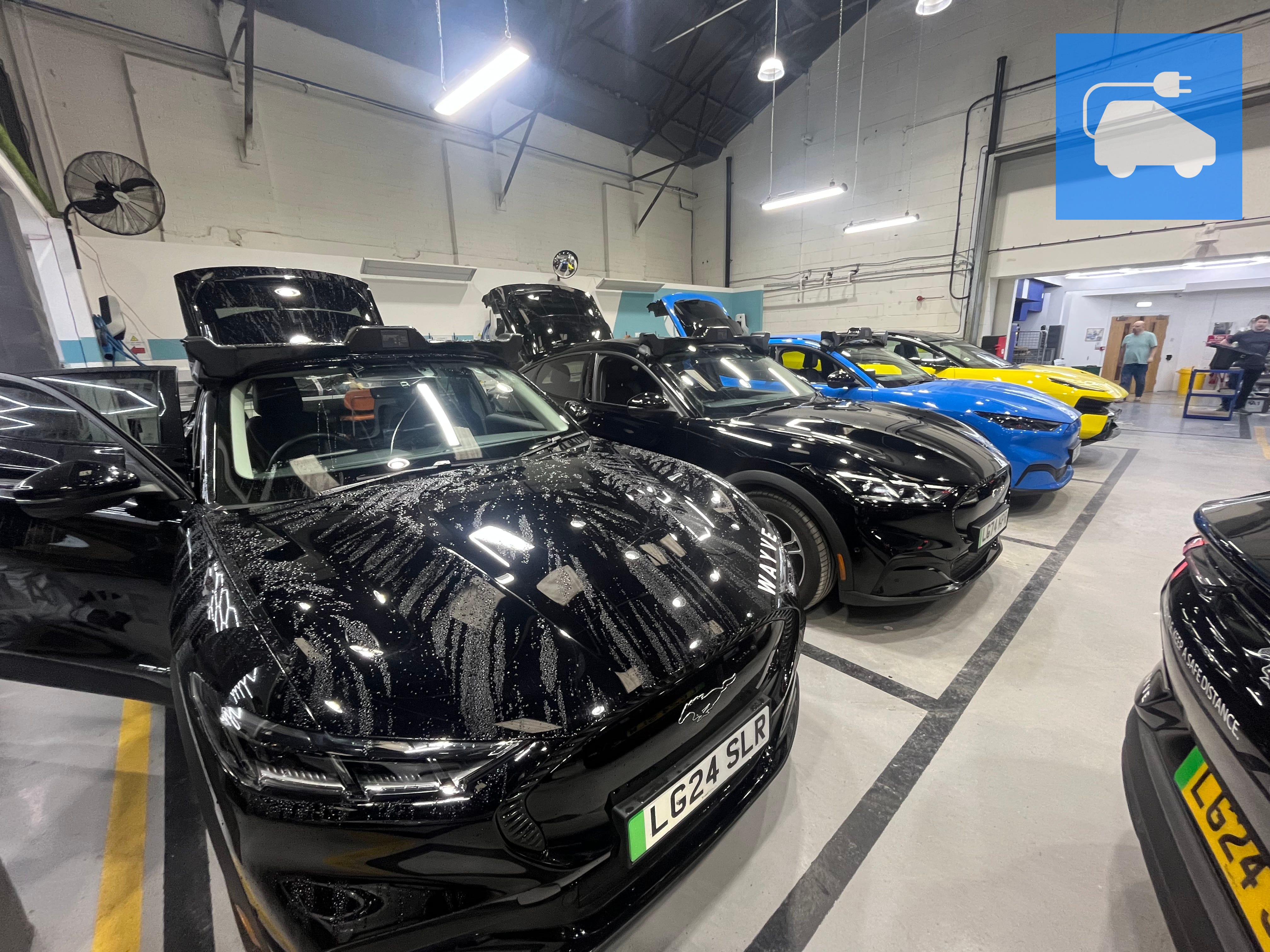
3️⃣ The approach being taken by two major players (Wayve and Waymo) is quite different. Wayve is effectively building an AI with eyes. The software is being trained so it could be installed in any vehicle, go down any road, and deal with any issue. Meanwhile, Waymo is mapping every road with its vehicles. They’ve been here since last year, driving all across London – they are, as I understand it, looking to map about 100 square kilometres.
4️⃣ What cars? Waymo has its own car fleet. At present, we will get Jaguar i-Paces from the US (aka, steering wheels will be on the wrong side), though that might not be forever, as in the US they’ve just partnered with Zeekr (who are soon launching in the UK). Also, don’t expect thousands of Waymos to be sitting on street corners; their fleet will more likely only reach the very low hundreds after many months (much like their footprints in the US). Wayve, on the other hand, is partnering with carmakers who want to get in on the AV game (they have a partnership with Nissan, are testing using Fords, and I also saw a Lotus Eletre in the garage - luxury AV cab maybe?). Tesla may also try get in on the trials. I hear from several that Tesla’s focus is now very much to be an AV-first business, so don’t forget about them. Lots of AV companies have been forming partnerships with ride-hailing services like Uber. Waymo, however, uses its own app.
5️⃣ The most amusing thing I learned... AV taxi operators may incentivise or credit riders who report they were sick in their vehicles after a big night out. This is to ensure the next rider isn’t met by a car full of second-hand kebab. In the US, Waymo is already paying people $20 to shut the doors properly. Likewise, if you fall asleep and don’t wake up on arrival, the car will play increasingly loud noises. Should that fail, a human will connect to the car to try wake you up through the speakers. Additionally, while you may feel alone in an AV, I wouldn’t recommend any hanky-panky, as there will be internal cameras. This is unlikely to be a problem initially, though, as I understand most AV firms entering the taxi trials will likely have a person sitting in the front seat, monitoring the cars and ready to take control if needed. Waymo will probably be the only one going fully autonomous from the start.
I’m still learning and keen to speak with others in the AV space, so please don’t hesitate to reach out! Likewise, if you found the above interesting, let me know.
Why is DfT letting Tesla hide its lobbying?
Headline: Officials at the Department for Transport have stood by their decision to allow Tesla to withhold five pages of policy asks of the UK government, despite 13 other major carmakers having had to disclose their positions under information rights law.
Context: Last year, readers will recall that I obtained the submissions made by carmakers in response to the government’s ZEV mandate consultation. After many months, I received submissions belonging to nearly all major carmakers (including BMW, Toyota, VW, Nissan, JLR, Stellantis, KIA, Hyundai, and Volvo). However, Ford, Mercedes-Benz, and Tesla all refused to disclose, citing commercial sensitivity. I challenged this, and before Christmas, I received the submissions from those other three.
However... One thing stood out. While 13 carmakers ended up sharing their policy positions and asks of the UK government, one did not. Tesla was seemingly allowed to keep five pages almost entirely redacted. Specifically, this large blackout covered the whole of Tesla’s response to question 8 of the consultation, which asked:
What are your views on current measures to support demand for zero emission vehicles? What additional measures could further support the transition?
Just hints... The only part of Tesla’s response to that question not redacted, other than several footnotes, is the line “1. Support for the used car market”. The Guardian reported on this at the time, as did this newsletter. The conclusion was that, presumably, Tesla was lobbying for used EV grants.
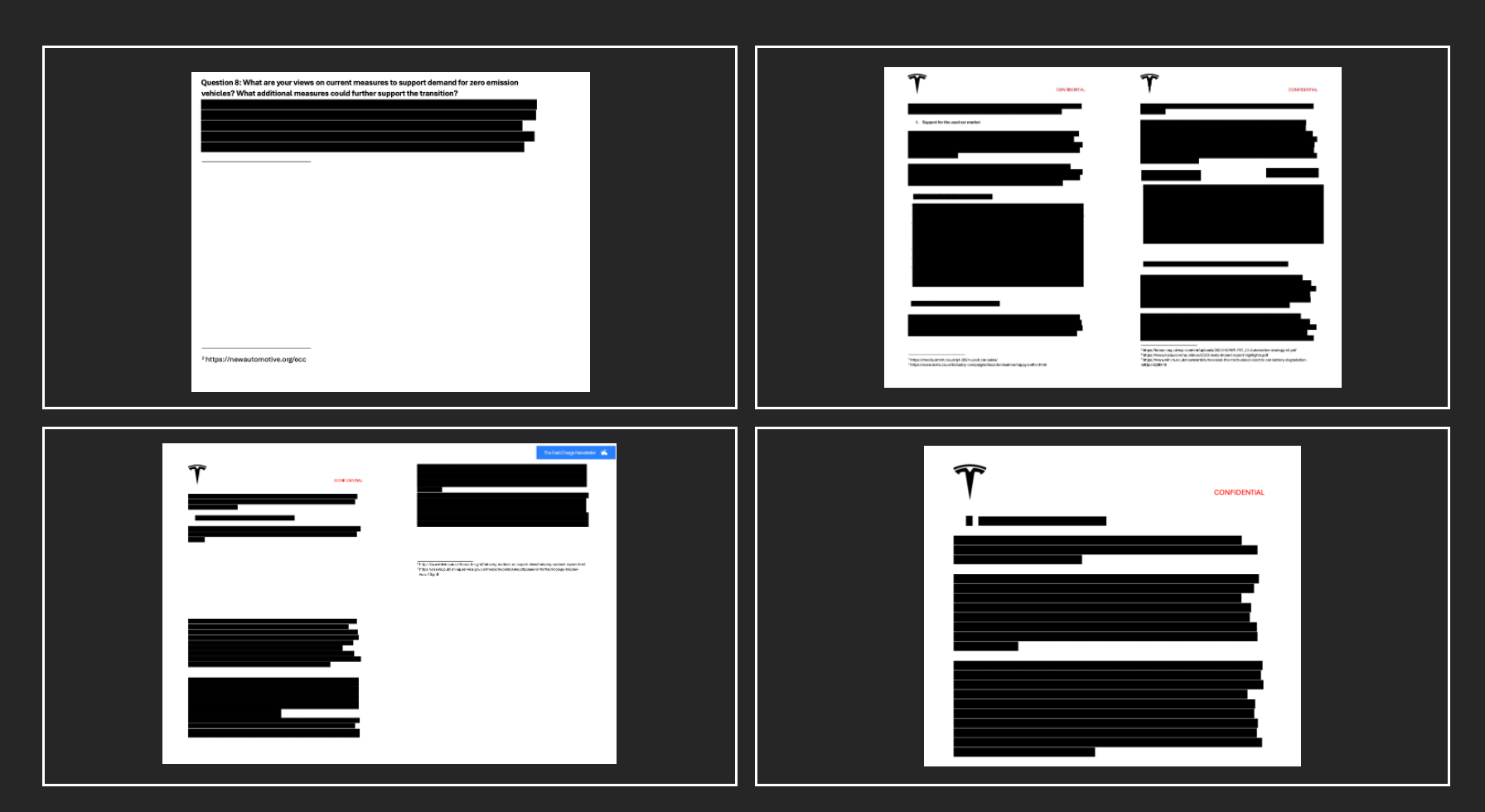
But... we don’t know, because it’s all blacked out. And this is a problem; consultation responses directly shape government policy. Allowing one major manufacturer to shield its policy asks from scrutiny, while forcing others to disclose theirs, raises questions about whether the law is being applied consistently.
The Information Commissioner’s Office is clear... Public authorities should provide “as much meaningful information as possible” and avoid redactions that render documents unreadable. Five pages of near-total redaction appear not to align with that guidance.
I challenged DfT about how it has handled Tesla’s submission. After a week, their information team wrote that they were reviewing the case and looking at whether they would “change our position from the previous internal review done.” However, this week, a DfT spokesperson told The Fast Charge the position stands. They added: “Tesla are within their right to withhold commercially sensitive information.”
I do not believe DfT has challenged Tesla hard enough in this case. As a result of DfT’s decision, I am escalating this to the Information Commissioner to review. See the document I obtained here.
