

Hello, I’m Tom Riley, and welcome back to The Fast Charge, a British EV newsletter.
Top stories in today’s edition... I investigate how five AI tools respond to questions about electric cars. And uncover the common traits AI models associate with the typical EV owner.
Elsewhere... The King’s Lotus, Great Grimsby Day, and the Sinclair C5 reimagined by Will.i.am.
As ever, if you have any comments or feedback, please reply to this email or message me on LinkedIn.
🧐 How do major AI tools respond to EV concerns and myths?
Background: New research last week by Close Brothers revealed that two-thirds (66%) of car buyers are now using AI tools, like ChatGPT, in their car buying process. One in three said they relied on AI to narrow down their choices. This finding isn’t a one-off. Last year, Autotrader found that 1 in 10 were using AI as part of their search, with those searching for an EV being twice as likely to use it.
Summary: Given the increasing value being placed on AI to help consumers with such large buying decisions, I thought it was about time someone test five major tools to see what kind of responses potential EV owners might be getting. Particularly as we know how often myths about electric cars and charging can surge across the news, social media, forums, and down the pub. I also asked these AI tools questions to try to determine what characteristics they associate with a typical EV owner.
The latter survey on ‘AI stereotyping’ is very insightful (and amusing), so we’ll come to that once we’ve dealt with how good AI is at myth busting.
My investigation... Using ‘The Facts’ as inspiration, I wrote up 52 questions – half focus on the basics of an EV, and the other half pose questions around what ownership is like. As someone who has never found it difficult to write like I know nothing about the subject, I am confident that the questions I drafted strike the right balance of someone sitting on the fence about EVs after being drip-fed years of negative press about them.
To run my experiment... I created a prompt with the questions and rules around how the AI should respond to ensure consistency across all the AI tools I tested. This included that the AI should:
1) Respond to each question as you would to any average user in the United Kingdom of Great Britain and Northern Ireland.
2) Treat each question individually and respond to it without taking into context the other questions being asked. Where possible, such as requests for numbers, please be specific.
3) Answer each question with only one sentence (10-20 words max).
👉 I also asked for the AIs to list sources for each of their responses in a table.
And, finally, my test subjects. For my investigation, I ran my prompt and questions through OpenAI’s ChatGPT, Google’s Gemini, Microsoft’s Copilot, Grok, and Perplexity. To further remove any chance of bias, I also ran this test in incognito mode, logged out of everything, and only used the free or basic tool on offer. The aim for me was to be as close to how a normal person might use these tools as is possible.
What did I find? Across more than 250 responses I’ve analysed, I only marked 21 responses as, to me, being factually wrong. Across the board, no specific AI model was acting worse than any other. And, when falsehoods did happen, it tended to centre around the same questions – aka, if one model tripped up, it tended to be the case that at least one other did as well.
The good news... When it came to key myths, which have brought great damage to brand ‘EV’, such as around fire hazards, high vehicle prices, battery reliability, range, environmental costs.... The instincts of every single AI was to be positive and reassuring. In fact, when it came to responding to my basic EV knowledge questions, the only times AI models tripped up was when the query demanded specific numbers.
For example... When AI models were asked about the number of electric car chargers, ChatGPT, Copilot, and Perplexity were way out. The real number is 87,000, a figure both Gemini and Grok either hit or were dead close to. Meanwhile, ChatGPT said 55,000, Copilot landed on 73,000, and Perplexity suggested 60,000.
Not updated? Yes, I wondered too whether some of the AIs were not able to reach the internet. However, while that was the case in early AI days, now I understand they all use and access the internet. So, I’m not sure why each AI had a different answer; one must assume they index certain sources differently?
It happened again when asked how many rapid chargers there are. According to the ‘facts’, there are 17,829. Both Gemini and Copilot got it right this time; meanwhile, ChatGPT, Grok, and Perplexity all suggested 10,000. Finally, when asked about the number of electric cars in the UK, which is around 1.8 million, three of them got the figure right – Gemini, Grok, and Copilot – yet again, though, ChatGPT and Perplexity were short by 700,000.
In the remaining questions covering EV ownership, such as around average running costs and range – everything which the Department for Transport is campaigning on right now – all the models responded factually and positively.
But... all five got confused when asked about the Electric Car Grant and tax changes. On the ECG, all suggested it either had ended or was only available for chargers and vans. Likewise, when asked about the new road tax, the tools didn’t focus on the pay-per-mile changes but largely defaulted to the existing Vehicle Excise Duty changes that came in during 2025. Only a specific question about the ‘mileage tax’ prompted the right response, though even then it was a bit mixed.
✍️ Based on my analysis, I only have one suggestion for the government and industry. In short, we all know help is there, so it’s strange if these AI models do not recognise all the guidance and facts available. And, who knows, maybe it’s not just EV policies, maybe other departmental services suffer the same issue. If I were in government comms, I would reach out to these major AI players to ensure the public using them are able to locate updated and helpful initiatives, such as grants or statistics.
Finally, the fun bit… What an EV owner looks like, according to AI
Background: Over the weekend, I read in The Times about an analysis of 20 million questions to ChatGPT about regional assumptions, conducted by the Oxford Internet Institute. What it found was that ChatGPT has certain biases and beliefs about certain regions, and it wasn’t exactly clear how those beliefs were formed. For example, in Oxford’s case, ChatGPT had said Oxford was “sluttier” than Cambridge.
This story made me wonder... What are the assumptions these five AI models have about the typical British EV owner? As surely these ‘headline’ views might influence its responses for all?
What I discovered was that pretty much all the AI models gave the same or similar answers, independent of one another, in response to my over 20 quickfire questions.
In short... all AI models agreed the average EV driver was...
Wealthy, young, urban, homeowner, in a heterosexual relationship, goes on holiday to Cornwall, holds left wing beliefs, but is pro monarchy, shops at Waitrose, eats Leon, drinks wine, prefers coffee over tea, and uses oat milk.
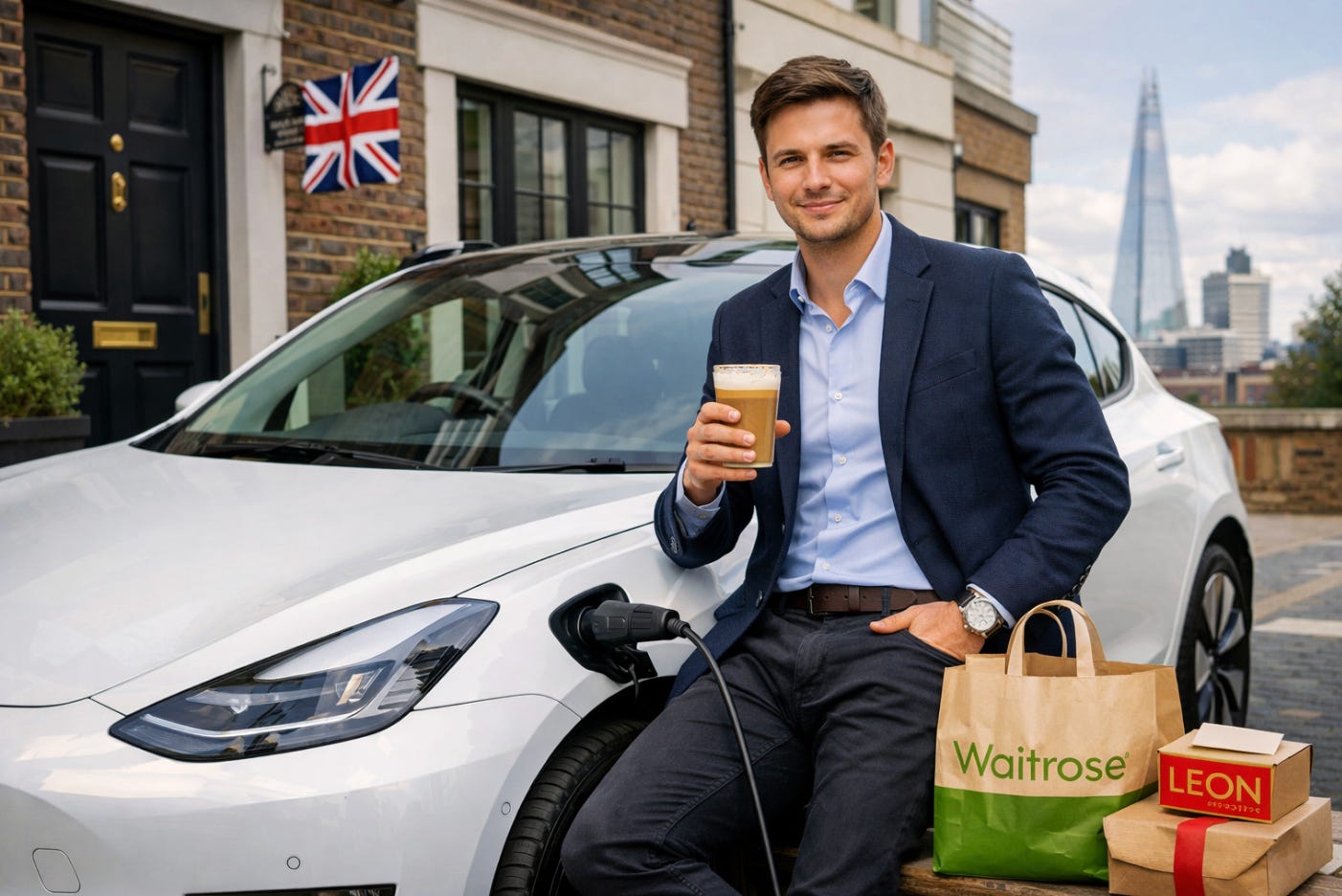
It’s funny but also a bit worrying how AI views EV owners. I just hope that the rather ‘posh urban male’ stereotype will not affect how AI engages with people using it to learn and explore about EVs wherever or whoever they are. In one question (part of the quickfire questions), I asked the five models: In three words, should a person without a driveway buy an electric car? ChatGPT was the only one to say ‘Yes’; the rest cautioned taking the jump. That lack of immediate confidence worried me a bit.
🚨 I’m not a professor, and my research is only light touch, but hopefully still useful. At the link here is a spreadsheet of responses so you can view all my questions across three tabs covering basic knowledge, ownerships, and AI’s beliefs. Green is for responses I saw as generally correct, positive, and reassuring. Red for ones I felt were wrong or unhelpful. Purple is for responses that I felt could have been more positive, definitive, or reassuring.
Latest EV news...
📉 The FT has reported this week that the UK needs to more than double the number of EV chargers being installed each year to hit the minimum the government has estimated will be needed by 2030. The bottom level of the range is 250,000, and so far, we are at just above 87,000. Read FT here (paywall). Or why not see my recent analysis on this topic here.
☹️ EVA England has found in a new survey that millions may miss out on affordable charging without reforms being put in place to make it easier to access cross-pavement charging solutions. Read the full report here.
📊 In better news around charging affordability, the latest AA survey of pricing suggests that in December, prices at the plug for the UK’s fastest devices off-peak dropped by 10% (or 5p per kWh on average). Within the same report, the AA calls on the Chancellor to cut VAT on public charging, further to reports that this is being explored in HM Treasury. This ask will likely fall on no ears, given the last I heard the charging cost review was yet to form, and the recent stories are thought by industry lobbyists to be the result of DfT spreading rumours to try force HMT to act.
⚡️ Speaking of fast charging, Ionity, the network which specialises in ultra-rapid hubs, has installed its 700th charger in Blighty, with plans to hit 1,000 in 2026. Read more.
🎥 JLR has today emailed those signed up for updates on the Range Rover Electric, sharing new films about its development. I’m unsure if these videos have been around for a while, but they largely focus on the noise, comfort, and silence of the car. The tagline at the top is: “A sanctuary for serene travel. New Range Rover Electric’s advanced technology makes every journey a tranquil occasion.” See here.
🏴 Talking of Range Rover sanctuaries... Ireland’s EZO network has started to migrate 177 existing chargers from the ChargePlace Scotland network to its platform in the Aberdeen City, Aberdeenshire, Highland, and Moray areas. Read more.
💷 A bit further south, West Yorkshire Combined Authority has reviewed its allocation of funds for EV charging, boosting the amount by £75,000 to £357,881 to deploy chargers across the region. Read more. The region had, in early 2025, come under some media scrutiny for not having enough chargers.
🔌 Aldi has partnered with Zest to install EV chargers at a new store near Grimsby. Read more. I don’t know if this was on purpose, but ‘Great Grimsby Day’ was on the 22nd of January, when this news came out. Though, like the King’s birthday, it seems Grimsby residents believe the town is so great they want to celebrate it twice this year, with 11 March being earmarked for further celebrating. Honestly, the things I’ve learnt doing this newsletter.
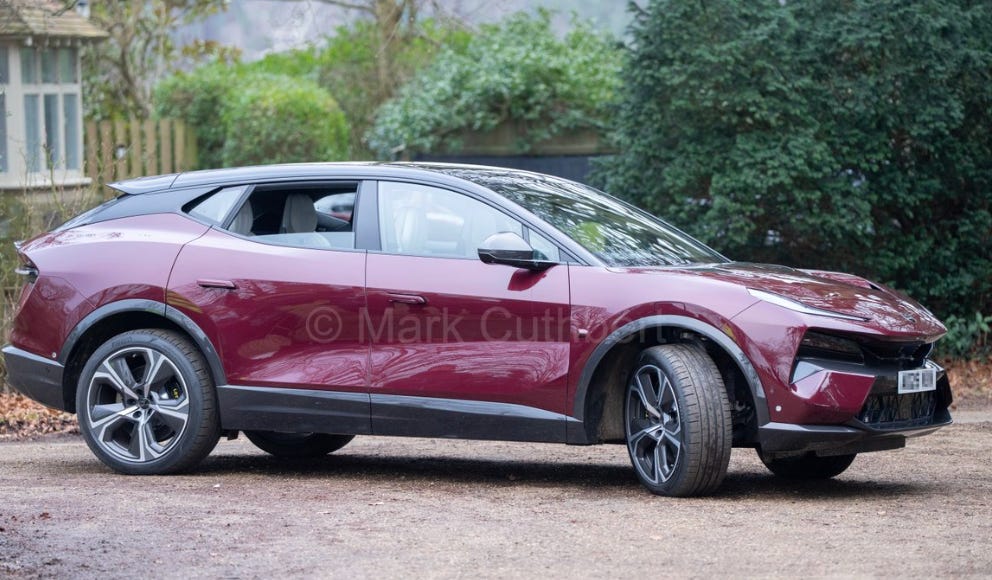
👑 Speaking of the King, this week he was snapped in his electric Lotus Eletre. It appears to have been produced in a unique colour for His Majesty: Royal purple… or is it… Burgundy.
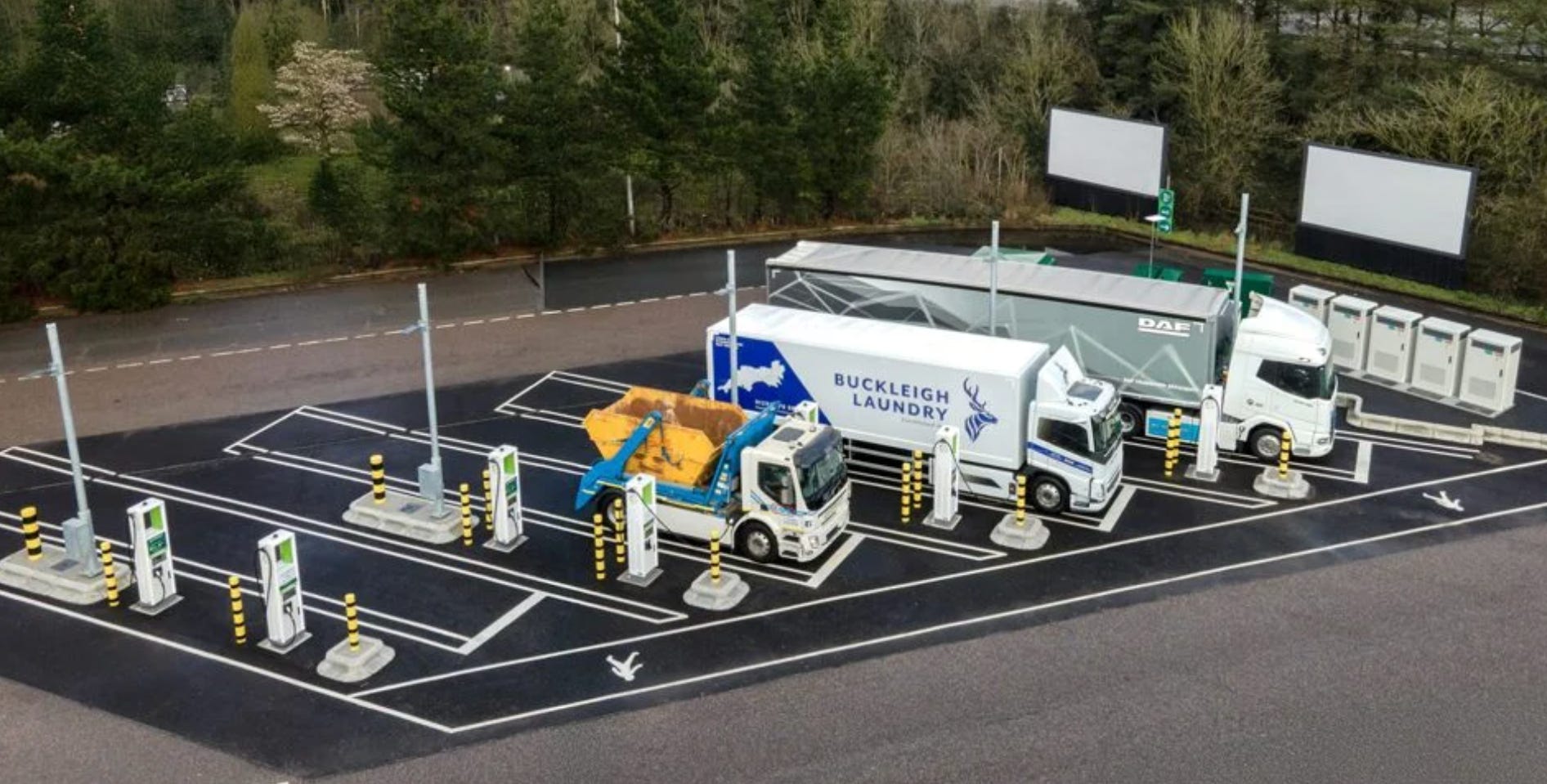
🚚 Gridserve has unveiled two HGV charging hubs. One at Extra Baldock on the A1(M) and the other at Moto Exeter on the M5. The hubs are the first of seven HGV hubs due to open in 2026. Great news. Read more.
📈 According to Europe’s motoring lobby group, ACEA, sales of fully electric cars in the EU just overtook sales of petrol vehicles. Woof. Read more.
🚗 Talking of EV confidence, a new survey from the AA and Electrifying found just 3% of drivers say they feel confident buying a used EV, with 38% saying a battery health certificate would make them more likely to buy a used electric car. Read more. Well, let’s hope DfT delivers on the rumblings (see here).
🔋 Mini has upgraded the range of its Countryman E to 311 miles, up from 286, by making some changes to its inverter. Read more. (Paging my brother and his wife, who have only ever owned Minis).
🌳 A university in California has found that the adoption of EVs has led to a significant drop in air pollution. Hopefully, we’ll see similar reports about the UK soon. Read more.
🇺🇸 While we’re on America... The musician Will.i.am has designed a micro EV called Trinity, which looks very much to be inspired by the OG EV, the Sinclair C5. It’s a single-seat three-wheeler and has a conversational AI built in. I like to think if it drove over a speed bump, it would start singing... Whatcha gon’ do with all that junk, all that junk inside your trunk? (My Hump).
🔧 Finally, a team of Dutch students has made a concept car that is built to be repaired easily. At a time when cars require a whole team of computer scientists to fix them, this is a very refreshing approach. The students hope it inspires carmakers. Read more. Thanks to Jo, who tipped me off about this!