

Hello, I’m Tom Riley, and welcome back to The Fast Charge, a British EV newsletter.
In today’s edition... New polling reveals more support for the ZEV mandate than those against. But as long as it’s affordable.
Elsewhere... Vicky Read stands down from ChargeUK, BYD’s flash chargers, and a reminder that the eVED consultation closes soon!
As ever, if you have any comments or feedback, please reply to this email or message me on LinkedIn.
📊 New poll finds nearly half of Brits back EV targets
Headline: Nearly half of British people (48%) say the government should keep its EV targets if cars become more affordable, according to YouGov polling commissioned by WA Communications and being reported exclusively in The Fast Charge today.
By comparison... Only three in ten believe the targets should be moved, while one in four did not know.
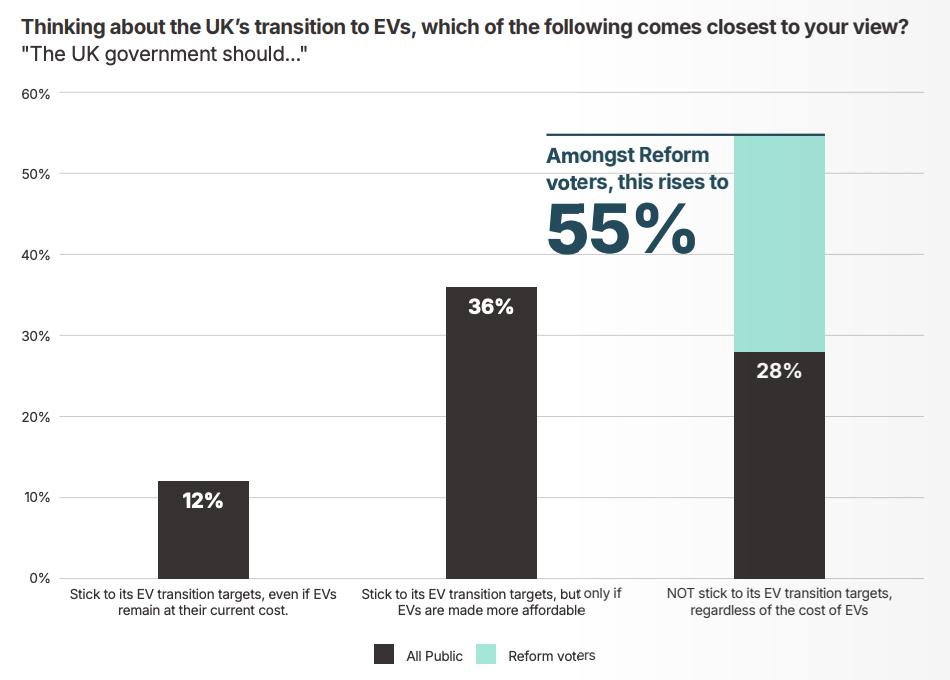
These results are positive for the EV sector. Presently, it is a deeply assumed belief that most of the public does not support EVs at large, and that the recent cooling of demand reflects wider consumer worries about the shift. Only this month, a separate survey found 55% would not go electric because of worries over the government introducing electric Vehicle Excise Duty, which could cost EV drivers hundreds of pounds annually from 2028.
However... This new polling signals there is public support, though only if EVs are affordable. In the poll, 36% of respondents said their backing for EV targets was contingent on them being affordable, whereas 12% supported the targets unconditionally.
Later this week... The Society for Motor Manufacturers and Traders will host its Electrified conference, and it’s highly anticipated that the carmaker lobby group will ask for more flexibility on the EV targets, claiming EV sales are only happening because of manufacturer discounting. It is also expected that SMMT may continue to call for a mandate on EV charge point installations, which would have to be met by EV charging networks.
Interestingly... In the new polling, when asked who was most responsible for making sure the UK has enough reliable EV chargers, only 2% said charging operators. In fact, 4% pointed to carmakers themselves. In the main, though, a quarter (26%) of Brits believe the responsibility lies with the UK government. This is quite a surprise, as most actual public charging deployment sits with local councils, through schemes such as LEVI, yet only 7% of the public saw councils as having the most responsibility.
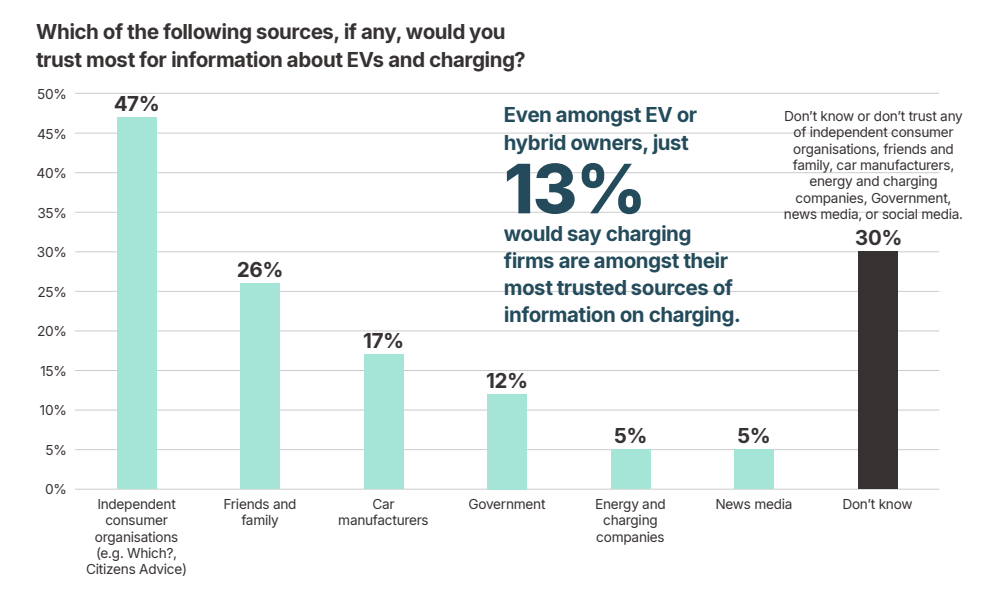
Worryingly for Whitehall... Given how many see them as responsible, when the public was asked about which sources they trusted most for information on EVs, only 12% mentioned the government or public bodies. This is concerning given the large communications campaign currently being led by the Department for Transport. In February, DfT told The Fast Charge that its campaign is multi-channel, but it would be interesting to know where exactly their messages are appearing.
In contrast... Independent consumer organisations, such as Which? and Citizens' Advice, scored 47% trust in the new survey. Carmakers also achieved a higher percentage (17%) than the government, albeit largely boosted by a very high degree of trust amongst 18- to 24-year-olds (27%). At the opposite end, only 5% of respondents said they trusted energy and charging companies. It was the same for news media (5%), and even less for social media influencers (3%). That’s a big piece of insight for comms teams within the EV sector.
When the response was broken down by political party voting... The poll results were how you might expect, though with some interesting nuances. For example, 55% of respondents who have previously voted for Reform were supportive of changing the EV targets. But a chunky 22% of Reform voters would support the targets if EVs were affordable. That’s a large amount, and it really underlines how important cost is to this transition.
My final outtake from the polling was... Shock. Shock at the perception the public has around domestic versus public charging prices. According to WA Comms’ poll, 38% believe public and home charging should cost the same. And an additional 11% believe public charging should be cheaper than at home. Translating this to plain English... that’s almost half of those surveyed (49%) holding a view at odds with the reality of how EV charging is operated. It should certainly be food for thought for the industry and the government, who are currently reviewing public charge point pricing.
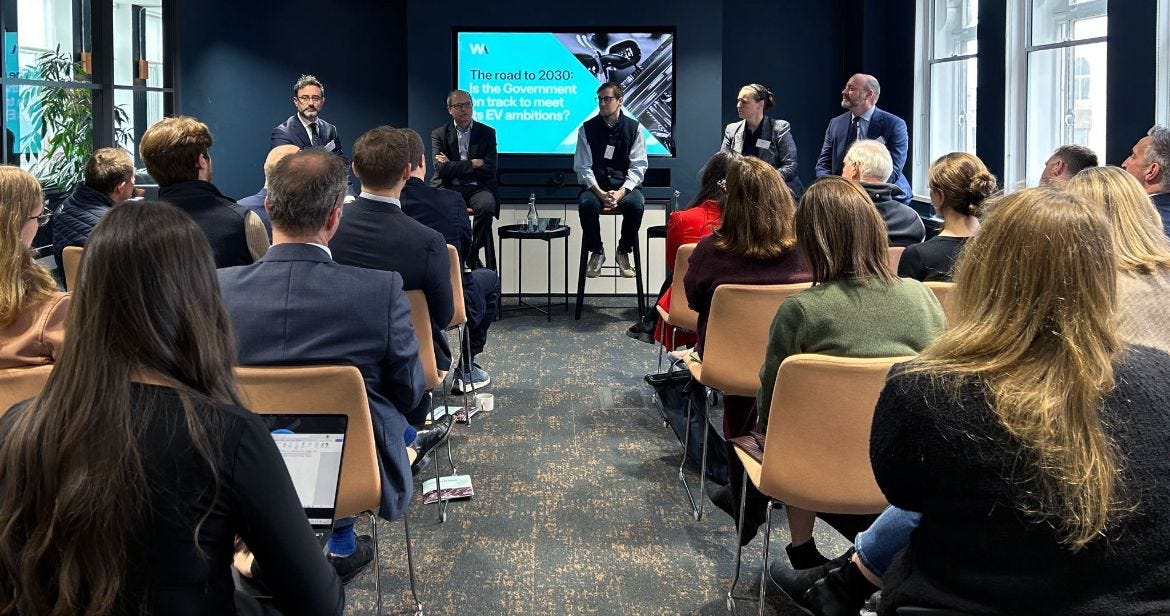
You can find the YouGov results here. Thank you to WA Communications for commissioning this research and providing it to The Fast Charge. I was pleased to discuss them with others at a panel event yesterday alongside Perran Moon MP, Claire Miller, and Sir Philip Rutnam.
Latest EV news...
⚡️ ChargeUK (1): It was International Women’s Day on Sunday, and in quite a surprise, a few days beforehand, Vicky Read, CEO of ChargeUK and one of the UK EV industry’s most senior women, announced she was stepping down. Several industry sources have speculated as to why she has left. Some argued she was pushed by bolshy members unhappy with the trade bodies’ progress, while others have simply suggested she’s delivered a great stint. My understanding is likely closer to the latter with Vicky. In a LinkedIn post, Vicky remarked she wanted to pass the baton to someone with a “fresh pair of legs” and mentioned that she’d spent four years involved with the group.
⚡️ ChargeUK (2): As Vicky steps down, she will leave behind an industry group that has no women on its board and a largely male day-to-day team. Although, the association has told me there are women on its All Member Council. Moving forward, I understand the relatively new Chair, Iain Coucher, is expected to play a bigger leadership role at ChargeUK. Several industry sources have shared concerns with me about the gender imbalance at the top of the public charging industry. Alas, in better news, perhaps you are the person to help change that – and lead ChargeUK as CEO after Vicky steps down. The job spec is here. It comes with a £130-150k salary with benefits. Tasty.
✍️ In a similar note, during Global Women in EV Day, one of the outcomes was the establishment of The 49 Collective. The group was set up to get organisations together around a shared commitment to improving visibility, opportunity, and leadership for women across the EV industry. The group is currently looking for organisations to sign up to its Charter – this is something I will be doing, and I do encourage readers to take a look here. Ps. If you’re wondering ‘why 49?’, it’s because 49% of driving licence holders in the UK are women.
🛢️ As readers may recall, I recently had an awful house move, and it seems I missed the start of the Iran war. You can get views on that elsewhere, but my observation is that any activity in oil states often results in greater interest in EVs. That’s what happened during the last energy/oil spike. It comes as new research from the network Char.gy suggests £20 of electricity will take you further than £20 of petrol. Read more.
🔋 Talking of charging, last week BYD unveiled a demo of its ‘flash charging’ forecourt, which can deliver speeds up to 1,500kW. Read more. It’s gathered a lot of press, but the question I have is: do we need it? Many EVs currently on the road could never take on such speeds. Likewise, what sort of grid would that require, and at what cost? It’s great to see headlines that ‘you can charge a car as fast as filling up’, though it’s like hearing a Bugatti can go 304mph. It’s amazing. Though, will many of us ever be in one going that quickly... unlikely! The Guardian has an interesting editorial about BYD’s chargers here.
🔌 Speaking of Chinese charging... The Register reports that Chinese home charger maker ELECQ, which sells devices in the UK, was hacked. Read more.
💷 Elsewhere in EV charging... Islington Council has secured £1m to install 840 new chargers using LEVI money. Read more. Meanwhile, outside the M25 in Shropshire, the local council has secured £2m from the government to install 550 devices. Read more. [Note to self... is the above still EV chargers or EV equipment? Are miles now kilometres? Is it pounds or sovereigns? Is the Earth flat?]
👍 The House of Commons Library has put together a really helpful tool to track EV uptake by local authorities. See here.
🧰 The Lib Dems in Scotland have urged the Scottish Government to support EV drivers in Orkney who will no longer be covered by Tesco Insurance, due to a lack of local repair capacity. Read more.
🫢A study by the Energy and Climate Intelligence Unit (ECIU) has found that only 51% could correctly answer two or fewer out of 10 statements about EVs. This underlines the lack of knowledge amongst drivers at large. Read more.
🚗 As a reminder, tomorrow I will be at SMMT Electrified during the morning. I’m expecting to hear about the ‘Made in Europe’ rules that UK carmakers are worried about, such as Nissan, which said it could put its factory at risk. Anyway, drop me a note if you haven't already done so, if you want to meet up. I have to leave in the afternoon.
☹️ In other carmaker news, VW has said it intends to cut 50,000 roles due to scaling back its EV ambitions. Read more (paywall).
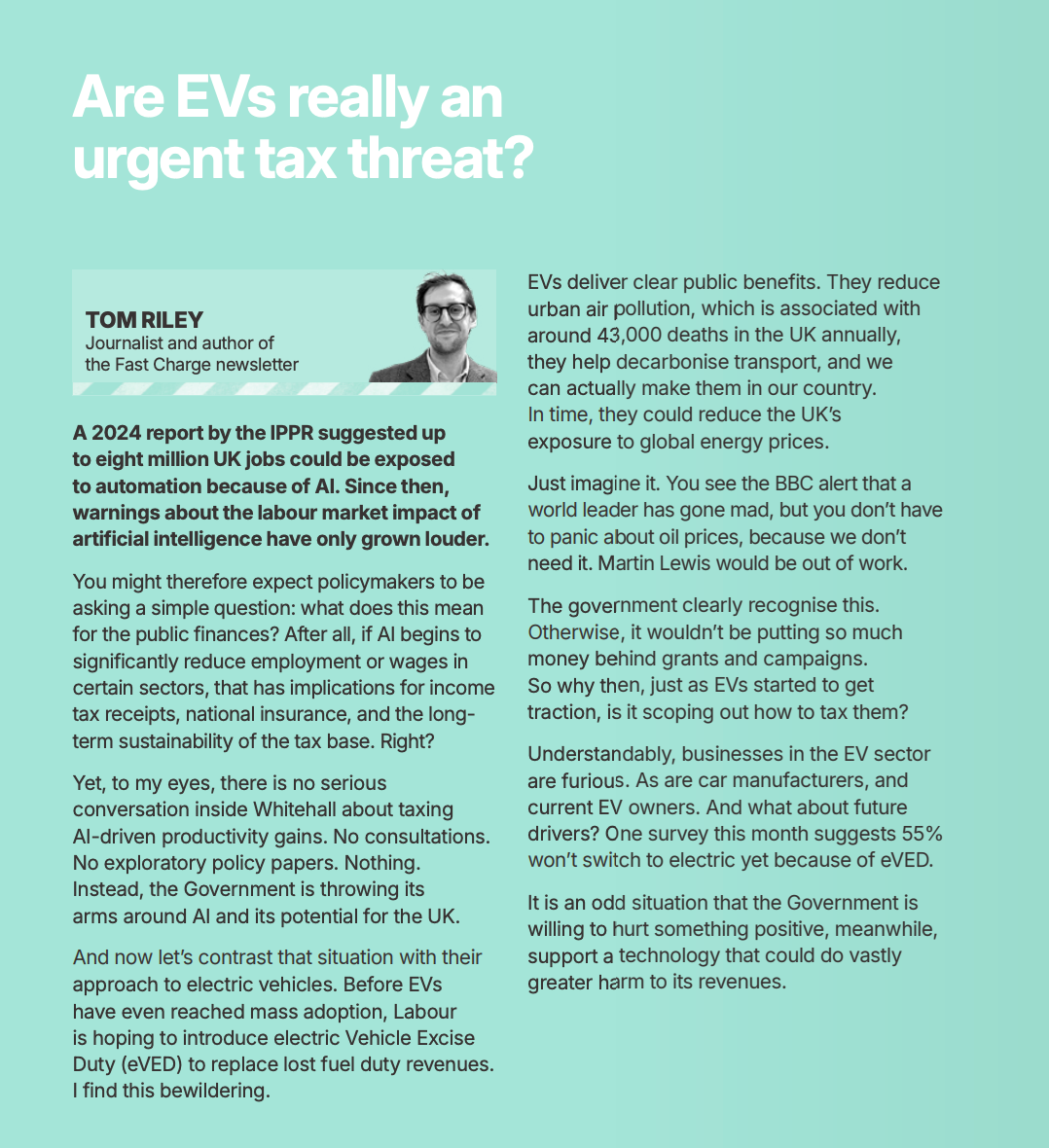
👉 Finally, if you have not already, you have a week until the eVED consultation closes. Find it here. If of interest, copied below is my recent take about the introduction of eVED (taken from the aforementioned WA Comms report).
See you next week!