

Hello, this is Tom Riley, and welcome back to The Fast Charge, a British EV newsletter.
Today’s story is about the Prime Minister’s choice to recuse himself from discussions on the Zero Emission Vehicle mandate, citing his wife’s links to Be.EV, the Manchester-based charging network.
Instead… the decision is being made by the Cabinet Office Minister, Louise Haigh, his deputy.
And I find this confusing… because Andy Burnham’s wife’s links to the EV sector did not prevent him leading decisions on EV matters last year while he was Mayor of Greater Manchester.
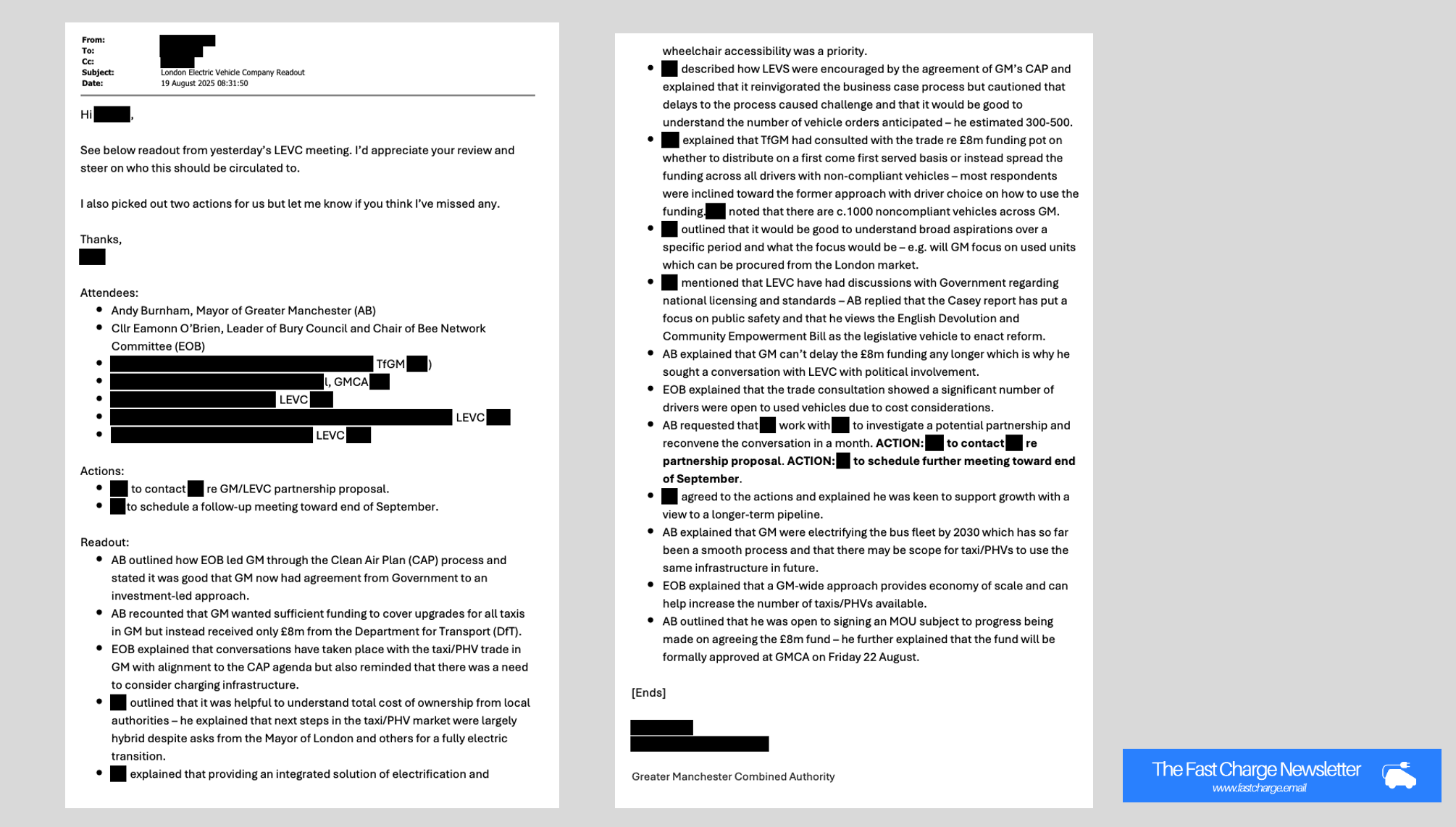
SCOOP… I have obtained two sets of meeting readouts from Greater Manchester Combined Authority from 2025. They reveal that while Burnham was Mayor, he led discussions between the electric taxi maker, LEVC (owned by Chinese carmaker Geely), Eamonn O’Brien (who was Leader of Bury Council and Chair of the Bee Network Committee), and Manchester authority officials.
The first readout from August 2025 shows… Burnham wanted to use his “political involvement” to unblock £8m in funds for drivers of older black cabs to buy new, cleaner electrified models made by LEVC.
As context… Earlier that year in May 2025, LEVC made a critical comment about the delay to Greater Manchester’s planned Clean Air Zone. In a statement published by LEVC’s Managing Director, the carmaker wrote:
“We are disappointed to learn that the Combined Authority for Greater Manchester has delayed the implementation of its Clean Air plans (notably the Clean Taxi Fund) – a scheme that would have supported drivers in transitioning to cleaner, wheelchair-accessible taxis faster. As an investor-led initiative, LEVC has sought to support the council’s plans, committing an additional £3 million to boost funding for drivers across Greater Manchester and we remain hopeful this important scheme will launch by the end of 2025.”
In their first meeting… Burnham asked officials to explore a ‘potential partnership’ with LEVC. He also told attendees that Greater Manchester were electrifying the bus fleet by 2030, which has ‘so far been a smooth process’ and that ‘there may be scope for taxi/PHVs to use the same infrastructure in future.’ The meeting ended with an action for officials to set up a second meeting, and an offer from Burnham to sign a memorandum of understanding subject to progress being made on the £8m fund.
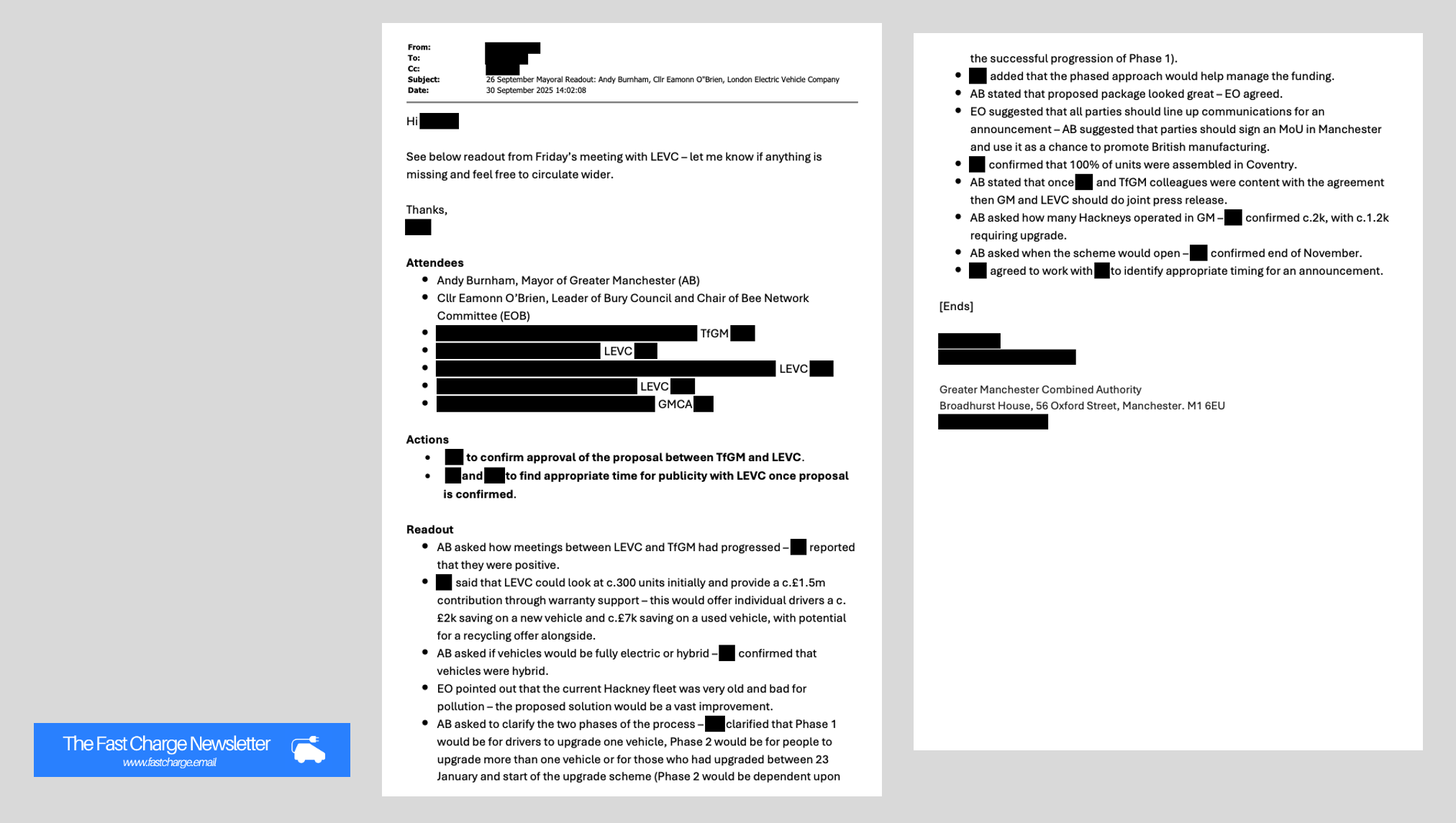
A second meeting happened in September… At this one, Burnham was informed talks between Manchester and LEVC had progressed positively, with Councillor Eamonn O’Brien saying the package would remove polluting vehicles and would be a ‘vast improvement’. Burnham said the package ‘looked great’, and suggested signing the agreement in Manchester as a chance to promote British manufacturing, followed by a joint press release.
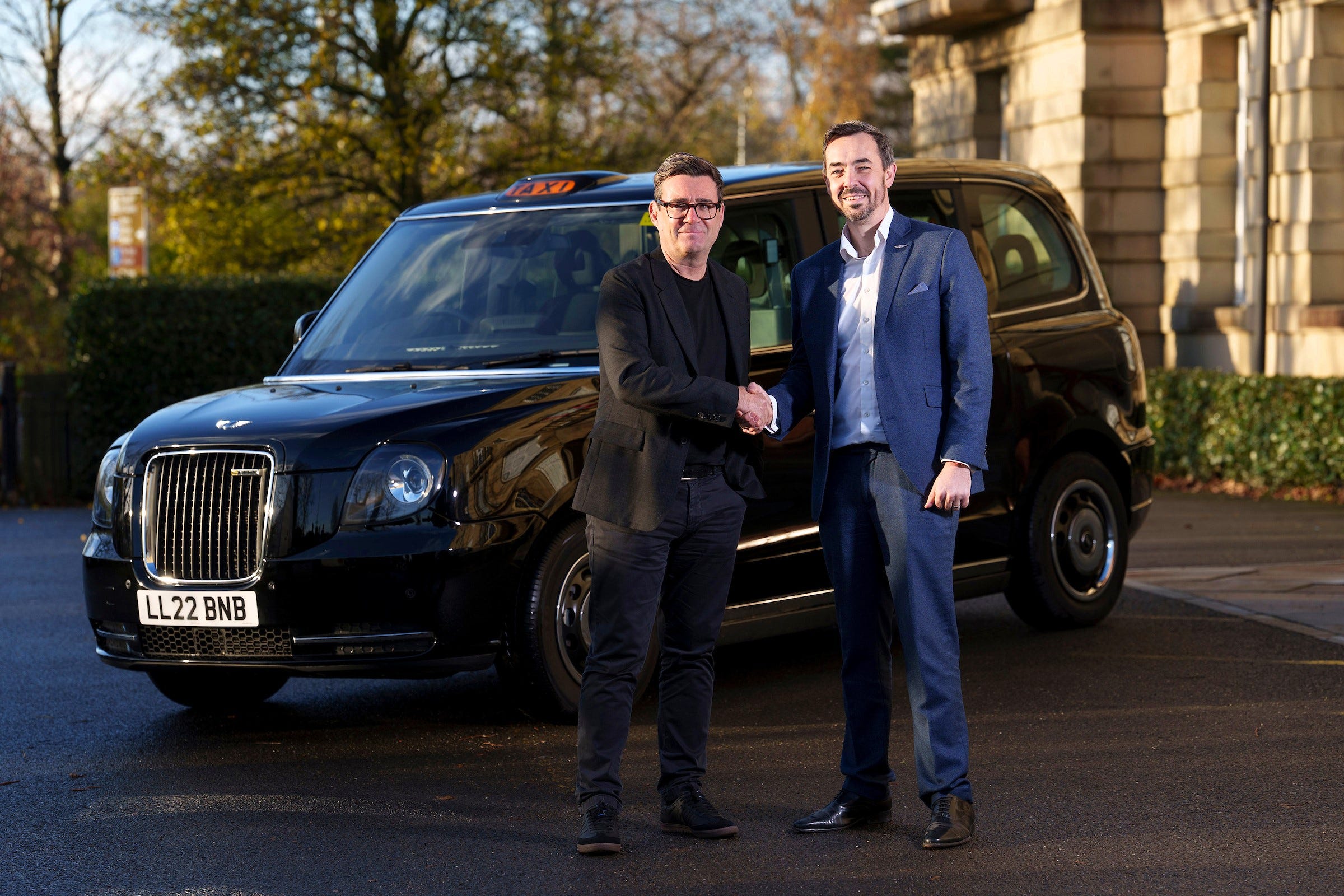
In December 2025… LEVC came full circle, publishing news of their “backing” to Burnham and the launch of Greater Manchester’s £8m Hackney Support Fund. The fund operates like a grant scheme, enabling Manchester’s taxi drivers to scrap and trade up to newer, electrified LEVC vehicles. As part of the deal, LEVC offered up to £2m in support.
Why the recusal raises questions
At the time of these meetings, which discussed electric vehicles, funding, and infrastructure, Burnham’s wife, Marie-France van Heel, was Chief Customer Officer at Manchester’s charging network, Be.EV. She was also director of its parent company, Iduna Infrastructure.
None of the above meeting readouts mention that Burnham had a conflict. This is interesting. Because in other meetings, Burnham has declared a conflict of interest. For example, in November 2025, at a meeting of the Greater Manchester Combined Authority, Burnham left the session during an item covering EV charger pricing in Manchester.
What this suggests to me is the following… Burnham believed it was fine to be involved in a broader debate about vehicle policy. However, not specifically EV charging that related directly to his wife’s company.
The last time I checked… The ZEV mandate is a rule on vehicle sales, not charging.
This raises the question… Why, as Prime Minister, has he decided to step aside from one of the government’s biggest climate decisions?
One industry source suggested it was a missed opportunity for the PM, who should be using his experience at Manchester to his advantage in this debate.
A split Cabinet, and no PM
The Cabinet is in disagreement… The Business department is pushing for EV targets to go as low as you can go (50%), while Transport wants a more reasonable change to 60%, and Energy does not want any change at all.
In the past weeks… There have been all sorts of urgent lobbying by both sides of the debate. From carmakers speaking to ministers, to Nigel Topping, Chair of the government’s Climate Change Committee (CCC), going public with a letter to the Transport Secretary claiming the mandate is working and that “Weakening the mandate will miss an opportunity to lower the costs of driving.”
It is getting messy. Topping’s letter led the Society of Motor Manufacturers and Traders to release a statement saying, “The CCC ignores the damaging cost of the targets it defends: billions in unsustainable discounts and millions more in government incentives.” And in a report by the Financial Times, two government officials told the paper that the car industry was “lying” about its inability to meet the mandate.
This is why we need the Prime Minister to take control. The whole consultation is starting to look ridiculous, and the debate needs his political involvement, just as he did in Greater Manchester.
On that note… If you want a comment that sums up why Burnham must get involved, this is a good explanation:
“So that we can all have a cleaner planet where children aren’t literally dying from breathing in toxic pollution.”
Who said that? Marie-France van Heel in 2025.
The Cabinet Office was approached for comment.