Hello, I’m Tom Riley, and welcome back to The Fast Charge, a British EV newsletter.
Top story in the newsletter this week… Since the introduction of new rules to make using public chargers easier, my analysis finds pre-authorisation fees for paying by card have risen by nearly a third (31%).
Elsewhere… A short review of what Andy Burnham as PM may mean for motorists, DfT covers its back on VAT, and MPs call on ministers to review the ZEV mandate.
As always, if you have any comments or feedback, please reply to this email or message me on LinkedIn.
For info, there will be no edition next week, as I’ll be six Chiantis deep in Tuscany. On my return, I’ll likely be at London Tech Week, MOVE, and London Concours. Please reach out if you want to link up.
Pre-authorisation fees now average £40 per tap
Headline: The amount of money that charge point operators take when a driver uses contactless on their networks has risen on average by £10 since 2023, based on an analysis of nine major UK networks.
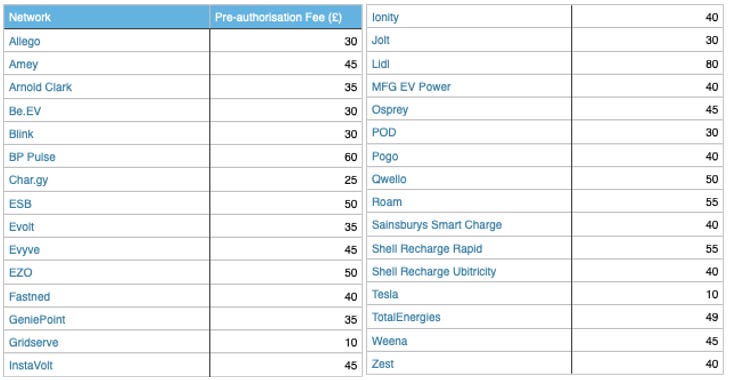
As of today… the average amount locked away from drivers whenever they tap their bank card is £40. That’s based on a separate review of 31 individual charging networks operating in Britain. While the amounts taken by charging networks are temporary, they can be held for anywhere from days to multiple weeks.
An analysis undertaken by The Fast Charge Newsletter in May of pre-authorisation fees across 31 UK charging networks. The fee is always the highest, as some networks charge different fees depending on the speed.
For a driver relying on public charging once a week… That means at any one time in a normal month, £160 could be sitting in limbo, tied up in pending transactions across multiple sessions before earlier holds have been released.
And that’s just the average… In many instances, the pre-authorisation fees charged by networks are eye-watering. As one example, Lidl, the ‘discount’ supermarket which operates a network of 1,388 chargers for its customers, charges £80 to its contactless users. Across 31 networks, seven of them have pre-authorisation fees either at or above £50.
When I last reported on pre-authorisation fees in 2023… I reviewed nine charging networks and found the average amount being held was £32, and the highest amount in the list was £50. When conducting a review of those same nine this week, the average amount has jumped by £10 to £42 on average. An increase of nearly a third (31%). Furthermore, whereas previously two networks (Gridserve and Ionity) offered a simple £1 reservation, now these are £10 and £40 respectively.
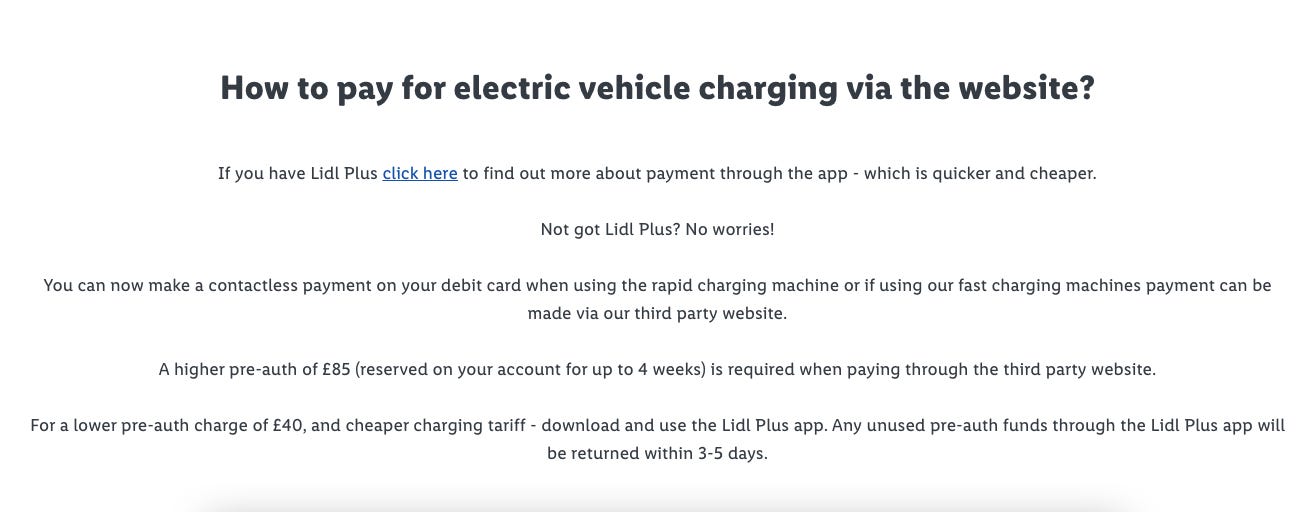
Why the rise? There is a multitude of explanations as to why pre-authorisation fees are so high. Some argue that it has followed the rise in charge point pricing, hence the risk from non-payment has also grown. However, others suggest that it’s a way of nudging people to sign up directly with networks and their apps. For example, to avoid Lidl’s £80 fee, according to its website, simply downloading the ‘Lidl Plus’ app to charge, you only face a £40 pre-authorisation fee, which also gets returned within days, as opposed to “up to 4 weeks” for using contactless.
Sticking with Lidl specifically… I contacted the supermarket yesterday about their fees, as on the website it lists £85 as the pre-authorisation fee. Initally they argued it was £40 for all, whether using contactless or their app. However, since publishing, I’ve been told it is £80 if you pay by card. The website remains inaccurate.
Steering away from the middle aisle now… Pre-authorisation fees make no sense to drivers. According to a submission to the Transport Select Committee by the network Fuuse, 40% of their helpline calls are about pre-authorisation fees. In online forums, there are regular posts by drivers perplexed by them, especially as if there’s a problem with a charger; the fees can quickly multiply. In my early days, I had £130+ frozen for weeks by one operator after the charger failed to work properly.
A few years ago… Drivers of fuel cars were in uproar as ‘pay-at-pump’ pre-authorisation fees jumped from £1 to nearly £120. Much like with EV charging today, this money could take days or weeks to return. However, nowadays, the return for most is closer to instant. In any event, fuel drivers can always pay at the counter. EV owners cannot.
In my opinion… While the Public Charge Point Regulations have done an excellent job in getting networks to offer contactless payments, the Government should now take it further and sort out the mess which is pre-authorisation fees. At present, it feels like the wild west, and I know that EV executives are equally as frustrated – many suggest it’s the banks and card processors that need to make changes.
It needs to happen soon… We are seeing a huge surge in EV registrations as people are increasingly persuaded by the cost benefit. However, while the regulations give drivers the right to pay by contactless, it says nothing about how much could be taken before the charging even starts.
What if Andy Burnham becomes PM? How will it impact the EV sector?
I’ve been doing some digging, but to be entirely honest, his positions are all over the shop at the moment. He seems to change his views with each passing day. He is clearly desperate to take his populist position nationally. And my instinct is… that’s not good for the EV industry.
At a high level, all Westminster squabbling does is hold up Whitehall and scare investors. And at a micro-level, should Burnham succeed in becoming PM, he has a history of caving to criticism, which worries me.
For example, he pushed strongly for a Clean Air Zone in Manchester before cancelling it after facing a backlash. The reversal reportedly cost taxpayers over £100 million due to the installation of ANPR cameras. The carmaker LEVC (owned by Geely), who make the famous electric black cabs, was furious about this and publicly criticised Burnham. A few months later, lo and behold, Burnham buttered them back up with an £8m pot specifically to help taxi drivers buy their vehicles.
Fair play to LEVC, but where was Burnham’s ‘Kingly’ strength in that situation? It doesn’t fill me with confidence, given how tenacious carmakers can be in this country about the ZEV mandate. Not to mention, in the face of growing calls within Labour for the net zero agenda to be sidelined.
In terms of what a Burnham premiership could mean for drivers of all fuel kinds…
Evidence submitted by Vision Zero Greater Manchester – a road safety strategy endorsed by Burnham – to the Transport Select Committee in March, and published on 20 May, may give us an indication.
In short…
20mph speed limits in built-up areas, which follows “robust leadership” by Wales
Reduced speed limits on rural roads
Mandatory refresher courses for those over 70
Restrictions on new drivers, such as a nighttime curfew, smaller engine sizes, and a minimum 12‑month learning period.
Find it here. Albeit, he’ll probably have u-turned by the time you read it.
Please consider supporting this newsletter or signing up ⚡️🚗
Quick EV news…
🐴 Ferrari has launched its first EV called the Luce. It hasn’t gone down well with critics, and its shares have slumped. I quite like it. Read more.
😊 “The electric car takeover is now unstoppable” are seven words I never thought I’d see the Daily Telegraph’s World Economy Editor write. But he has. See here (paywall).
🧐 The Guardian has learnt that DfT supports the equalisation of VAT between home and public charging, pinning the blame on the Treasury for keeping it going. DfT advisors have been briefing this to the industry for a while behind the scenes, so to see it in a national paper is interesting. It either means the Treasury is lining up to change it as part of the charging cost review, so DfT is doing a sort of “I heard of that band first,” so Reeves doesn’t get all the glory. Or it’s the opposite, and DfT’s political advisors are taking steps to protect its ministers from bad press. Intriguing. Read here.
😡 Talking politics, the Business and Trade Select Committee has called on ministers to review the ZEV mandate. See their letter here. In response, Vicky Edmonds, Chief Executive Officer of EVA England, said the letter showed “poor judgement at a crucial point in the EV transition”. Adding: “The UK’s focus should be on how to support mass uptake of EVs, in the face of clearly rising demand.”
👎 An analysis of the impact of eVED by BVRLA and New Automotive has found it will be “structurally unfair for rural, semi-rural, and post-industrial communities” as they are areas with high mileage counts. Read more.
💷 Speaking of the cost of EVs, a new survey by Motability Operations has found the proportion of Britons who believe EVs are cheaper to fuel than petrol or diesel vehicles has risen from a fifth (20%) to a quarter (25%) in the past six months. However, confidence in local councils’ deployment of public chargers remains poor. Read here.
By Tom Riley | Add me on LinkedIn | Drop me an email