

Hello, I’m Tom Riley, and welcome back to The Fast Charge, a British EV newsletter.
Top story in today’s edition... North Yorkshire Council, the largest UK authority by geography, has abandoned its £8 million government-backed plan to roll out EV chargers in a blow to the region. The news applies further pressure on a government review of pricing at public chargers. Full story below.
Elsewhere... Lots of hub openings, Tata gets more millions from the public, and the most pretentious car advert I’ve seen to date. Also, the Department for Transport has not just done one good thing since last week, but two!
Finally, it was super to join Liz Allan on her Electric Evolution Podcast this week. We discussed a lot, including the realities of the EV industry and my experience reporting on it. Take a listen here.
As ever, if you have any comments or feedback, please reply to this email or message me on LinkedIn. I always enjoy hearing from people.
Scoop: North Yorkshire Council abandons its EV charging rollout
A plan to install thousands of EV chargers across North Yorkshire’s green and pleasant land had been in the works since 2023. The plan, which was backed with £8.1m from the Department for Transport, was set to be one of the country’s largest public charging contracts under the government’s local EV infrastructure fund.
But... North Yorkshire Council surprised industry leaders this month by “abandoning” its EV charging rollout due to “significant changes in the EV market” and “wider economic conditions,” according to correspondence from North Yorkshire Council and seen by The Fast Charge Newsletter.
Big project: It’s believed by one industry source that North Yorkshire Council expected 3,000 charge points to be installed across the region and that the rollout was due to be delivered by Connected Kerb. North Yorkshire Council confirmed that Connected Kerb was the awarded operator; however, the authority made clear its decision to halt its programme had nothing to do with their ability to deliver.
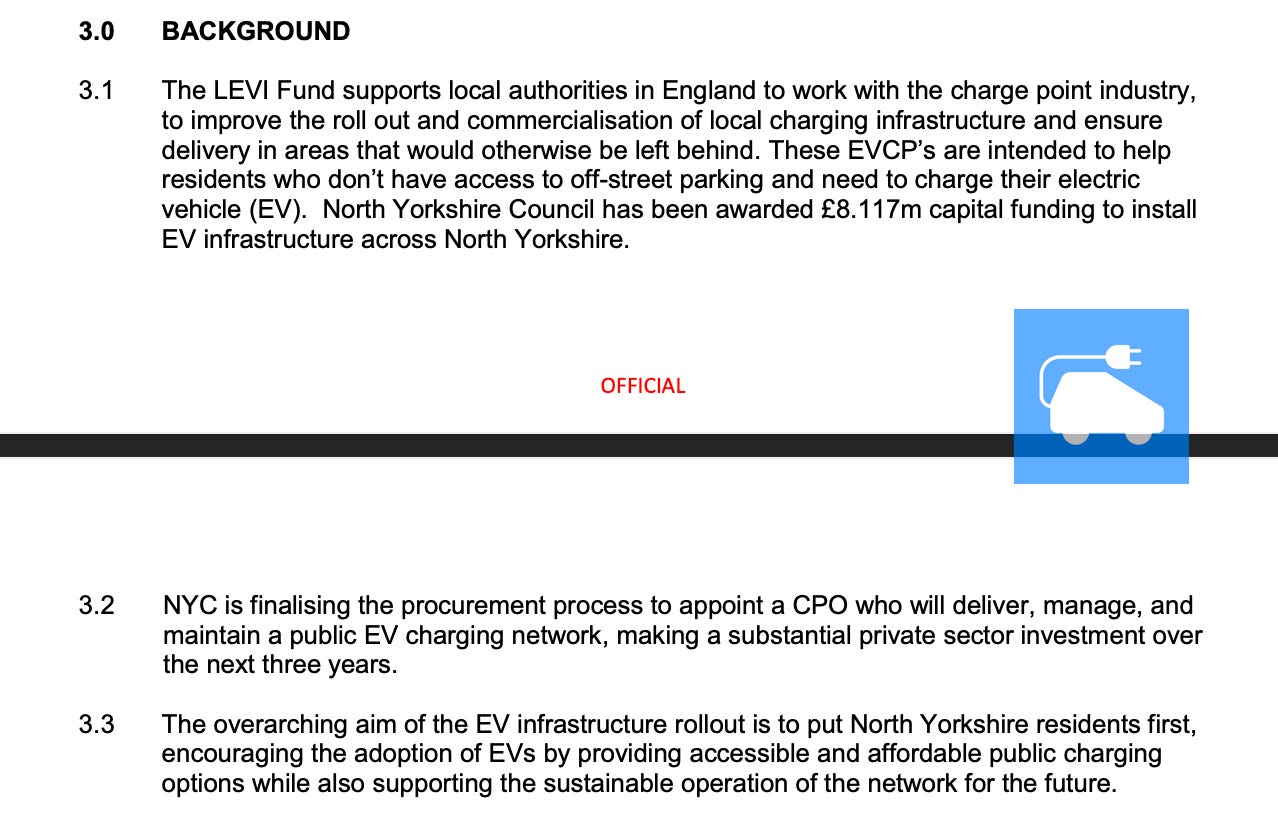
So, why cancel? Within its formal notice of procurement abandonment, North Yorkshire Council cited several factors that caused it to revisit its plans, which were put in motion in November 2024, including:
Significant market changes... The council wrote that the EV charging market had undergone fundamental change, noting that there had been shifting ownership among operators, which, as a result, had caused substantial amendments to contract terms. The authority noted the “EV charging sector has shifted at pace, and the market picture today is materially different to when the procurement commenced. A revised approach is required to ensure alignment with current supplier models and market realities.”
Economic conditions... The council wrote that global volatility in energy tariffs had introduced further risk, making the continuation of its procurement economically unviable for the council. This was reinforced further by the council, which blamed “notable increases in standing charges, including instances where these are uncapped.” The authority wrote that this trend had significantly affected its EV programme’s viability.
Strategic misalignment... Lastly, the council suggested that its current approach would no longer meet its objectives, claiming that proceeding without addressing the gaps in its approach would risk “failing to deliver the strategic, commercial, and operational outcomes required.”
North Yorkshire Council confirmed the news but declined to provide an on-record comment. However, the authority did tell me that there were benefits in altering their approach, and that by revisiting the procurement strategy, the authority could reflect the current market and secure the best long-term solution for North Yorkshire. The council is now undertaking a review of its position. This review will look at its commercial model, contract structure, and its overall strategic delivery approach for EV charging.
DfT, who run the LEVI scheme, said it would not be appropriate for them to comment on the decision by North Yorkshire Council. However, I’m told officials were aware of the council’s decision and expect it to re-tender, though the timing is unknown.
Anyway… Where does this leave Connected Kerb?
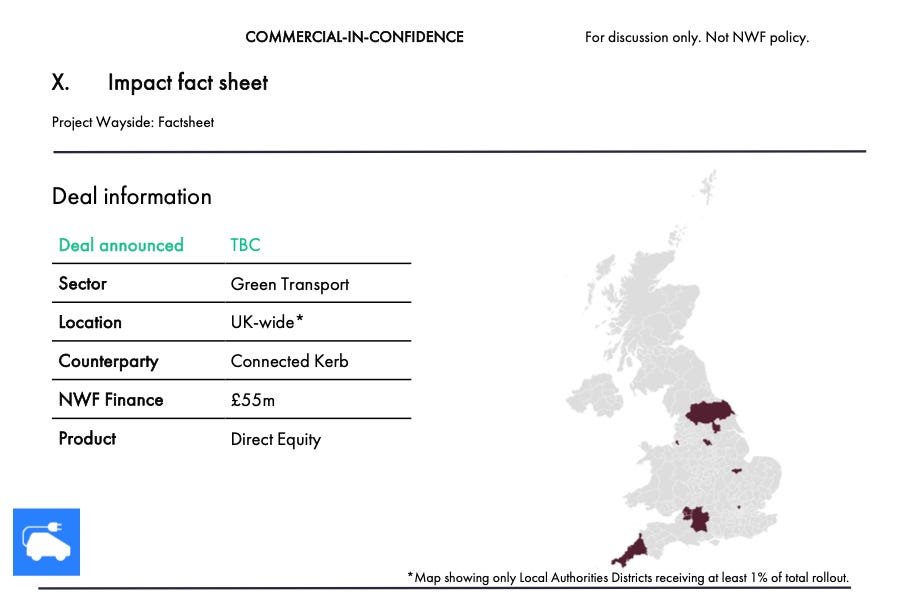
North Yorkshire was an important contract for the network. So much so that it was highlighted in the investment note used by the Government’s National Wealth Fund to back the company with £55m last year. An investment which, for many in the EV sector, remains controversial given the operator was loss-making at the time.
The Fast Charge obtained the investment note used by the National Wealth Fund in 2025. Dubbed ‘Project Wayside’, the document was heavily redacted. However, a map was included under the sub-header ‘deal information’, highlighting regions of the UK expected to receive significant deployment by Connected Kerb. One of these was North Yorkshire. This suggests the contract formed part of the wider national rollout used to underpin the taxpayer-backed investment.
When asked about the impact of the abandoned contract… Connected Kerb did not respond to multiple requests for comment. Meanwhile, a spokesperson for the National Wealth Fund defended its investment in the operator, saying:
“Improving access to electric vehicle charging is an important sector for the National Wealth Fund as reflected in our new strategy.
“Our investment in Connected Kerb has been based on its nationwide pipeline to rollout on-street charging points across a multitude of locations, not on any one area.
“Our investment decisions are guided by a comprehensive view of the market and a commitment to supporting government policy objectives. As with all of our deals, this investment was subject to a thorough and robust due diligence process.”
This edition is free to read, but most editions are paywalled. Please consider supporting this newsletter by signing up or becoming a paid subscriber ⚡️ I know not everyone can afford £10 per month, so do contact me if you want to discuss a tailored rate, especially if you want to cover multiple people 🚗 Thank you, Tom
Latest EV news...
☹️ Two weeks ago, I wrote that EO Charging was on the verge of entering administration, and last Thursday, a statement by PwC confirmed that it had indeed happened. As a result, 69 employees have been made redundant. PwC will now look to sell its assets. Thoughts with those who have lost their roles.
💷 Agratas, the company building a gigafactory in Somerset to supply batteries to JLR, has in the past week received a £380m cheque from the government. The Business Secretary, Peter Kyle, said the money would “help ensure advanced manufacturing remains a thriving sector in the UK for decades to come.” It’s good news. Read more. However, is anyone else not a little curious about the vast sums that Tata-related companies seem to get from UK taxpayers? The government provided a £500m subsidy to their steel business in 2024. And last year, when JLR (owned by Tata) fell apart because of cybersecurity weaknesses, the govt guaranteed a loan worth £1.5 billion. And that’s not to mention when the Prime Minister got involved in sorting out JLR’s tariff situation with President Trump and announced flexibilities to the ZEV mandate from JLR’s factory. I know we like a Range Rover in this country, and want to keep jobs here, but where does it end?
👍 Last week saw some good news for charge points in the UK, as the Department for Transport announced changes that should streamline admin and lower costs for installations in England, as it moves to a permit system for street works. Read more.
🔋 Also in DfT news, officials have launched a consultation that may bring about a standardised battery health check, which will provide greater confidence for the used EV market. Thomas McLennan, from the BVRLA, said, “This consultation moves that reality forward and has the potential to put clear, comparable, and easily accessible battery health information in the hands of drivers and fleet operators. That clarity is critical in giving used EV buyers the confidence they need to make the market stable and sustainable.” Find the consultation here. It closed on 25 May.
👉 Interesting comment piece in The Times’ Money section further supporting the fact that rising oil prices are causing more families to consider the cost savings from going electric. Read more (paywall). It will be interesting to see if the current shift outweighs people’s concerns about eVED.
🙅♂️ East Devon District Council has rejected plans for 30 EV chargers near a business park due to concerns that, should an EV catch fire, water used to put the car out could end up in the local water supply. This would present a health risk. An interesting case, and this wasn’t the only reason for rejection. Read more.
🔌 In better news, Thurrock in Essex is due to get 4,046 new chargers over the next 15 years as part of a deal with Zest. The deployment will consist of a combination of lampposts and rapid chargers. Read more.
🤨 Talking of Zest, there was an interesting comment by the operator’s CEO, Robin Heap, on LBC, writing about the charging industry not having a Standard Industrial Classification (SIC) code it naturally falls under. It’s interesting as these codes are used by authorities to monitor and research industries. So, if all the networks are using different codes, policymakers may not have a true picture. Surprised nobody has realised this until now. Read more.
🎳 Raw Charging is continuing its surge of openings, this week launching a rapid EV charging hub with 32 bays at the Cardigan Fields leisure complex in Leeds. Read more.
🕺 Talking of hubs, E.ON Drive has unveiled four 300kW chargers in York. They’re located near George Hudson Street, making it a perfect spot to plug in and spend your waiting time dancing on the revolving floor at Popworld. Read more.
⚡️ On rapid charging, BYD has confirmed plans to roll out 300 of its 1,500kW ‘Flash’ chargers in the UK over the next 12 months. And it sounds like the sites will be open for all, which is a problem, because most EVs can’t charge up that fast. Autocar reports that BYD is still figuring out how to manage it, and this may include penalising people who block them up. Read more.
📈 Elsewhere, it’s all happening in Hertfordshire. Firstly, the county council has appointed Believ to deliver up to 4,000 chargers as part of a £38m deal. Meanwhile, East Herts Council has signed up Otaski Energy Solutions to install 193 slower chargers. Read more.
🏴 A bit more remote than the home counties... up in the Western Isles of Scotland, an insightful report on local councillors discussing plans for EV charging, noting that a hub may be planned for Islay. Good news for any EV drivers considering a whisky tour. Read more.
🚗 Coming to the salesroom in 2027, an electric version of the Nissan Juke. Unlike some previous iterations of the Juke, the EV version looks quite good. Read more.
😅 Finally, what on Earth is happening at Rolls-Royce? They have just unveiled their coach-built two-seat EV convertible called the Nightingale.

Ignoring the rather ‘out there’ baby blue they’ve applied to the car, who the hell buys a convertible from Rolls-Royce? Unless you are a Middle Eastern Sultan, I am not sure who RR is trying to cater to. Its promo video is such a mess, to the point of hilarity. Images of a young woman peering out from a beach into a sunset, then the car. Then images of a ballerina. Then a man throws some paper. Then back to the beach woman, oh wait, show the car again. It is literally Fry and Laurie’s mock perfume advert come to life. See it here.