

Hello, I’m Tom Riley, and welcome to a bumper edition of The Fast Charge, a British EV newsletter.
Top story this week... I can exclusively reveal that Tesla is so worried about the UK used EV market that it has created a hidden ‘orphan company’ to shield itself from up to £700 million of exposure.
Also, a big story, I unveil the lobbying efforts by Ford, Mercedes, and Tesla in response to the ZEV mandate consultation earlier this year. I was very pleased to see these responses reported on by Jasper Jolly at The Guardian.
Elsewhere... New EV registrations took 26% of the market in November, more cars are eligible for grants, and can you name Cumberland Police’s new EV?
As ever, if you have any comments or feedback, please reply to this email or message me on LinkedIn.
Let me introduce you to Awesome Range UK…
The ‘orphan’ company quietly set up by Tesla to isolate its used car exposure
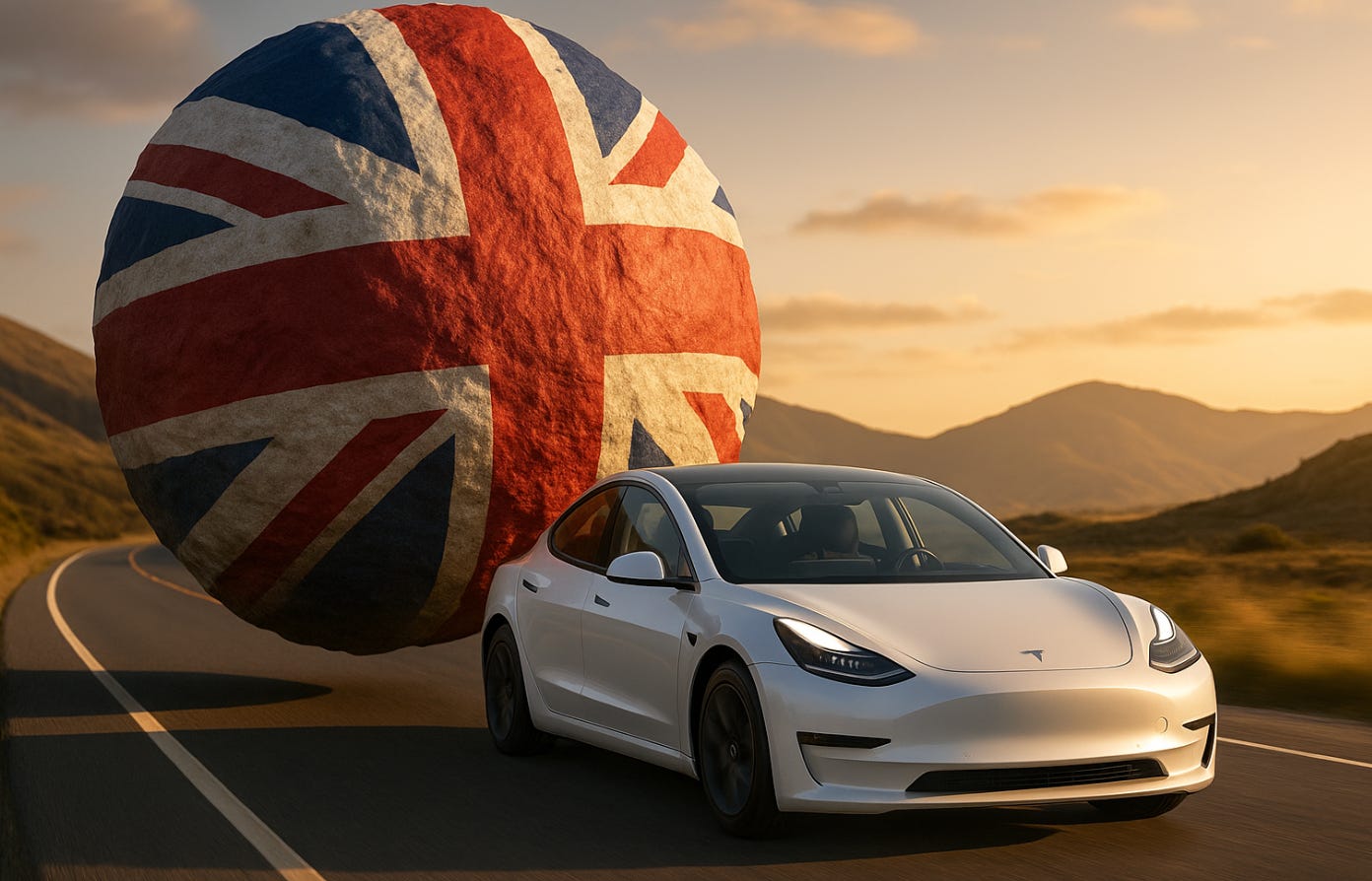
Summary: I can exclusively reveal that Tesla’s finance arm quietly set up an orphan company called ‘Awesome Range UK Limited’ in April 2024 for the purpose of offloading up to £700 million of lease receivables and residual value exposure from its own balance sheet.
Why would they do that? By shifting its risk to an orphan firm, Tesla effectively insulates the carmaker from future instability in the used EV market, such as falling residual values or if it struggles to sell cars secondhand for the right price when they return after contracts end.
Wow! But what is an orphan firm? An orphan firm is a company that has no real owner and is kept legally separate so that any financial risks inside it can’t affect the parent company that controls it. They are often used to shield a parent company from risk or exposure. In short, and talking hypothetically, if an orphan firm were to go insolvent, the parent company is protected and can continue operating as it was, as they are not connected, so have no direct liability for any losses.
So how and why was this done? Well, Tesla has been worried about used EVs for a while. A couple of years ago, Tesla got caught off guard by collapsing residual values, and I was told by a source at Tesla this year that support for used EVs was important for them. It was acknowledged by the same source that the polarisation around Tesla’s brand, largely due to Elon Musk’s activities, in addition to surging Chinese sales, had really not helped their situation in the UK.
Within Tesla’s ZEV mandate response from last Christmas, which I’ve published today and has been reported on in The Guardian, one of the key government asks by Tesla was getting the UK to ‘focus attention on the used-car market’. The Guardian asked Tesla if they had asked for a used EV grant, and no comment was provided. (More on that below).
And this is why this new company was kept hidden. If you are a huge EV carmaker like Tesla, I cannot imagine you’d be too keen for everyone to know how worried you are about something, especially if you’re lobbying for government help. Hence, when it came to setting up an entity that could take on Tesla’s risk, it appears they sought the services of CSC Global, a financial firm that specialises in creating ‘special purpose vehicles’, such as establishing orphan firms that large businesses can quietly control without being publicly linked to the firm.

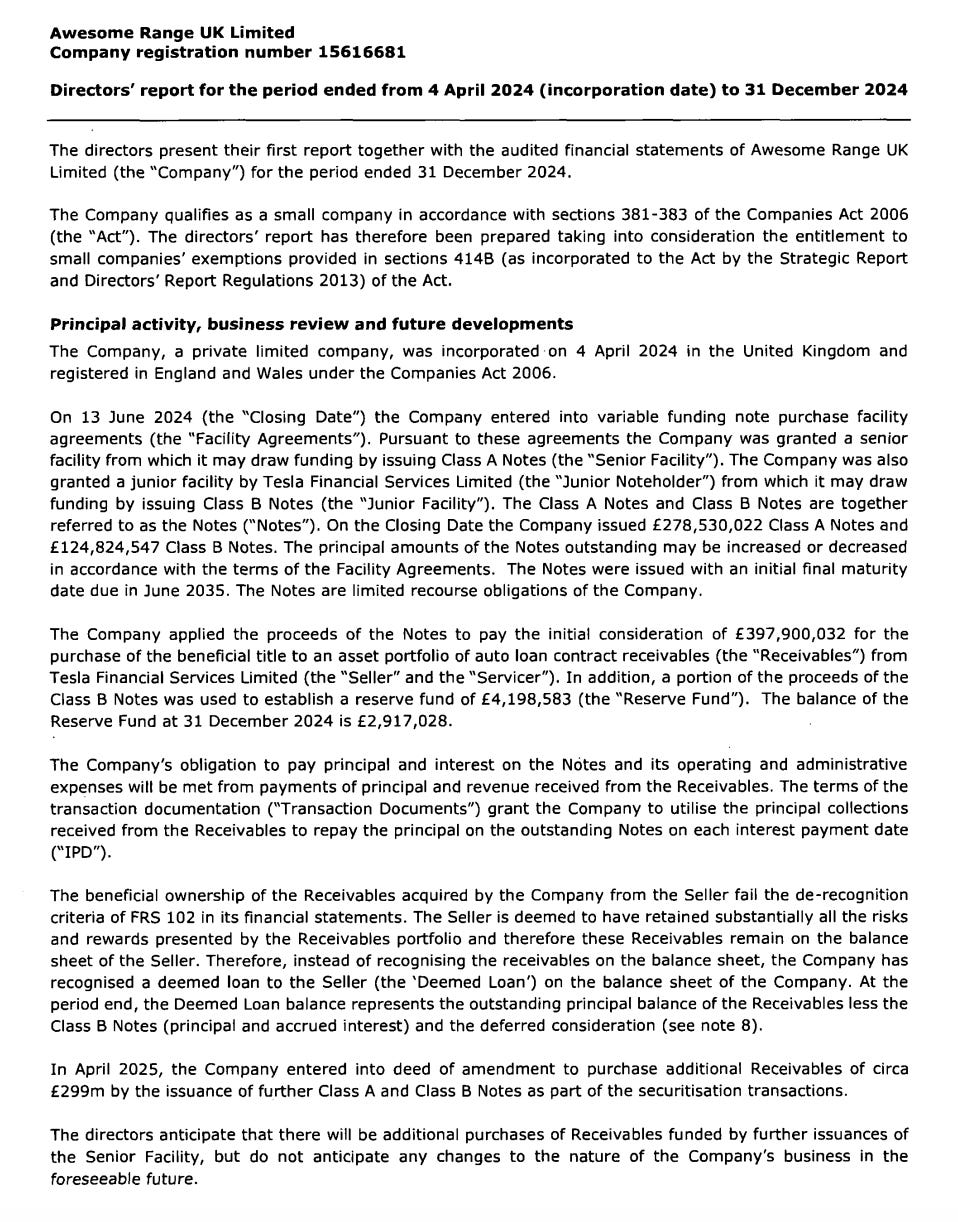
I only happened to discover Awesome Range UK, the firm CSC Global appears to have set up for Tesla, by accident. There were several mentions of transactions with ‘Awesome Range Plc’ within the latest accounts published by Tesla Financial Services (see here). After some searching around, I finally found the company in question, and it had only just published its own first set of accounts. Those revealed that Awesome Range had effectively bought one tranche of lease related exposure from Tesla in April 2024 for £398 million. The same accounts suggested a similar transaction for £299 million was due to occur in April 2025. See Awesome Range UK here.
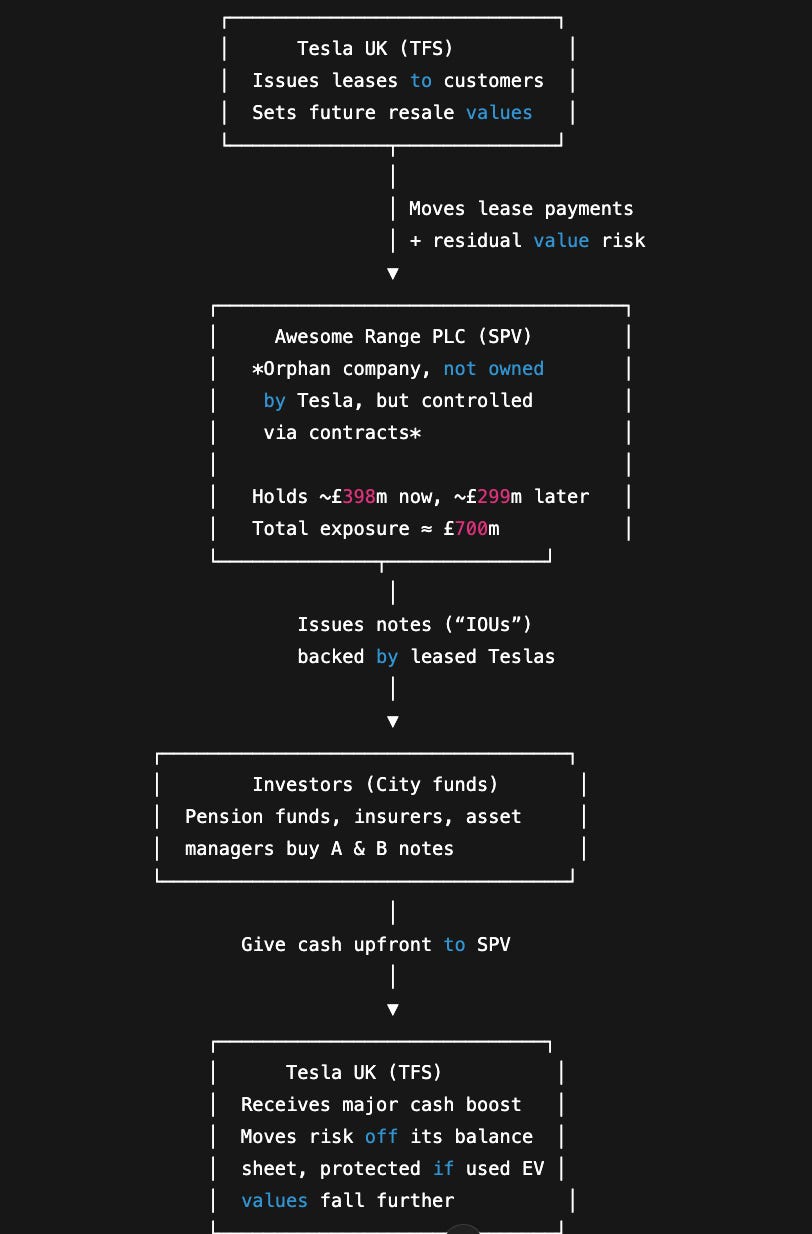
What does that mean? The graphic below might help you understand. In short, Tesla gets an injection of cash from investors who bought up the ‘risk’ from Tesla. In this case, it appears that an organisation linked to Citi is acting as trustee for investors who have bought the risk from Tesla, according to Companies House documents.
For consumers, it doesn’t change anything. For example, if you have a contract with Tesla, you will still pay them normally. However, when you make finance payments to Tesla, behind the scenes, those holding the risk (aka the bank) will likely get the money. It’s a bit like what happens with a mortgage.
What I find interesting is, none of this is very transparent. Unless you were really looking, it is not obvious at all that Tesla would have any sort of direct involvement or control over Awesome Range UK. The significant owner is listed as CSC Global, as are the listed directors. However, within Tesla Financial Services accounts, they state clearly that it “does control activities of the entity.” Tesla accepts that it is essentially a subsidiary. However, because of the way it’s been set up, they are exempt from having to consolidate those huge transactions into the balance sheet of Tesla Financial Services.
It is bewildering and bonkers. But, to be clear, it’s not illegal. And Tesla will not be the first company to use this method to isolate risk. What’s noteworthy in this situation is that it’s evidence that Tesla, one of the largest carmakers in the world, is clearly uncomfortable with the amount of UK exposure it’s carrying related to the used car market and may not have wanted people to know. Obviously, that was before I found it.
👉 Tesla was contacted for comment.
Revealed: What Ford, Tesla, and Mercedes lobbied the UK for last Christmas
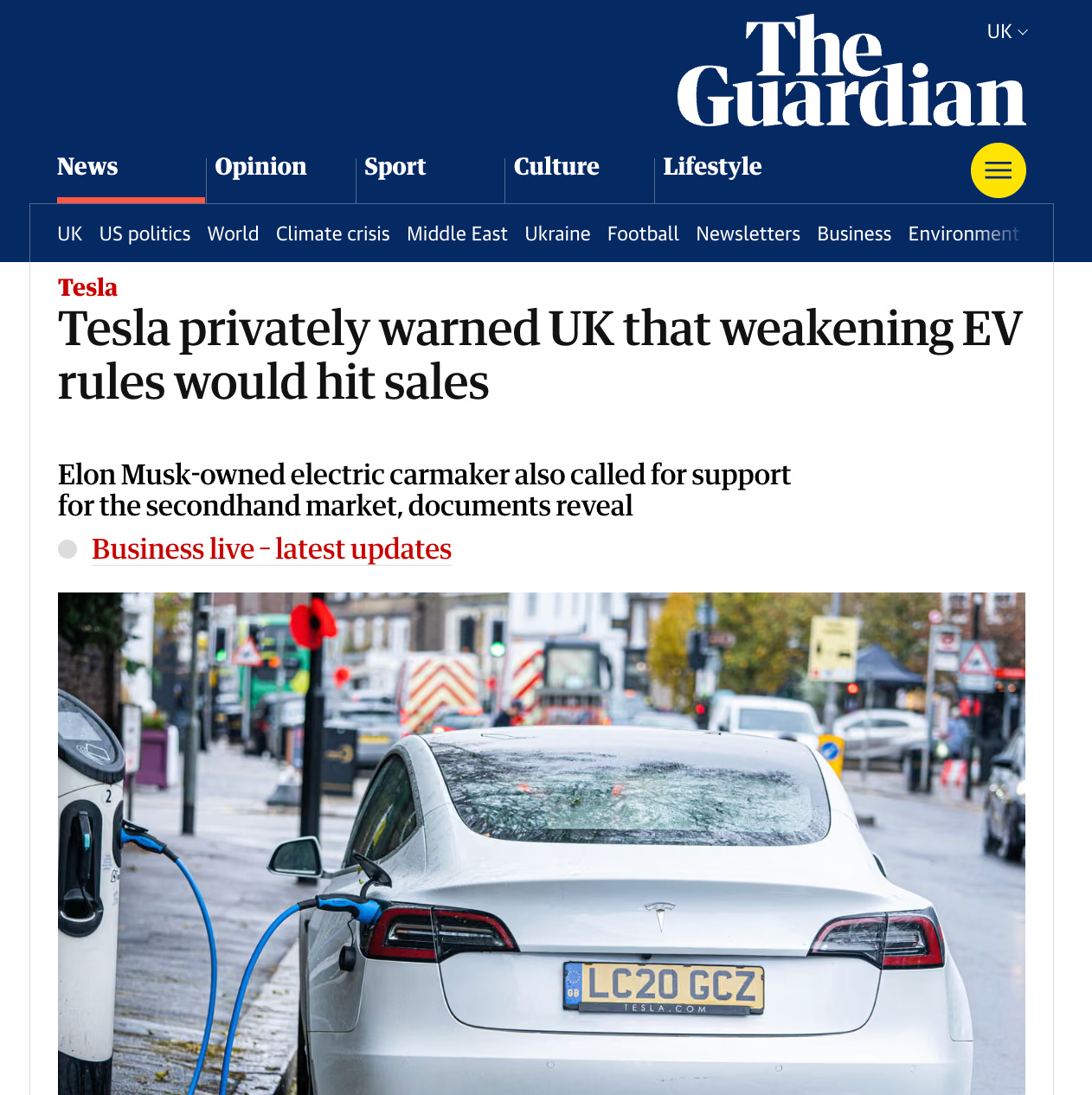
Background: Do you remember back in the Summer when I obtained all those submissions from carmakers about their submissions to the last ZEV mandate consultation? Well, as readers may recall, at the time, three carmakers (Ford, Mercedes, and Tesla) refused to disclose their documents, claiming they were commercially sensitive. How the Government even allowed them to claim such a blanket refusal, given 11 others did disclose, baffles me. In any case, after endless waiting and pushing of DfT to get them released, I now have them!
What do they reveal? In short... Ford’s is feisty and critical of politicians across Europe, Mercedes lobbied for a price cap on EV charging (I think the only carmaker to go that far), and Tesla’s was full of pleas not to add any more flexibility as it would weaken sales – which was clearly ignored by Labour, as the Prime Minister announced in April they were providing more flexibility.
Below I have included a summary of each of these three carmakers’ submissions. I have also included a link for you to access the full suite of ZEV mandate submissions I obtained – previously only available to paid members – from Toyota to Tesla, SMMT to ChargeUK. Think of it as an early Christmas gift.
Ford’s Response: I would describe Ford’s submission as feisty; a borderline ultimatum to the government, asking them to boost EV demand or adjust the ZEV trajectory. Ford warned that they and the industry couldn’t keep absorbing the cost of the transition, suggesting it was “wholly unsustainable,” and said modest tweaks to flexibilities would not be enough. Ford wanted many more flexibilities, including a pause on penalties and even suggested that, after 2030, the UK should remove the targets in the years up to 2035.
Ford wrote: “Micromanaging the final remaining percentages of new sales creates further complexity in an already complex scheme and removes the ability of OEMs to manage the final years of technology transition most efficiently.”
Mercedes’ Response: They took a stance that was quite like other carmakers and clearly was closely aligned to SMMT’s submission. They urged the government not to tighten the ZEV mandate any further. More interestingly, though, Mercedes called for stronger demand-side incentives, especially around EV charging. Like many OEMs, they called for a mandate on the number of public charge points. However, on public charging costs, alongside calling for a cut on VAT for public charging to 5%, Merc even suggested capping prices at chargers. Big move.
Tesla’s Response: Despite what Elon Musk, CEO of Tesla and former advisor to President Trump, likes to say about the UK’s Labour government, yet again, those public views clearly are not the views shared by Tesla. Their submission to the Department for Transport begins by praising the UK for showing “global leadership in legislating for the end of the sale of new internal combustion engine vehicles by 2030.”
Clearly, the submissions indicate Tesla was not happy with the ZEV mandate as it was set previously, and argued that the government should “not take any steps to undermine these conditions through the introduction of further compliance flexibilities which already allowed manufacturers to sell 47,641 fewer vehicles than mandated in 2024.” In their consultation response, they wrote explicitly that, “The creation of new flexibilities, or extension of the deadline applied to the existing flexibilities, will suppress battery electric vehicle (BEV) supply, carry a significant emissions impact and risk the UK missing its Carbon Budgets.” Tesla believes the flexibilities already gave enough leeway to carmakers, which is something think tanks such as Transport & Environment and New AutoMotive have also argued previously.
What’s most interesting about Tesla’s response, especially given my top story today about their hidden company, is that in the document, you’ll see some four pages entirely redacted. All apart from one sub header titled... “Support for the used car market”. This was in response to a question about incentives for consideration. When asked by The Guardian about their submission and if they asked for a grant, Tesla did not comment. The only clues we have are the footnotes containing links to information that was cited in Tesa’s response. One of them was a link to the BVRLA’s ‘Happy EV After’ page, a campaign that called for grants and schemes to support the purchasing of second hand EVs. Again, to me, this reinforces the huge concerns Tesla has for the UK market.
👉 Access all the ZEV mandate submissions obtained by The Fast Charge here.
⚡️ Latest EV news...
📊 New EV registrations rose to reach 26.4% share of the market in November. See here.
☹️ A real loss for the UK as Zipcar, the car and van sharing business, considers leaving. This is a huge loss for London in particular. The shared cars are the go-to for when moving home or picking up furniture. My first experience of an EV was in a Zipcar (an electric Golf). If they do go, it’ll be a shame, though it seems the business has been losing money for years. Read more.
🔥 The designer behind Jaguar’s revamped EV has been let go by JLR, according to media reports. Read more.
🚗 Four new EVs are now eligible for the higher £3,750 grant from the UK government. They include the Renault 4, Alpine A290, Mini Countryman, and Renault 5. Read more.
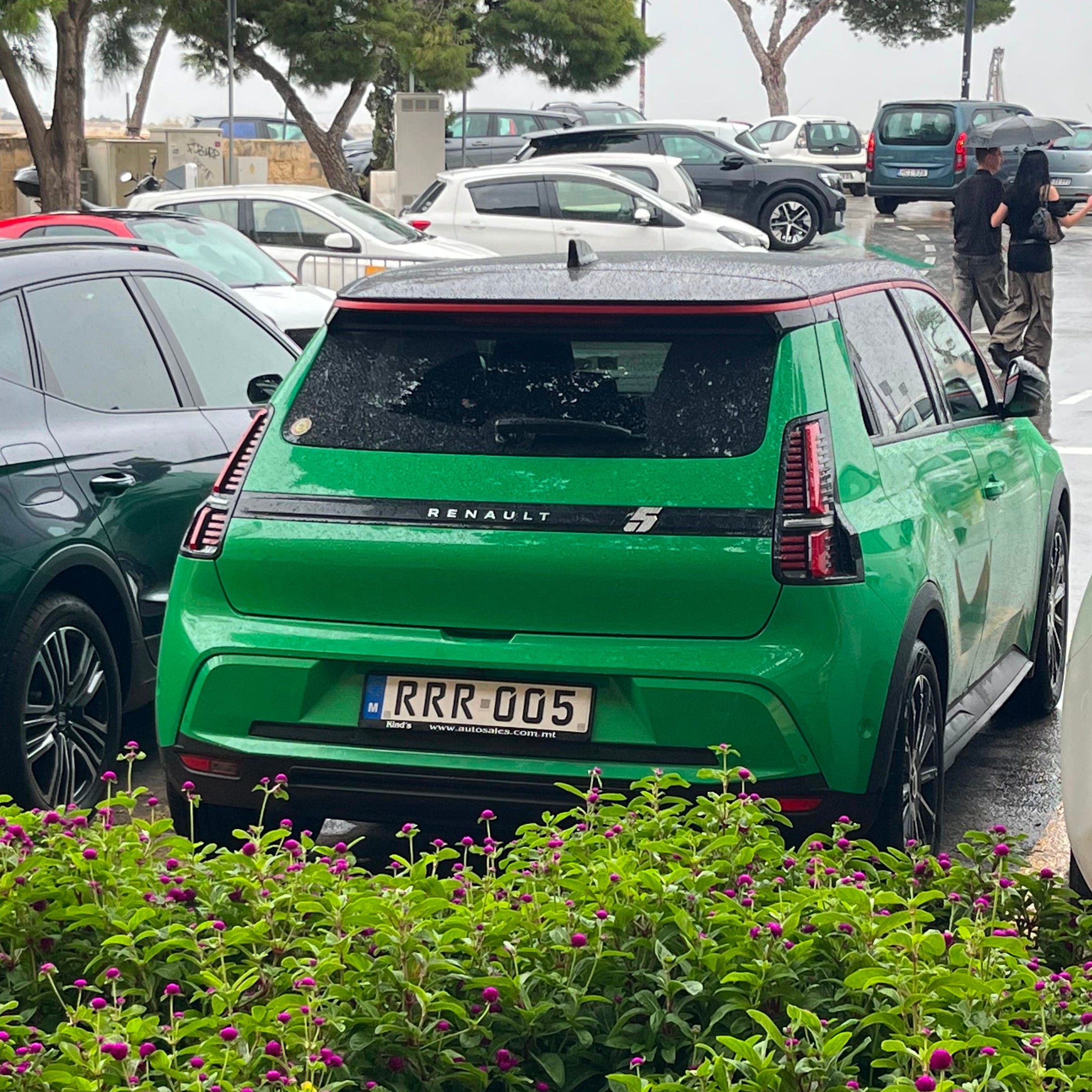
Speaking of the Renault 5, when I was in Malta recently, I saw a green one with the number plate ‘RRR-005’ (very cool!)👇
🇬🇧 Back in the UK now, Mercedes is launching a new project to make EV motors which should create 150 jobs. Learn more.
🛻 The Royal Mail has purchased 100 micro-EVs which are going to be rolled out across London, Bristol, Newcastle-under-Lyme, Solihull, Brighton and the Scilly Isles. Read more.
🚛 Speaking of deliveries, Amazon has purchased 160 electric HGV’s to run in the UK. They are also adding 800 more electric vans. Woof. Read more.
👍 Hats off to local councils who, according to new research by Drax Electric Vehicles, are now increasingly compliant with the public charger regulations. In 2024, the level of full compliance was 47% and this year it’s 67%. Likewise, whereas last year 21% were non-compliant, this year it’s dropped to 6%. Read more.
💷 Following the EV pay-per-mile tax, the stories this week have turned to how those with plug-in hybrids are effectively being ‘double taxed’. Well, yeah? Elsewhere, the CEO of Vertu Motors suggested the tax will result in petrol car rationing. Eye roll. Read more.
🧮 Speaking of the new tax. Want to know what the proposed new mileage tax means for you? New AutoMotive has created a helpful tool. Find it here. Overall, according to the advice site, Electrifying, EVs are still cheaper to run even with the tax. However, without home charging, that is not the case.
🔌 Gridserve have completed upgrades at Knutsford Services, both north and southbound now offer 12 ultra-rapid charging bays. Learn more.
🚔 Police in Cumberland are looking for a name for their new KIA EV police car. At the moment, the Eden Neighbourhood Policing Team have come up with... the KIA Starmer EV. I think that’s very Chris Witty. Read more.