

Hello, I’m Tom Riley, and welcome back to The Fast Charge, a British EV newsletter.
Top story in today’s edition… I provide my analysis and key pullouts from the 165 pages of submissions I received from carmakers, trade bodies, and Motability relating to the ZEV mandate. A link at the end of this article will take you to a shared file, where you can access all the documents.
Elsewhere... Lilian Greenwood out as EV Minister. Is mini-Keir the new one?
In other news… You will note this edition has arrived two days late. But you’re not allowed to be upset, as this is because I’ve been supporting the launch of Brain Cancer Justice, a group I’ve helped co-found after my own diagnosis last year. On Tuesday, we held numerous events and have been promoting our petition, which gained 10,000 signatures within 48 hours. If you haven’t signed it, I’d be very grateful if you could.
As ever, if you have any comments or feedback, please reply to this email or message me on LinkedIn.
New: Is mini-Keir now the EV Minister?
Summary: During the recent reshuffle, Lillian Greenwood MP left her DfT role where she was the Minister responsible for EV policy. In her place, we seem to have the young MP for Selby*, Keir Mather. However, nearly a week after his appointment, DfT cannot say whether he is in fact going to take on the EV brief. Some have suggested that he’s too young for such a critical brief, and others have said the fact he doesn’t have a licence is why he shouldn’t.
My view: I agree it’s a steep learning curve - roads is a huge policy area at that level. However, officials shouldn’t be worried about appointing him because he’s unable to drive, as some have suggested. That’s stupid. Wes Streeting isn’t a surgeon. Emma Reynolds isn’t a farmer. To use this excuse for not appointing him to the motoring brief is utterly weak thinking. I don’t have a licence. I am probably the only motoring journalist in the UK who cannot drive. Does that mean what I have to say is wrong? No, of course not. Because the point of a journalist, like a minister, is to be a good listener. Remember, in the UK we go... mirror, signal, manoeuvrer.
Anyway... Here’s a little poem on Greenwood’s departure, as we look set to have, I believe, our seventh EV minister since 2020.
So, farewell, Greenwood, your stint is through,
Twelve months in post - a record? Hardly new.Industry mourns the wisdom you’d begun,
But reshuffles wait for neither race nor run.Enter young Keir, with ambition to spare,
But will he bring volts - or just hot air?At DfT’s wheel the gears still clink,
Another short chapter, gone in a blink.
What carmakers, trade bodies, and Motability lobbied DfT on during the ZEV mandate consultation 📮
Summary: After much teasing and the gradual release of stories, I am publishing all 165 pages I received in response to the FOI request I made to the Department for Transport in April. The purpose of the request was to see what the EV industry - from carmakers to trade bodies - had submitted to the government about making changes to the ZEV mandate.
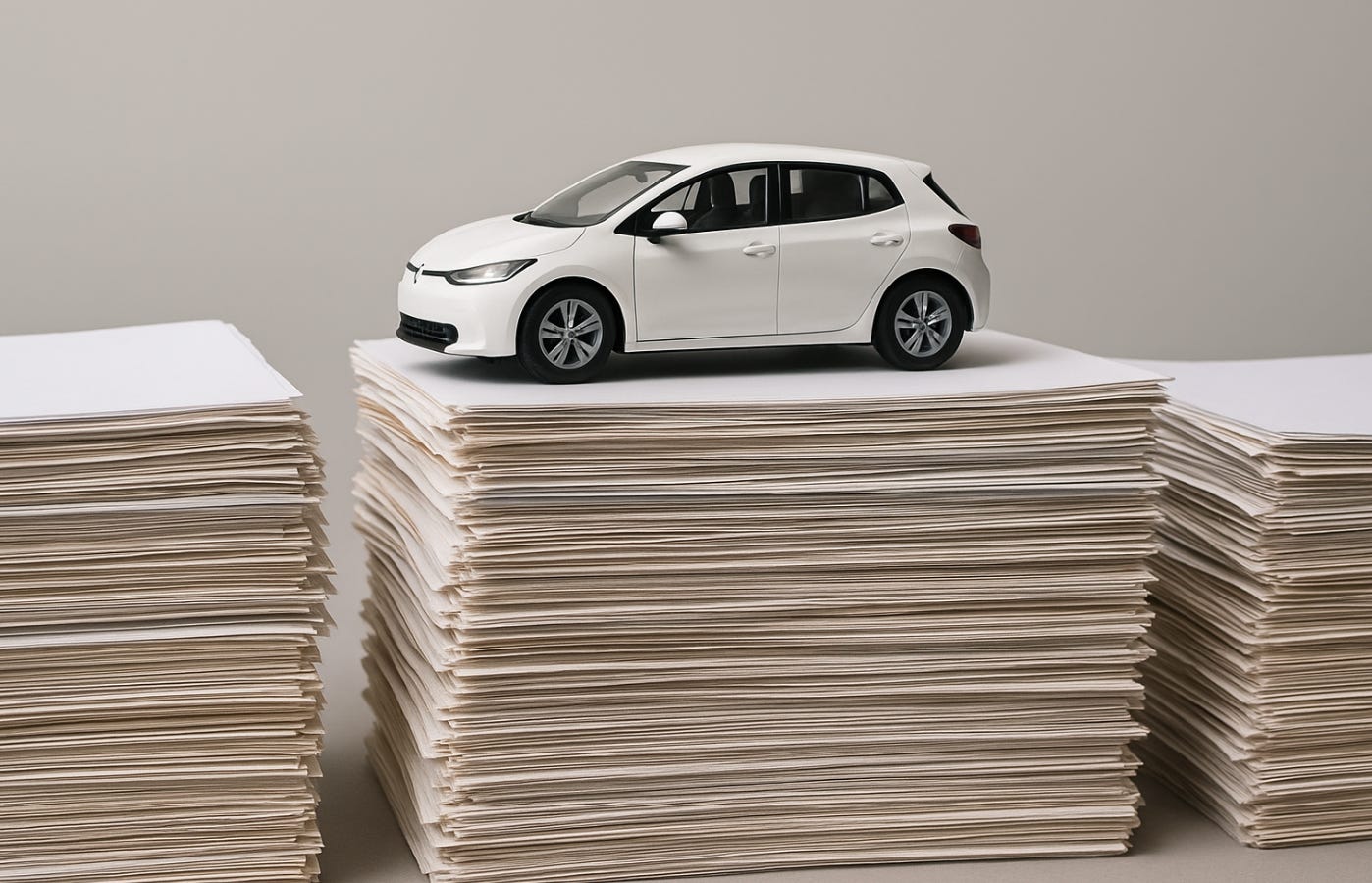
Detail: After a bit of to-and-froing, I received the submissions from BMW, Toyota, VW, Nissan, JLR, Stellantis, KIA, Hyundai, Volvo, Honda, SAIC (who own MG), SMMT, Motability, and ChargeUK.
To access the 165 pages... You will need to be a paid subscriber, as the link is at the end of this email behind a paywall*. For everyone, I have summarised the key themes across all the documents and then provided specific pullouts from each submission.
*Please, a polite warning: if you are not a paid user but want access, do contact me about signing up. I know this will come off OTT, but if I notice ‘paywall misuse’ (e.g. signing up, downloading the docs, then un-subbing), I will take action, which may include... a ban, outing you publicly, or taking legal action. I say this not to be aggressive, but because it takes me time, and you are effectively stealing from me.
A final note on these documents... You will note that Ford, Mercedes-Benz, and Tesla are not part of the list. That’s because they told DfT to refuse to disclose their submissions in my FOI request. This is despite the consultation page containing a prominent ‘your submission will be covered by FOI’. Hey ho, I have made a challenge and expect to hear back next week.
✍️ Summary of responses broken down by themes
Job Security and UK Competitiveness 🧑🏭
BMW, Toyota, Nissan, and JLR stressed risks to UK jobs and manufacturing if flexibilities weren’t extended or if penalties were too harsh.
JLR highlighted how credit trading subsidises Chinese OEMs and Tesla.
Nissan and Stellantis argued the UK needed to match France’s bonus écologique model - which seems to have happened with the new EV grant (which has now supported 7,000 EV purchases since launching, according to DfT).
Britain’s Public Charging Network 🔌
Nearly all carmakers criticise UK charging in some way.
BMW wants more than 300k chargers + hydrogen stations every 100km
JLR made thoughtful suggestions, saying it wanted mandates on petrol stations, accessible charge points, contactless on chargers below 8kW, and penalties for ICE cars blocking bays.
Volvo, Honda, Hyundai, Stellantis, VW, and Kia all called for binding targets for chargers.
Purchase Incentives 💸
Broad consensus that scrapping the plug-in car grant was a mistake.
There were calls for new grants, VAT cuts, reduced VED, or other schemes to stimulate demand.
Nissan, Stellantis, Toyota, Hyundai, and Honda all emphasised “immediate action” to boost retail demand.
Flexibilities and Penalties 🚓
Nissan, JLR, Volvo, and Toyota wanted the mandate flexibilities extended (ideally to 2030).
Toyota warned penalties could hit “hundreds of millions” per manufacturer.
JLR stressed that compliance costs could crush its EV transition.
Public Awareness and “Myth Busting” 📢
Most responses called for a government-led media campaign to shift sentiment.
⚡️ Key takeaways from each submission...
BMW
Warned the UK’s 80% EV target by 2030 was “incredibly stretching” and more radical than EU/California.
Said up to 50,000 jobs (including within its supply chain) were at risk.
Wants to see more than 300,000 chargers and a national hydrogen network - a hub every 100km on main roads.
Pushed for new purchase incentives and a government “myth-busting” campaign.
Dismissed moving the dates back to ‘2030’ suggesting the Labour government was only doing it for “politically symbolic” reasons.
Volkswagen
Argued the 2030 ICE ban risked keeping drivers in older cars.
Called for new grants, binding charger targets, exemption from Expensive Car Supplement, and a consumer awareness campaign from government.
Nissan
Urged ministers to amend the mandate “by the end of the financial year” to avoid carmakers having to subsidise rivals.
Said a lack of flexibility would have a “significant impact” on UK industry.
Highlighted France’s bonus écologique scheme as a model to copy, which now appears to have inspired the UK’s new grant.
Stellantis
Said boosting EV demand was “a matter of urgency.”
Wanted even mild hybrids to count until 2035.
Called for grants, VED reform, support for UK-made vehicles and binding charging targets.
Criticised company car tax breaks for being skewed to premium EVs.
Much like Nissan, Stellantis also floated the idea of following France’s ‘ecobonus’ scheme.
Toyota
Repeatedly used the phrase “carbon is the enemy.” A corporate social responsibility manager must have written it.
Highlighted Toyota had £2.75bn of UK investment and 11,000 direct employees.
Warned penalties could hit “hundreds of millions” per manufacturer without greater flexibility.
Asked for hybrids to remain post-2030 and for new incentives, including grants and a public awareness push.
Jaguar Land Rover
Backed the mandate in principle but argued Chinese OEMs and Tesla were unfairly advantaged by credit trading without amendment.
Demanded new mandates: chargers at petrol stations, wanted to see more accessible bays, contactless on 8kW (or below) chargers.
A very pro-EV suggestion that there should be penalties for ICE cars blocking chargers.
Pushed VAT cuts, new loans, a “Cycle to Work”-style scheme and a pro-BEV media campaign.
Floated the idea of “GB Super-credits” to promote UK manufacturing.
Warned compliance costs without flexibilities would put its EV plans under “immense pressure.”
Said armoured BEVs were “not technically feasible” and secured a government exemption. Story below…

Kia
Opposed mild hybrids being included.
Called for urgent VED reform and the return of grants.
Said Special Purpose Vehicles (e.g. Ambulances) and kit cars should meet the 2030 rules.
Took aim at small luxury brands, saying they couldn’t plead poverty on EVs while bankrolling Formula One. See my story below.

Hyundai
Called for “immediate action” to boost demand.
Proposed cutting VAT to 10% on EVs and 5% on charging, removing ECS, and launching a comms campaign.
Opposed transferring credits between vans and cars.
Volvo
Wanted only PHEVs permitted post-2030, with flexibilities extended.
Called for redirecting rapid funding, reducing planning red tape, three-year incentives and charger mandates.
Suggested mandating contactless on 8kW (or below) units - similar to JLR.
Honda
Said demand needed stimulating. They asked for the plug-in grant to return, VED reform, home charge point incentives, a social leasing scheme, and a government comms campaign.
Supported a charge point mandate, as outlined by SMMT
SAIC/MG
Most of its submission was very focussed on vans and didn’t seem to me, at least to be entirely thrilling.
Society of Motor Manufacturers and Traders (SMMT)
Framed the ZEV mandate as a threat to UK competitiveness, claiming jobs were already being lost and that the industry itself was “under threat.”
Warned that without changes, the rules risked deterring investment in Britain, especially against a backdrop of international subsidies.
Called for a comprehensive package of incentives: reintroducing the plug-in car grant, cutting or discounting VED, and introducing binding charging targets to guarantee a “right to charge.”
Backed hybrid and plug-in hybrid vehicles remaining on sale after 2030, saying consumers still needed choice and affordability.
Pushed the government to intervene more heavily to stimulate demand, rather than relying only on manufacturer investment.
Stressed that the UK’s targets were out of step with competitor markets, and that flexibility and financial support were essential to protect factories and supply chains.
ChargeUK
Rejected carmakers’ call for more flexibility and also a charge point mandate, arguing the market was already scaling with private investment and needed stability.
Said the real blockers were planning delays, grid costs, and local authority processes.
Supported VAT reform on charging and proportionate rules on payments, but warned heavy-handed regulation could slow rollout.
Motability (response combined both Operations and the Foundation)
Warned that half of its customers could not charge at home and needed reliable, accessible public infrastructure that could support this, such as cross-pavement and shared community charging.
Called for mandatory accessibility standards (PAS 1899) across the UK’s charging network.
Urged exemptions for wheelchair-accessible vehicles, and pushed for reforms to the grant scheme and support for affordable hybrids post-2030.
Highlighted falling used EV values and called for new incentives, including VAT cuts and scrappage schemes.
Ford Motor Company
I would describe Ford’s submission as feisty; a borderline ultimatum to the government, asking them to boost EV demand or adjust the ZEV trajectory. Ford warned that they and the industry couldn’t keep absorbing the cost of the transition, suggesting it was “wholly unsustainable,” and said modest tweaks to flexibilities would not be enough. Ford wanted many more flexibilities, including a pause on penalties and even suggested that, after 2030, the UK should remove the targets in the years up to 2035.
Ford wrote: “Micromanaging the final remaining percentages of new sales creates further complexity in an already complex scheme and removes the ability of OEMs to manage the final years of technology transition most efficiently.”
Mercedes-Benz
They took a stance that was quite like other carmakers and clearly was closely aligned to SMMT’s submission. They urged the government not to tighten the ZEV mandate any further. More interestingly, though, Mercedes called for stronger demand-side incentives, especially around EV charging. Like many OEMs, they called for a mandate on the number of public charge points. However, on public charging costs, alongside calling for a cut on VAT for public charging to 5%, Merc even suggested capping prices at chargers. Big move.
Tesla
Despite what Elon Musk, CEO of Tesla and former advisor to President Trump, likes to say about the UK’s Labour government, yet again, those public views clearly are not the views shared by Tesla. Their submission to the Department for Transport begins by praising the UK for showing “global leadership in legislating for the end of the sale of new internal combustion engine vehicles by 2030.”
Clearly, the submissions indicate Tesla was not happy with the ZEV mandate as it was set previously, and argued that the government should “not take any steps to undermine these conditions through the introduction of further compliance flexibilities which already allowed manufacturers to sell 47,641 fewer vehicles than mandated in 2024.” In their consultation response, they wrote explicitly that, “The creation of new flexibilities, or extension of the deadline applied to the existing flexibilities, will suppress battery electric vehicle (BEV) supply, carry a significant emissions impact and risk the UK missing its Carbon Budgets.” Tesla believes the flexibilities already gave enough leeway to carmakers, which is something think tanks such as Transport & Environment and New AutoMotive have also argued previously.
What’s most interesting about Tesla’s response, especially given my top story today about their hidden company, is that in the document, you’ll see some four pages entirely redacted. All apart from one sub header titled... “Support for the used car market”. This was in response to a question about incentives for consideration. When asked by The Guardian about their submission and if they asked for a grant, Tesla did not comment. The only clues we have are the footnotes containing links to information that was cited in Tesa’s response. One of them was a link to the BVRLA’s ‘Happy EV After’ page, a campaign that called for grants and schemes to support the purchasing of second hand EVs. Again, to me, this reinforces the huge concerns Tesla has for the UK market.
👉 Here is a link to all the documents I received.
If you have any trouble accessing this file or its contents, please do drop me a note. Or try this link instead.
By Tom Riley | Add me on LinkedIn | Get in touch