

Hello, I’m Tom Riley, and welcome to the first Fast Charge newsletter of 2026.
I trust you all had a terrific festive period and are ready for whatever 2026 throws up. By the looks of things, it could be the most critical year yet for the EV industry.
Top story in today’s edition... I reveal the slow progress being made by the Government Car Service to go electric, with a fresh comparison to figures from 5 years ago.
Elsewhere... Car registration figures, chargepoint installations, new research suggesting chilly weather cools EV demand, and BYD hires former Gridserve manager to deploy its new ‘Flash Charging’ network.
And last, but certainly not least, I’m pleased to share that I’m joining the new Global Women in EV Day campaign as a founding partner – including details of how you can get involved too.
As ever, if you have any comments or feedback, please reply to this email or message me on LinkedIn.
👀 Revealed: Ministerial fleet’s slow progress to go electric
Summary: Just as we broke up for the festive period, I received an early Christmas gift from the Cabinet Office – a Freedom of Information response all about the Government Car Service. Aka, the fleet that exists to ferry around ministers.
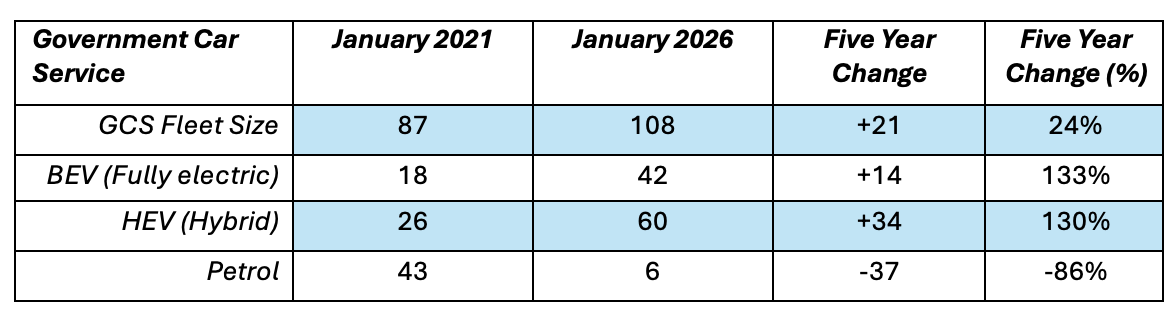
The headline? The size of the ministerial fleet is now 108. It’s got 88 drivers on the payroll. And, out of those 108, only 42 are fully electric, 60 are hybrids, and six are purely petrol-powered. Here’s my observations...
To me... The size of that fleet seems enormous. By law, the UK Government can only have up to 109 paid ministerial roles across the board. Under Kier Starmer’s government, it’s believed there are around 120 ministers, as some are unpaid. That still means, as there are only 24 ministerial departments, that each Secretary of State could have almost 5 cars in the garage. Wowsers.
Likewise... 88 drivers, that is huge! I appreciate that we don’t want our ministers turning up to events in an Uber, but 88 does feel quite large. That’s bigger than most companies.
More importantly... I was quite surprised to discover that, despite the government having a deadline of 2027 for a fully electric fleet, the fact that, with 12 months to go, the ministerial cars are still largely petrol-powered feels misaligned with their rhetoric. Yes, of course, as I’ve reported before, we do not want to have a situation where our ministers can be blown to smithereens. However, as I said to The Times, which kindly covered these statistics over New Year, you do have to practise what you preach!
For comparison... Back in January 2021, I made the same request about the GCS fleet. In one of my first scoops for this newsletter, I found that only 2 in 10 cars (18 out of 87) were fully electric. So, despite having had five years, the Government Car Service doesn’t seem to have made much progress at all, adding only 14 more BEVs.
My bet is the GCS will be allowed to miss that deadline, although I hope to be proved wrong.
Finally, on this story... The Cabinet Office refused to tell me which makes and models of EVs they kept in their fleet. They cited national security as the reason not to disclose. However, having gone through Hansard, it seems the Department for Transport and the Scotland Office didn’t get that memo. In October 2024, both departments revealed they had been allocated a Jaguar I-Pace. Doh! Furthermore, in 2020, the then Conservative Government revealed to Parliament a full list of car models they’d procured which, from an EV perspective, included the Nissan Leaf alongside the i-Pace. Woops!
🚨 I am supporting Global Women in EV Day on 10 February
Summary: I’m really pleased to share that The Fast Charge is joining Global Women in EV Day, a new campaign to elevate the women driving the global transition to electric mobility, as a Founding Partner.
Why now... I have been covering the EV sector each week for more than five years now, and while I’ve seen more female voices in this industry – which is terrific – the truth is, the automotive and energy sectors can still be very male-dominated. There are lots of existing projects to raise the profile of women in these industries, though with Gill Nowell at the helm of this campaign, probably one of the UK’s earliest EV advocates, I’m excited for what this initiative can achieve.
The facts also remain stark... According to the IEA, wages for women in energy businesses are 15-20% lower than their male equivalents. Likewise, consistent studies have found that women feel under-represented in leadership roles across the automotive industry. One Deloitte report from 2020 found that this was felt by 90% of women surveyed.
I cannot give out any jobs. However, as a publisher, I can work harder to champion women’s voices. So, my pledge for the launch of this campaign is simple: I am going to increase the number of female EV industry voices quoted and featured in this newsletter. I’ll also be plugging this campaign in the run-up to its launch on the 10th of February.
Want to get involved? If you or your organisation is interested to learn more or would like to become a Founding Partner, you can drop Gill a message on LinkedIn. Or, why not sign up for the launch event in London (here).
⚡️ Latest EV news...
🔋 A company called Donut Lab has unveiled the world’s first manufacturer ready solid-state battery. The battery, which has been designed to power EVs, can be charged in five minutes, is much lighter, denser, and most importantly, can deliver a huge amount more range. It’s been suggested by Donut Lab at the CES conference that 200 automotive OEMs are talking to them about the tech. If it is a good as they claim, it would be an understatement to say this will be a game-changer for EVs. Watch their video. Obviously, proof is in the pudding.
🔌 Over the festive period, there were several stories highlighting how the number of EV chargers being installed has slowed year-on-year. The reports conclude the total chargers will likely be short of the government’s own estimate of 300,000 by 2030, and certainly will miss the 555,000 that the National Audit Office believes are needed by that point. Read more (paywall). Vicky Read, CEO of ChargeUK, responded to these stories on LinkedIn: “The network’s still growing; plenty more charge points are waiting to be deployed; misinterpreting this data as a sign that the UK needs to change its approach to EVs, is the opposite of what is needed. To deliver more of the right chargers in the right place we need stable policy, reduced energy costs and speedier grid connections.”
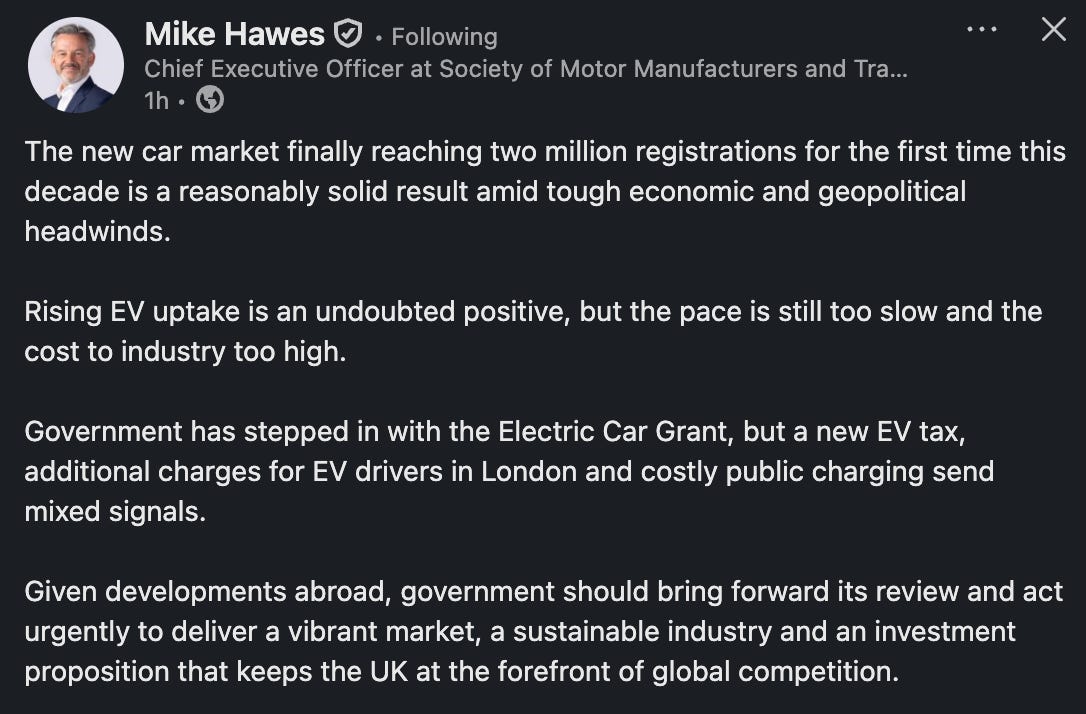
🚗 In better news, the latest car registration data from New AutoMotive and SMMT has revealed EVs took 23.4% of the new car market in 2025. Or, to put it in real terms, 473,348 new EVs were on the road last year. Even SMMT’s CEO, Mike Hawes, had to acknowledge it was “positive”. Though, as I think everyone expected, he also suggested this surge was largely due to manufacturing discounting, and also suggested that the UK should follow other countries that have reviewed their own ZEV mandates. This sentiment has been echoed by some carmakers (*cough* Ford) as well as the National Franchised Dealers Association (see here), who wrote to DfT asking for an early review. Ben Nelmes, from New AutoMotive, argued that the 2025 figures showed the UK’s transition was a “success”, saying it was “the result of pragmatic policy that rewards carmakers for the billions they are investing in delivering EVs that British motorists increasingly want.” Meanwhile, Vicky Read simply labelled SMMT’s call for a review “highly misguided”. Vicky Edmonds, CEO of EVA England, commented: “It is crucial now that we build on this progress and ensure all drivers are properly supported to make the switch. This can be done by expanding reliable, affordable and accessible charging, supporting the used EV market, and ensuring incentives reach everyday drivers.” New AutoMotive’s bulletin here.
📉 Talking of carmakers rowing back, Rolls-Royce has told Bloomberg that it has seen low demand for its Spectre EV in 2025, despite a strong start in 2024. Read here (paywall).
🤔 On a more positive note, there was an upbeat interview with Polestar CEO, Michael Lohscheller, in The Sunday Times, in which he talks up the brand’s opportunity in the UK. However, as much as I really rate Polestar, their accounts don’t lie, and they look in a very sketchy position – and clearly lots of analysts as well. Read more (paywall).
👊 Also, from New AutoMotive... according to their analysis, EVs will overtake diesels on Great Britain’s roads by 2030. And, apparently, London will be the first UK city to be diesel free – largely due to the robust emission rules (and generally tougher car rules) that London now enforces. Read more.
☹️ Speaking of London, the congestion charge came into effect for EVs at the start of this year. The only saving grace is that EVs are eligible for a 25% discount if registered for Auto Pay, reducing the fee to £13.50 a day. Still huge. Read more.
🌨️ Topical given the snow... new research from the Motability Scheme’s EV Transition Tracker revealed that around three in ten (29%) drivers believe electric car range drops in the winter, while a quarter (25%) believe cold weather slows charging speeds. Read more.
👩🦼➡️On a same-same but different note... DfT has launched a new consultation seeking views on changing the rules for using powered mobility devices, including powered wheelchairs and mobility scooters, on public roads and pavements. Find it here.
💷 Speaking of DfT, big grant news to kick off the year, they are boosting grant funding for fleets adopting electric trucks. Operators looking to purchase the biggest electric HGVs could access discounts of up to £120,000. Blimey O’Riley! Read more.
👍 A huge 14 retail parks belonging to Columbia Threadneedle Real Estate are due to get EV chargers supplied by BP Pulse in a new deal. Read more.
⚡️ Talking of EV networks, we heard last year that BYD would be bringing forward its own charging network. Well, Mark Stubbs, previously a senior manager at Gridserve, announced his appointment to the role of BYD’s Flash Charging deployment manager for the UK this week. That suggests 1000+ kW hubs could be close on the horizon!
👉 Wigan Council has partnered with Trojan Home, meaning residents who park on-street can now connect directly to their own home energy supply with their own pavement plug. Read more.
🐴 Finally, I leave you with news from the Shetland Islands that one EV owner has been prevented from using a local charger because of a council-owned car blocking it. The situation has gotten so bad that the impacted driver told the Shetland Times he may have no other choice but to return to petrol. It’s all the drama, Mick, I love it. Read more.