

Hello, I’m Tom Riley, and welcome back to The Fast Charge, a British EV newsletter.
Top story in today’s email… The Transport Secretary failed to declare five meetings with carmakers about the ZEV mandate, as OEMs racked up more than thirty discussions with officials and ministers during January to March.
Elsewhere… MG makes a copy of the Renault 5, EV sales soar, and Grimsby’s council planners choose to keep it grim.
As always, if you have any comments or feedback, please reply to this email or message me on LinkedIn.
Carmakers dominate meetings with the Department for Transport
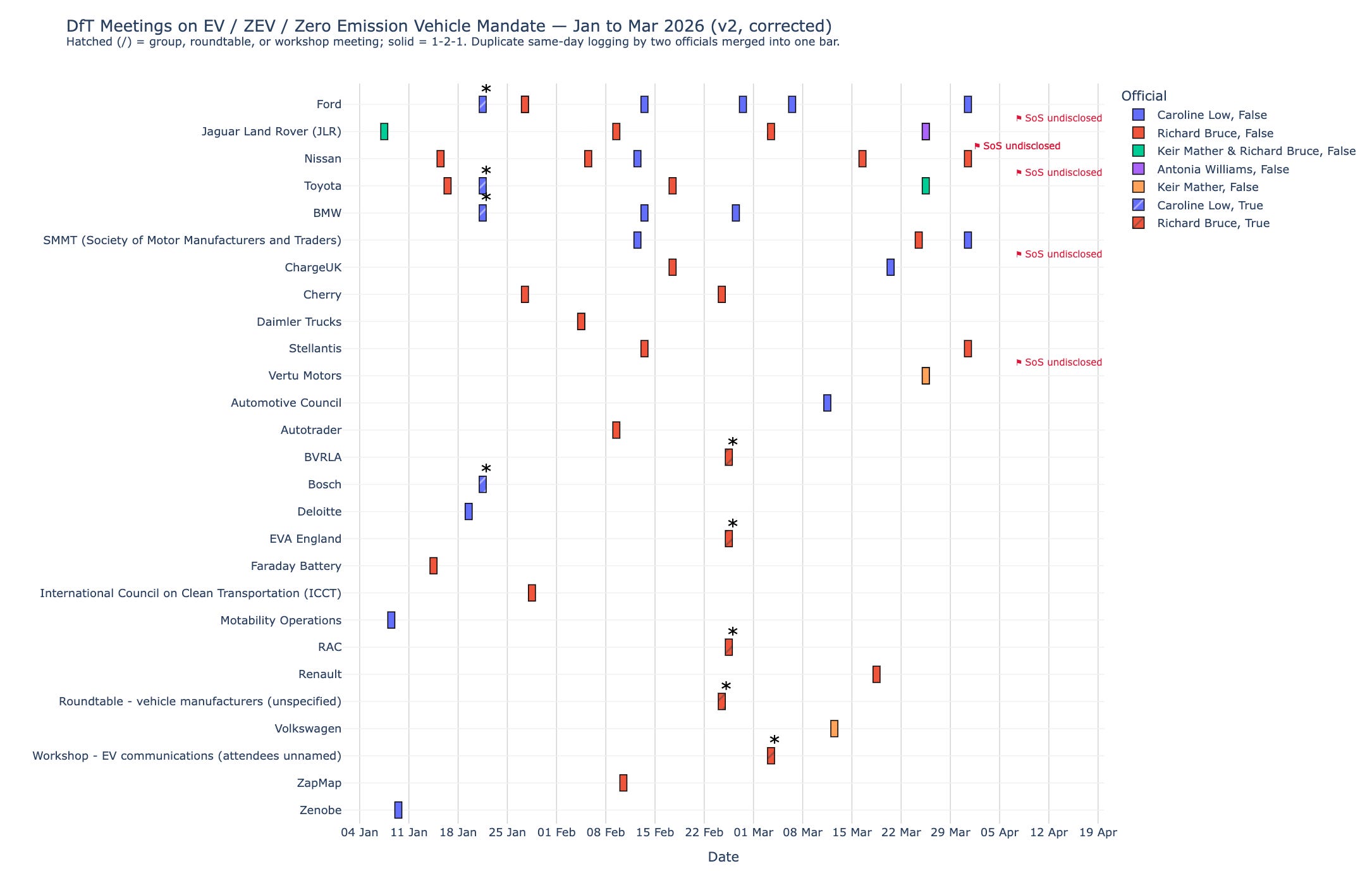
Summary: Carmakers met with senior officials and ministers 31 times between January and March 2026 to discuss EV policy, according to an analysis of recently released transparency documents from the Department for Transport.
By comparison… There were only two meetings where DfT met with bodies representing drivers, and only two with those representing EV charging.
As the chart below shows… Carmakers dominated meetings with officials at the start of this year, with Ford alone getting six sessions, including one with the Transport Secretary. During this quarter, the Society of Motor Manufacturers and Traders hosted its Electrified conference. At that event, SMMT, alongside its members, called for a review of the ZEV mandate. This was despite DfT publishing an analysis on the same day showing that the mandate had been met during 2024.
👉 There are a few interesting outtakes from these new documents, so here’s my top three…
1) Transport Secretary failed to declare meetings with carmakers
Heidi Alexander, the Transport Secretary, attended five meetings with carmakers in late March. One meeting is understood to have been with Jaguar Land Rover on 25 March, while four others were with Ford, Nissan, Stellantis, and SMMT on 31 March.
However… none of these meetings have been declared in her transparency log. Under the Ministerial Code, ministers are required to disclose external meetings. I was only able to figure out she attended by analysing a long list of meetings attended by senior DfT officials over the same period, which includes short notes against several entries mentioning the Secretary of State.
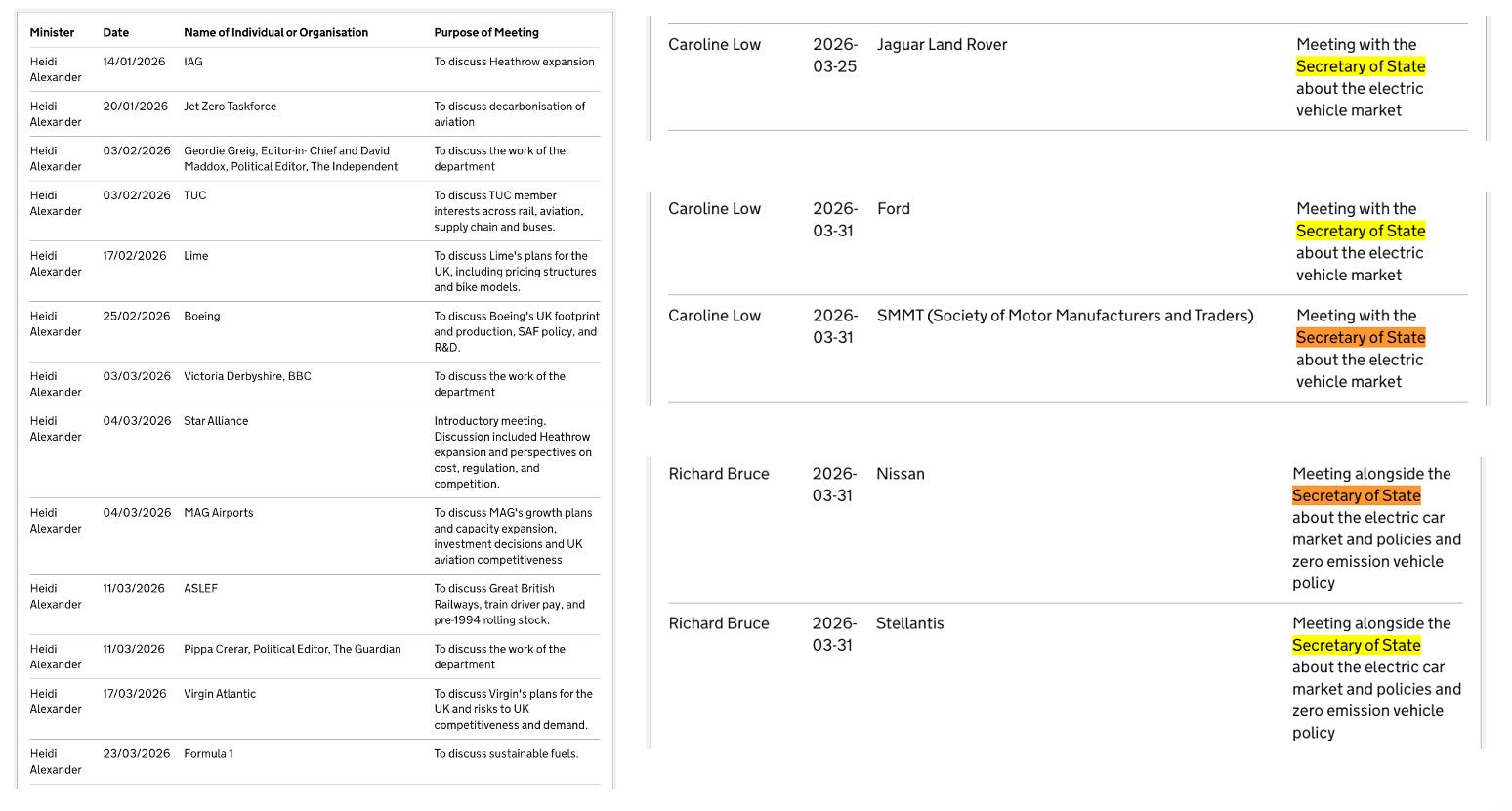
On Tuesday… I approached DfT about this, and a spokesperson confirmed that Alexander did attend the meetings and claimed the omission from the record was an ‘administrative oversight’ which would be corrected on GOV.UK. Two days have now passed since that response, but the public page remains uncorrected. Until it’s updated, one assumes the Transport Secretary is in breach of the Ministerial Code? More importantly, though, how did these clearly critical meetings not get included in the first instance?
2) Did Toyota lean on the business department?
According to the filings, Toyota attended four meetings with DfT between January and March. All of them were focused on the ZEV mandate, and one in March – after the SMMT event – was attended by the EV Minister, Keir Mather.
Here’s what’s interesting… I checked the transparency documents for the Department for Business and Trade (DBT), covering the same period, and I found Toyota also had a meeting with David Bickerton about the ZEV mandate in January. Bickerton is the Chief Strategic Business Adviser at DBT, and according to his submitted notes, the meeting was a “Discussion on ZEV Mandate issues in relation to Toyota.”

Most notes typically do not provide this level of colour. The meeting happened only one day after Toyota had a joint discussion with DfT alongside BMW, Ford, and Bosch about the mandate. And it was only four days since Toyota had a one-to-one with Richard Bruce, the co-head of the Office for Zero Emission Vehicles.
So why did Toyota meet with Bickerton? Why did they need to raise issues with a senior official at DBT about a policy that sits outside its remit? Is Toyota concerned about UK jobs and investment, as it has threatened to pull in response to previous ZEV mandate consultations? Hopefully, we’ll know soon. I have submitted a request for the meeting notes.
3) Vertu Motors got to meet the minister
Readers may recall my post a couple of weeks ago titled ‘Who Killed the ZEV mandate’. Within that story, I revealed that the car dealer Vertu Motors had been running a highly active campaign through its network to lobby MPs and Ministers.
It seems the campaign worked. As in late March, Minister Mather declared a 1-2-1 meeting with the company, which presumably was with Vertu’s boss, Robert Forrester, to discuss the EV transition and government support for the automotive sector. On the same day (25 March), Caroline Low, the other co-head of OZEV, also had a meeting with Vertu. I assume it was the same one that Mather attended.
Meanwhile… Groups representing real drivers barely get a look-in. According to the documents, EVA England has not had a 1-2-1 with senior officials or ministers. I find it quite disturbing that the department responsible for introducing the greatest change to drivers in a century is never engaging with them.
I put this to DfT, and they defended their engagement approach by saying:
“Manufacturers play a key role in the EV transition, so it is crucial to engage with them alongside a wide range of stakeholders including chargepoint operators, consumer organisations, and environmental groups. Our most recent consultation received 605 responses from industry and the public, all of which were taken into account when shaping the ZEV Mandate.”
*FYI, that consultation was over a year ago.
Clearly… I am not alone in believing the EV driver is missing out. A new report by consumer group Which? published this week has also called for a driver-centric approach. It is critical as the transition goes from one that mostly serves driveway owners to one that will see a great mix of driver types. Read their report here.
Quick EV news…
📈 EV sales are continuing to soar. In June, registrations of EVs made up 30% of all registrations. That’s 64,000 cars and clearly demonstrates high demand. Read more. Even electric van sales were up by 23.2% last month. Albeit, van electrification still has some way to go. Read more.
☎️ Speaking of fleets, Openreach has partnered with the charging network Source to help power its 7,000 EVs. Read more.
🚙 Bentley’s first electric car is going to be an SUV called the Torcal. The name derives from a famous Spanish limestone rock, which hopefully isn’t a suggestion that it’ll erode. According to Autocar, the name also links to the word ‘torque’. Read more.
🚗 Today, MG has launched a new concept EV called ‘GO!’. The hatchback will be launched in 2027. The carmaker has said the design is a nod to the MGB GT. However, I think it’s plain to see that this is the ‘Temu’ Renault 5.

⚡️ Two bits of Ionity news. Firstly, in a survey of British drivers it commissioned, the charging network found 94% of EV owners plan to take at least one long-distance journey this summer, with one in five planning to venture beyond the UK. Read here. Secondly, Ionity is offering drivers a 5kWh credit this Summer if they stop their charge at 80%. It’s called the ‘Fast Lane Reward’ and is part of moving EVs through their hubs quickly during peak hours. Read more. I wonder if other CPOs will follow.
☹️ Going from high utilisation to very low… An EV charger in Scotland operated by Connekt has apparently only been used once in six months, earning just £1.46 for the Oakbank Community Inn, which got it installed. Read more.
🔌 The Guardian reports that EV charging deployment has been slowing down. According to data from Zapmap, only 5,100 chargers have been added so far this year, which is only a 10% increase compared to last year. In 2024, the growth was 40%. The thought is that networks are increasingly focused on ultra-rapid chargers, which continue to see high growth. Likewise, we are still only just seeing LEVI projects in lots of areas get going, so one assumes the number will jump up again soon. Read more.
🤨 Speaking of installing chargers, local planners in Grimsby have refused permission to tear down a building near the town centre to make way for a 20 bay EV hub. The reason given is that it would mean the “loss of a non-designated heritage asset considered to be of local significance and value”. I have copied an image of said building below. Are they blind or stupid? Or both?

🔋 A Wall Street Journal story went viral this week and was featured as a top story on LinkedIn. Its title… EV Batteries Are Defying Expectations After Hundreds of Thousands of Miles. The story begins with a feature on a British used EV dealer. Great stuff! Read here (paywall).
💷 An interesting story on the BBC today about insuring EVs. It very much chimes with what I often hear, which is that if an EV is only involved in the tiniest of tiny scrapes, it can result in a write-off. Which is mad. Read more.
♿️ Finally… To demonstrate how unsuited Europe’s EV charging network is for disabled people, the group Disabled Motoring UK conducted a road trip from Britain to Spain. They covered 3,000 miles and stopped to recharge 24 times. The conclusion was that no charging network was fully catering to accessibility needs. Read more.