

Hello, I’m Tom Riley, and welcome back to The Fast Charge, a British EV newsletter.
I think we all know what the top story is this week… To quote Malcom Tucker in The Thick of It… “Our f**k-lustrious PM has opened Pandora’s f**king Box, and curled a massive steamer right into it!”
Elsewhere… Autotrader data reveals a gender gap, Fastned opens the first of 25 London charging hubs, and BYD goes on a United States naughty list.
Before we get to that, a quick note on my story last week about Octopus Electric Vehicles raising new cash and lobbying. Since publishing, Octopus Energy has told me it does meet the Ofgem capital requirements. I am always happy to correct the record. And, as such, I have also lifted the story’s paywall. Read it here:

As always, if you have any comments or feedback, please reply to this email or message me on LinkedIn. I am at MOVE today – so drop me an email if you are around!
Who stabbed Caesar the ZEV mandate?
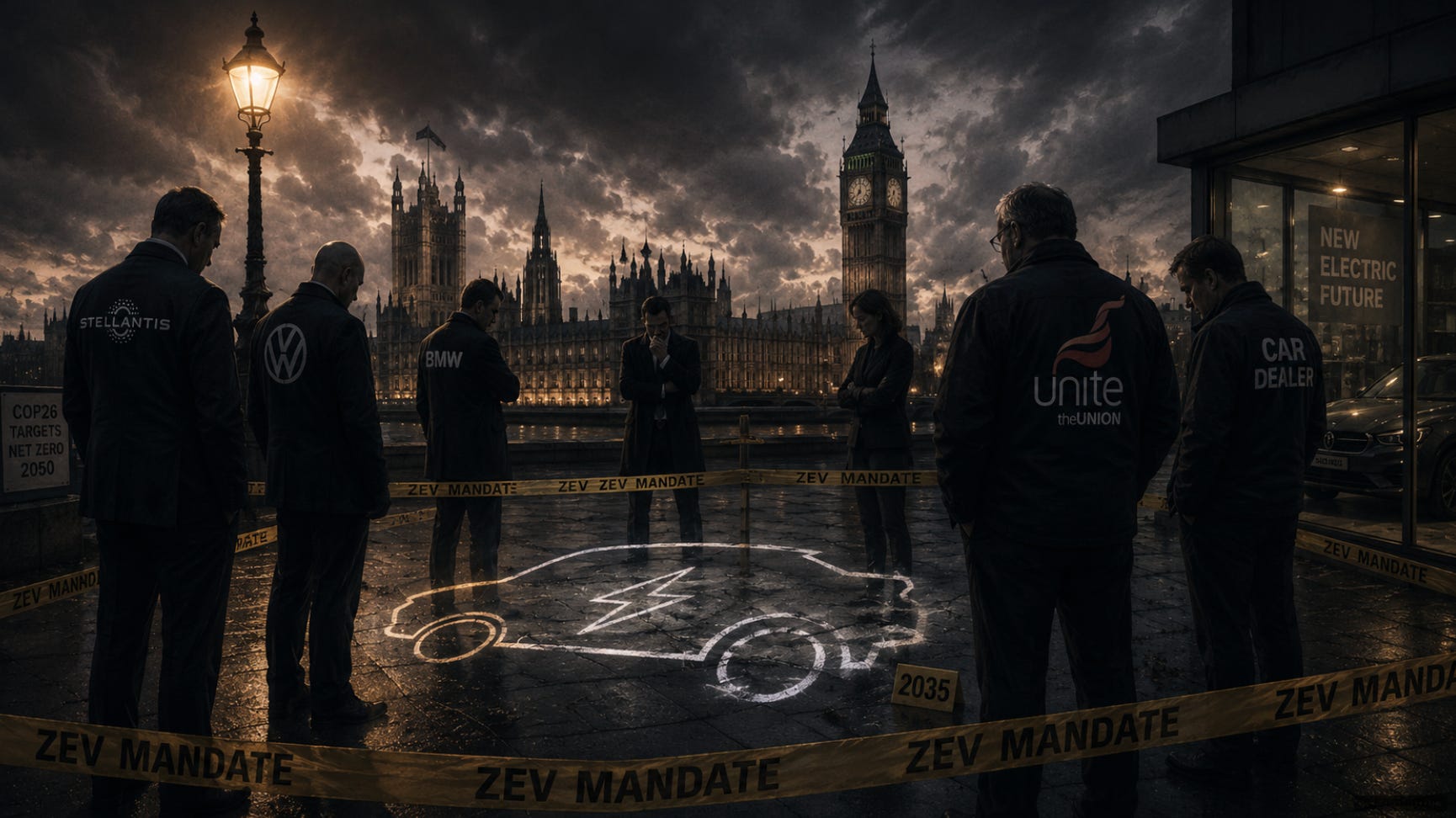
Summary: There has been great upset across the EV industry this week as the Sunday Times revealed the Zero Emission Vehicle mandate is set to be watered down. Based on the reports, it’s thought that soon the government will launch a fresh consultation on the deadline and associated trajectories. It’s expected to mean that, rather than 80% of sales being fully electric by 2030, it may be cut to as low as 50%. Despite my headline, the mandate won’t be entirely killed, as the other 50% of cars will have to be hybrid. Read more.
The briefings to the press have been branded a ‘blatant lie’ by EV leaders. This is because nearly all coverage has suggested new EV registrations are nowhere near the 33% required under the ZEV mandate projections this year. However, as pointed out by Osprey Charging’s CEO, Ian Johnston, on LinkedIn, due to the existing flexibilities that carmakers have, the real mandate is only around 24.6%, based on analysis by New AutoMotive. In the year-to-date, the EV registration rate sits at around 23.7% - and that’s with half a year left to go.
Why make this change? Ministers and MPs have been under sustained pressure from carmakers about softening the mandate for months. Only in March, the Society of Motor Manufacturers and Traders published their own analysis suggesting there was a big gap between the government's ambition and consumer reality. At the time, I wrote how SMMT were clearly capitalising on unstable politics. It’s perhaps no surprise that, on the week which could split apart Sir Keir Starmer’s premiership, Downing Street has seemingly blinked.

But SMMT has not been alone in conspiring against Caesar the Mandate… Compared to previous times the policy has come up over the past year; this time, the trade union Unite has been especially vocal. Last Thursday, Unite called on the government to reduce the percentages of the ZEV mandate, labelling the targets as ‘ridiculous’.
Interestingly… Unite has close ties to Andy Burnham, who could be making a challenge for the Labour leadership should he win the Makerfield by-election this week. Likewise, Burnham’s “political lead” is the MP Anneliese Midgley. She previously worked as the political director at Unite.
Following The Sunday Times story… Unite published a statement branding the mooted changes as “a huge victory”. I contacted Unite about this and asked if they had anything to say to the 12,000 workers already working in the EV sector who, as a result of Unite’s demands for ZEV mandate changes, may now be fearful of losing their jobs. In response, a Unite spokesperson avoided addressing the EV job risks, instead telling The Fast Charge:
“Unite supports a just transition, however the ZEV mandate was unjust and flawed and put thousands of workers’ jobs at risk. Should the expected changes to the ZEV mandate go through, this will allow for a fairer, more thought through transition where electric cars will still be made and workers will be employed to make them and maintain the infrastructure they require, while also avoiding large scale job losses across the sector.”
It’s a strange world when a trade union does the dirty work of multinational businesses. But there is one other suspect in the line-up…
There has been a sustained campaign from car dealers too. The main driving force, I understand, has been Vertu Motors chief executive Robert Forrester, who welcomed the review and has written repeatedly to ministers about it. His campaign was run by Darlington-based agency Recognition PR, whose founder Graham Robb this week boasted of supporting Forrester and others to persuade the government of the merits of staying in line with the rest of the developed world. Having spoken to Recognition PR, I understand they helped Forrester’s campaign, including creating a briefing for use by Vertu dealers to write to dozens of MPs about taking action.
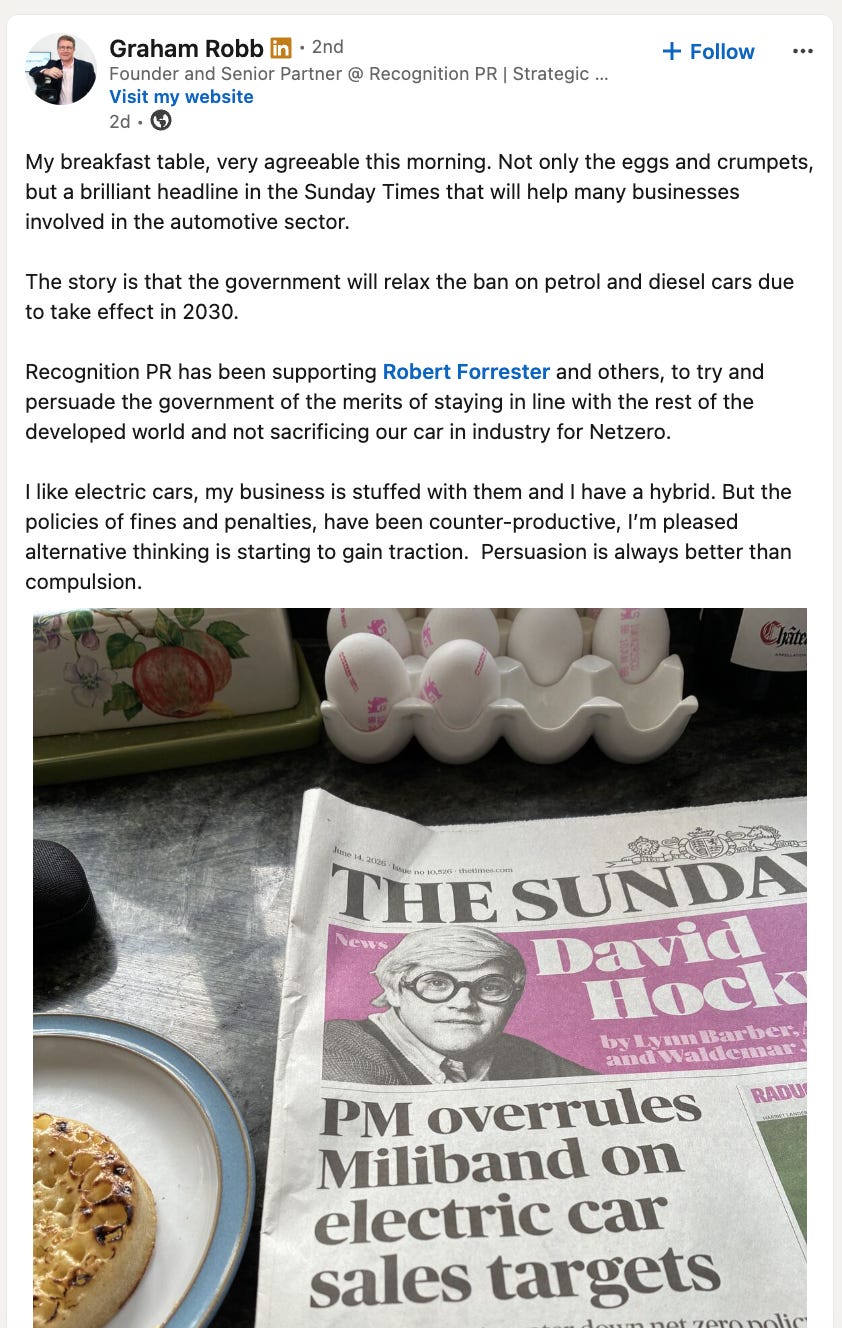
Et tu, Miliband? In normal times, one suspects the Prime Minister would not have buckled under this pressure, due to the closeness of the relationship he had with Energy Secretary Ed Miliband. However, that’s understood not to exist anymore, since the latter is known to be supporting Burnham in a leadership challenge. The Times reports today that Miliband is now actually ‘ghosting’ the PM, which underlines how dire the relationship has become.
Clearly… this potent combination of carmaker lobbying, trade union criticism, and a leadership challenge has caused Starmer’s team to blink.
A popular change may help the PM in the short term… But based on the strength of response I’ve seen, I’m unsure how forgiving EV leaders and investors will be in the long-term. One imagines this change in approach will not just impact Labour’s EV credibility, but its whole clean energy mission, which was core to its manifesto. And for it to happen as British consumers have been seeking out more affordable ways to lower their living costs - such as via EV ownership - it certainly seems shortsighted.
But was the death of the mandate inevitable?
While it’s a tragedy to see Labour create this instability… Everyone in the sector that I have spoken to, over the past six months, is highly aware that a change was coming down the tracks before 2030 anyway. Not only is there an existing ZEV mandate review baked into the existing law. But boardrooms also are unable to ignore that Reform UK is still polling high. And, so far, the party has been successfully translating its popularity into seats (locally at least). Given that one of their national policies is to remove the ZEV mandate entirely, all businesses should be operating on the assumption it could eventually change – either by Reform itself or by a Labour Party trying to shore up its votes.
The question for right now is this… As an industry, do you accept there will be changes and try to shape the ZEV mandate to be Reform-proof? Or do you fight these mooted changes before a consultation even starts?
I do not envy the situation EV businesses have been put in. Both options are bleak and tiresome. The only insight I’d remind people of is that what is coming through from these changes is that politics is clearly, across left and right, shifting back to pleasing that mythical ‘red wall’ voter of 2019. These voters do not like being told what to do, how to think, or how to act.
For climate-related businesses, they are a conundrum. They are households most likely to dislike net zero, yet also the ones most likely to benefit from the energy transition through lower running costs. One idea I’ve heard discussed quite a bit at events lately is whether it’s time for EVs to be separated out from the wider net zero agenda. We always wanted them to one day just be ‘cars’. Maybe that narrative tweak needs to start now?
FYI, my current understanding is a fresh ZEV mandate consultation will be forthcoming this Summer.
Latest EV news…
🔋 Agratas, the Tata Group company building a gigafactory in Somerset, has announced it’s parted ways with its previous builders in a “mutual agreement”. Agratas has said it needs a “different construction delivery model to support the next phase” and to ensure it remains on track for opening in 2027. Read more.
🇨🇳 Over the pond… the US Government has recently added BYD to its list of companies that it believes work with the Chinese military. Read more. Will China retaliate against Tesla?
👀 Research by Autotrader has found 17% of women believe their lack of knowledge about EVs is stopping them from buying one. It’s only 8% for men. Read more (paywall).
🏆 Talking of Autotrader, last week the company named the Renault 5 ‘Car of the Year’ as part of a survey with 160,000 drivers. I was at the ceremony where Tesla seemed to scoop more awards than any other brand - it seems their drivers still love them. Read more.
👋 Changes have been underway at the operator Fuuse, with founder Michael Gibson stepping back and Roger Hunter, formerly of the Shell e-mobility parish, stepping in as the new CEO. Read more.
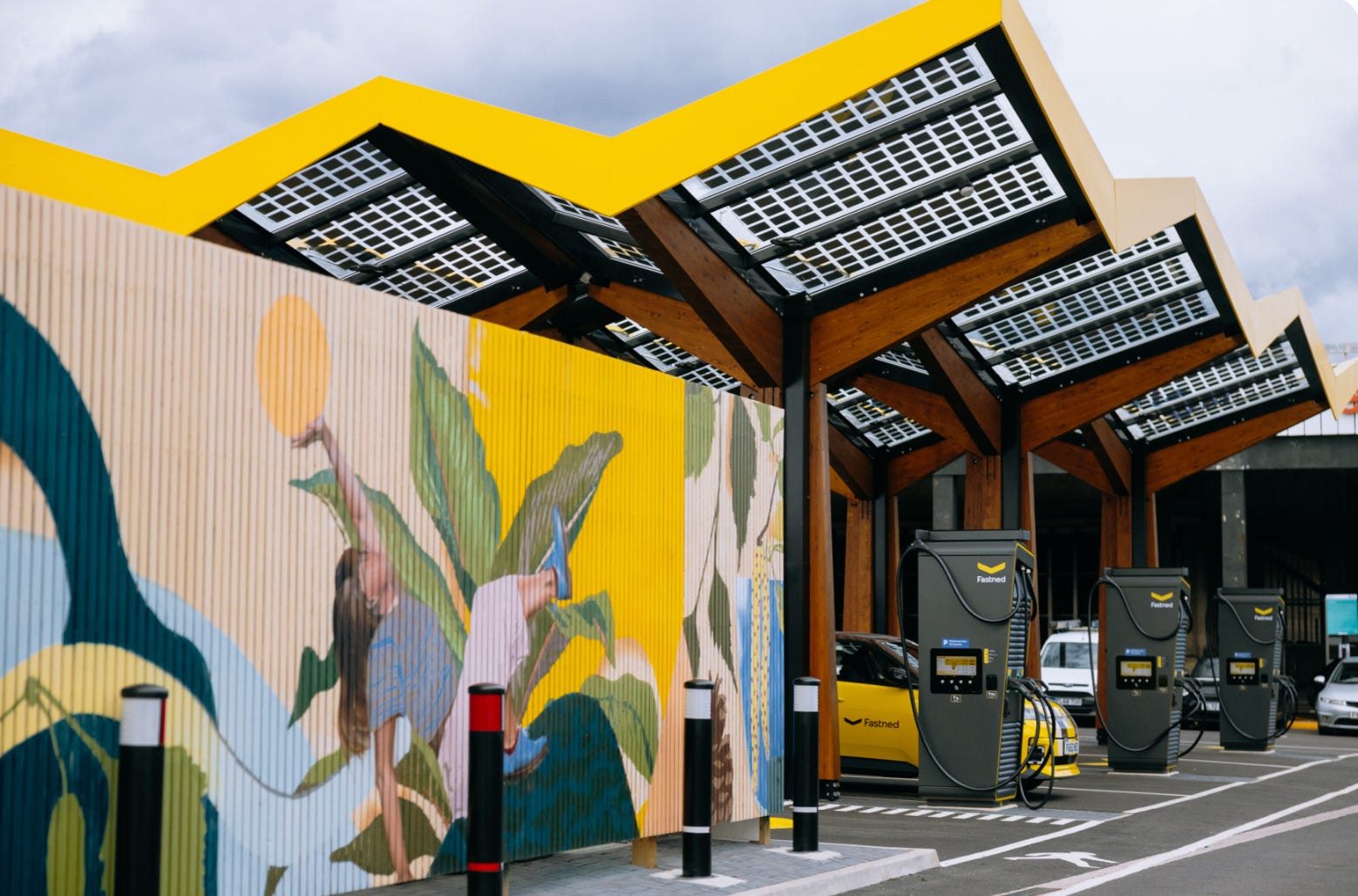
⚡️ Last week, I was pleased to attend the launch of Fastned and TfL’s first joint EV charging hub at Hatton Cross near Heathrow. This hub is the first of 25 planned across London. And if the other 24 are like the one I saw, Londoners are in for a treat. Read more. TikTok video to follow.
🔌 The EV charging network Urban Fox has won a LEVI contract with Hertfordshire County Council to install 1,200 EV chargers. Read more.
👍 It has been reported that Enfield Council is going to accelerate the installation of 1,000 Char.gy lamppost chargers. Read more.
📞 A UK start-up called Enera, which uses AI to monitor calls to EV charging networks and offers an agent service that can solve queries, has just raised $2m. Looks pretty neat. Read more.
🏛️ The Association of Directors of Environment, Economy, Planning and Transport (ADEPT) – what a mouthful(!) – has called on the government to get local authorities to deliver consistent EV charging through national direction. Read more.
✌️ I leave you with hope as… Staffordshire County Council has this week launched a survey asking residents if they’d like an EV charging gully which can “ease cost of living pressures and ensure people have the best transport option available to them for employment, leisure or independent living.” That quote is from a Reform UK councillor at a Reform UK led authority.
The Xpeng article is unsurprising. Once you strip away the ridiculously inflated list prices of European cars, Chinese EVs are priced to match the.
I've never understood why Ford and Stellantis offer such huge discounts, as it killed off their company car offerings. We used to be offered 50% off Vectras, but nobody wanted to pay BMW tax for a Vectra or Mondeo so none of our staff chose them.
I appreciate the government seems to prefer to announce policy via a series of leaks, but all we have so far is speculation.