

Hello, I’m Tom Riley, and welcome back to The Fast Charge, a British EV newsletter.
Top story in the newsletter this week… I can reveal that Octopus Energy’s EV arm is seeking to raise several hundred million in fresh debt funding, as a document obtained by The Fast Charge reveals the UK’s largest energy supplier lobbied ministers to cover losses on its EV fleet.
Elsewhere… The government excludes VAT from its charging price review, flash charging comes to Britain, and EVA England publishes a fresh paper highlighting how the EV transition is at risk of becoming two-tier.
As always, if you have any comments or feedback, please reply to this email or message me on LinkedIn. If you are attending MOVE next week, drop me a note – let’s get a coffee.
🐙 Octopus Electric Vehicles has a £111m hole - here’s how it’s trying to plug it
Summary: The EV leasing business that sits under Octopus Energy is lining up to raise hundreds of millions in new debt funding, The Fast Charge has learned. This comes despite the company having raised £2 billion since its founding in 2018, with £500 million of that only being secured in November 2025.
According to its latest accounts… Octopus Electric Vehicles (OEV) ended 2025 with a net liability position of £111 million. This is an increase from £76 million in the previous year. Auditors at Deloitte only signed off on OEV’s accounts because of a letter of support from its parent, Octopus Energy Group. Without this support, the business would be unable to continue operating.

While continuing to operate at a loss… A source with knowledge of the current dealmaking has told The Fast Charge that the new money will go towards continued expansion. This was confirmed with another source close to Octopus, who added the company had no shortage of interest from financers and that investors remain very happy. The expectation is that OEV wants to capitalise on the increased interest in EVs, where new registrations are at record highs in the face of rising fuel prices.
I contacted Octopus about this story, including the debt funding, and they declined to comment on the record.
Let’s take a step back from the above… While sales are soaring today, they have not always been. And as a first mover, OEV is known to have had significant exposure in previous years to, in its own words, an “unprecedented decline” in EV residual values.
These words come from a consultation response written by OEV and obtained by The Fast Charge. The document is from early 2025, when the UK government sought views on amending the Zero Emission Vehicle mandate. In OEV’s submission to ministers, over the course of two pages, the leasing firm set out an idea for taxpayers to share in the losses on each leased car due to the “heightened volatility” of residual values. Octopus argued this would be akin to a “contract for difference“ model “rather than just a subsidy.”
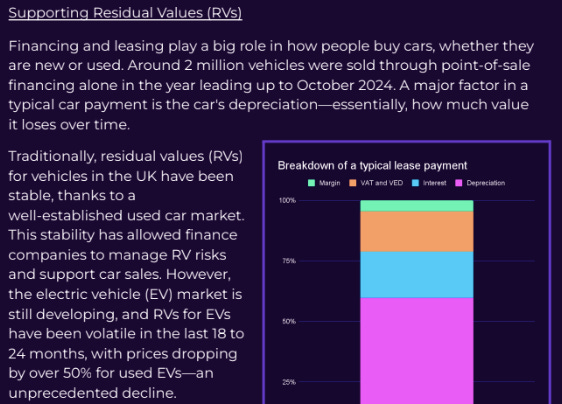
Here’s a snapshot from OEV’s document that explains how the proposed scheme would work:
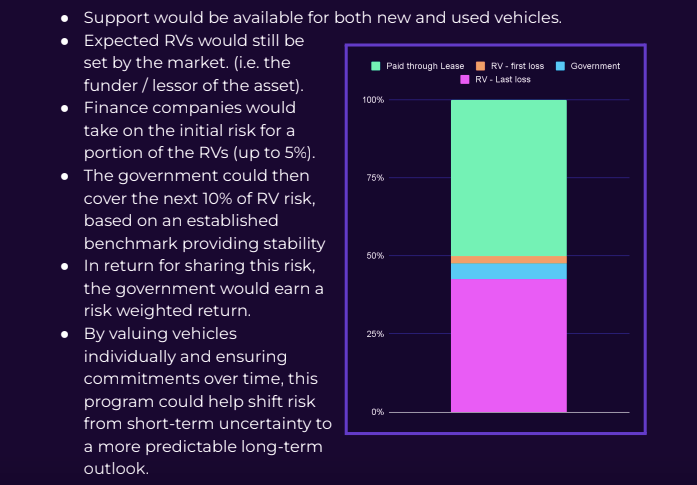
Octopus argues that their scheme would be good for taxpayers. Sources at Octopus have told me this idea was not unique to them, and that several other leasing firms made similar asks. Octopus believes its scheme could enable them to significantly lower prices for consumers, as a state-backed guarantee would provide the leasing industry confidence to expand. Octopus has said it believes the scheme would be net neutral or even positive for the public. I also understand that a private sector solution is being explored alongside asking for government support.
For now, the idea has not been adopted by the UK government. However, elsewhere, Octopus has taken several steps behind-the-scenes to shore up its balance sheet.
Finance structuring…
In 2023, OEV set up an ‘orphan company’ called Everdure No.1 Limited – a business registered to an office in Canary Wharf, which has more than 2,000 other active companies also linked to it.
Everdure No.1 was set up to raise debt against OEV’s lease portfolio by selling lease contracts to investors, such as banks, in exchange for loans. By April 2025, OEV had used Everdure to draw down approximately £278 million in this way. £236 million of this money came from Lloyds Bank. According to Companies House, OEV could use Everdure to draw down up to £660 million.

The use of orphan companies is common among businesses trading with assets, as the set-up can shield a parent company from any bankruptcy liability should a subsidiary go insolvent. Readers may recall that last year I wrote about Tesla taking this approach.
In the case of OEV, because they have chosen to retain the economic upside of its vehicles, OEV and its parent Octopus Energy remain tied to any profits or losses relating to Everdure.
Alongside the set-up of Everdure, The Fast Charge understands that several financial firms have been approached by OEV’s team to seek help on creating a fresh model for how the company manages its residual values. It is not known if OEV managed to succeed at this. Although there is evidence that the market has improved. Analysis by Cox Automotive in November 2025 suggested the average EV depreciation sits at 38-42% after three years versus 35-40% for petrol vehicles.
In more recent months, as the company has been exploring a new raise, the company has been recruiting for several senior Capital Market roles, including a lead deal principal, who “will be responsible for helping source, structure, and execute the key funding lines for Octopus Electric Vehicles’ substantial and rapidly growing fleet of electric vehicles.”
Consumer incentives…
On the ground with customers, OEV has also taken steps to prevent bringing losses back onto its balance sheet. This has included offering customers extended lease contracts and re-leasing returned vehicles.
These practices are not unique to OEV, and it is known that several other firms with residual value exposure are doing this. But OEV has gone further to boost its incentives. Namely, Octopus has now brought its own home charger to market, and many of OEV’s listed deals offer it for free. And for existing energy customers who take up a lease, OEV offers 8,000 miles of free home charging through its tariff.
For those without driveways, those leasing through OEV can get 50% off charging with Ubitricity and Connected Kerb. Alternatively, they can claim credit for Octopus’ roaming app, Electroverse. For new cars, you get £800, or £400 for used EVs.
Wider group activity…
OEV is ultimately owned by the Octopus Energy Group. In its latest accounts, the Group announced a pre-tax loss of £254.8 million across its whole operation. Octopus Energy acknowledged in 2025 that it had not yet met Ofgem’s capital adequacy rules, though the company subsequently confirmed it had done so in January 2026.
Soon, it is expected that the group will spin out its proprietary software, Kraken, which is currently valued at £6.4 billion.
The challenges facing OEV and its parent are distinct. But Octopus Energy Group has committed to supporting OEV financially – meaning the group’s own balance sheet is not insulated from its subsidiary’s losses. Or vice versa.
*This article has been updated to reflect that Octopus Energy now meets the Ofgem capital requirements.
Latest EV news…
🚘 EVA England has published a new whitepaper highlighting how the EV transition is at risk of becoming two-tier. It is essential reading, full of new data and solid recommendations. Read ‘Putting the Driver First’ here.
🧐 Yesterday, the Department for Transport published the government’s Cost of Charging Review terms of reference. It’s chaired by Phil New, an executive with a lot of experience in the EV transition. Critically, though, the review will not consider tax changes, so that means we should not expect a recommendation on VAT or eVED. This has displeased campaigners, such as EVA England. It will report in Autumn, around Budget time. See it here.
⚡️ Also yesterday, I was pleased to attend the launch of BYD’s Flash Charging in the UK. These are chargers which can power an EV from 10% to 70% in five minutes, and to full in nine minutes. BYD plans to roll out 300 in the UK this year, and they can avoid grid challenges by relying on huge batteries. Clearly, at the moment, only the soon-to-be-launched Denza Z9GT will be able to benefit from those speeds, though it will end up being other models. Additionally, the chargers will be open to other cars. Read more.
💸 A new report from ChargeUK with LCP Delta has found that EV charging growth will provide the foundation for a £385 billion UK economic contribution, establish 35,700 jobs directly, whilst enabling 334,000 additional jobs across the EV sector. That’s as long as the ZEV mandate remains unchanged. Ministers Keir Mather and Katie White attended the report’s launch, which is hopefully a positive indicator that the upcoming review will be more of a tick-box exercise. Read here.
🔌 Speaking of charge point rollouts, there’s been a flurry of news over the past week. Zapgo has a new site in Newcastle. Hampshire County Council has plans for 17,000 with Believ. And Telford has launched 126 (also with Believ). Elsewhere, all of Aldi’s 1,200 EV chargers are now being run by Drax.
📈 Last week, new industry data revealed EV registrations continue to surge in the UK. According to New AutoMotive, during May EVs reached a 27% market share. Read more.
📝 A new report by the International Energy Agency on EV running costs, which includes a UK comparison to other countries. Apparently, on average EVs are still £9,700 ($13,000) more than ICE here. Find it here. That gap seems a bit bigger than other reports I’ve read.
🤑 In more positive news, data from Zapmap and Autotrader shows that the annual savings from running an EV now stands at £980 on average. Read more.
🇪🇺 SMMT has called on the UK and EU to revisit the implementation of ‘rule of origin’ tariffs due to come in at the start of next year. The warning is that, without carmakers having enough time to update their supply chains, there will be an unnecessary 10% increase in vehicle prices. Read more.
🏭 I’m a bit late to this, but great to see Chery finally jump into the UK through a tie-up with Nissan. They certainly teased us for long enough. It also puts a renewed question mark on the Coventry gigafactory site. Read more. Or see my previous write-up about Coventry’s empty site here.
💷 Slightly odd story about Northern Ireland politicians and civil servants having to reimburse their use of free chargers located at Stormont (Northern Ireland’s Parliament). The initial story focussed on politicians who also received travel expenses. Read more.
💃 Finally, Heaven & Hell, a former Hull nightclub where La Toya Jackson (MJ’s sister) performed on its opening night in 1990, is due to be turned into an EV charging hub. One of La Toya’s top songs was ‘Starting Over’. Read more.