Hello, this is Tom Riley, and welcome back to The Fast Charge, a British EV newsletter.
Last week… EV charging network Zest and I published a major impact assessment. It revealed how a design flaw in the way businesses are billed for using electricity is leading to higher prices at public charge points.
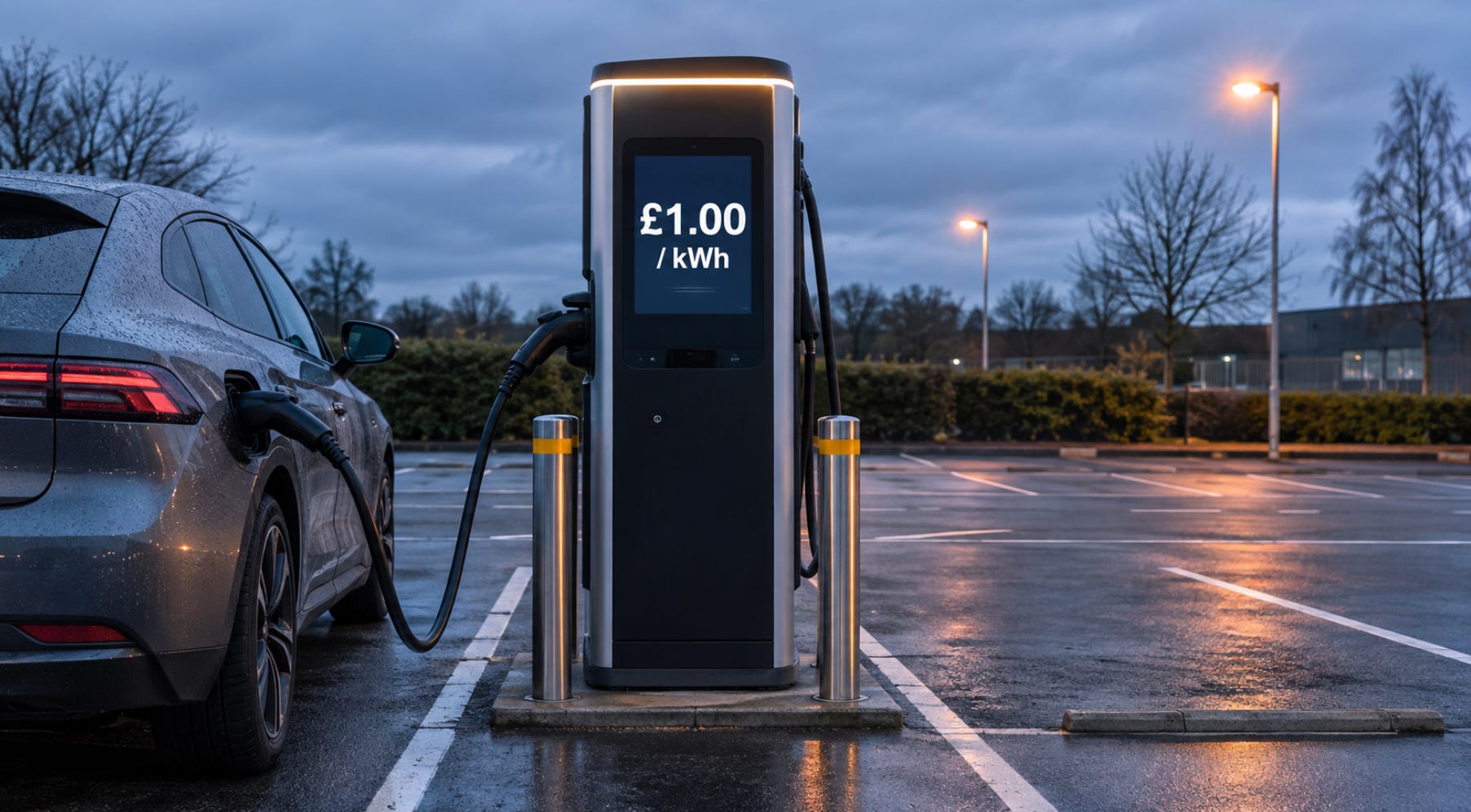
Next year… our analysis suggests prices could start to go above £1 per kWh at many public rapid chargers across the country.
The assessment… called Reverse the Charge, was also published alongside documents, which I obtained via Freedom of Information requests, that revealed both HM Treasury and the UK’s energy regulator, Ofgem, have had extensive and long-term knowledge of the impact the issue is having for EV charging firms. And, as a result, on drivers.
On its publication… I received several inbound messages from across the industry that only reinforced that action by Ofgem is needed. And, worryingly, that our £1 prediction might even be too low.
One charging network told me… on condition of anonymity, that they would need to increase prices well above £1 to break even, and that without raising their price to that level, one of their investors would not provide any more funding.
Elsewhere… I heard tales of how planned EV charging hubs had been scuppered by the current rules, or how some sites had already been shut because of them being too costly to run. One policymaker told me they were shocked by the level of understanding Ofgem clearly had of the issue, suggesting the regulator had been playing dumb.
Ofgem were not happy to have all this reported.
Readers may recall… last week I mentioned I was due to speak with Ofgem. However, on Thursday afternoon, our meeting, which was due to occur on Friday, was cancelled. This was before the Microsoft blackout too.
Ofgem insists they still want to engage. And as such, they sent me a long list of points relating to the assessment. Throughout the development of Reverse the Charge, I have been keen to be open and factual. So, further below I’ve shared a copy-and-paste of what they sent me.
For what it’s worth… I don’t think it disputes much. In fact, there are two things I want to point out before you read.
1] Ofgem says the £1 figure is for a low-utilisation scenario. But 100kWh a day at a new device is a pretty standard benchmark. We also looked at much higher utilisation scenarios (see table from our assessment below). All the costs are heading in one direction: up! Furthermore, Ofgem acknowledges in its response that there has been a “significant impact” on parts of the EV charging sector, and that it is a “particular challenge” for infrastructure installed ahead of demand.
2] Ofgem claims the solutions cannot be actioned by them yet. In their words, “it would not be accurate to suggest that these proposals are ready for Ofgem to implement but have simply been ignored.”
‘Ignored’. That is quite a word. The CEO of Zest, Robin Heap, sums up the current situation neatly:
“Fixing this now is arguably the single biggest step we could take to unlock investment and make public charging more affordable. Ofgem has an opportunity to demonstrate real leadership with the backing of central government. What matters now is action.”
Everything below is from Ofgem:
“1. £1/kWh reflects a particular scenario, rather than a forecast – The £1/kWh figure is based on a specific low-utilisation scenario and should be seen in that context, rather than as an indication that this will become a typical public charging price.
The calculation assumes a rapid charger selling around 100kWh a day, equivalent to roughly two or three charging visits, meaning fixed costs are spread across a relatively small amount of electricity.
Utilisation can therefore have a significant impact on the resulting cost per kWh, alongside electricity, network and wider operating costs.
We recognise, however, that low utilisation can be a particular challenge for infrastructure installed ahead of demand. Ofgem wants to support the transition to EVs and ensure the infrastructure needed can be put in place at the right pace.
2. There are a number of factors behind public charging costs – Network charging arrangements are an important part of the picture, but public charging prices are influenced by a number of factors, including utilisation, electricity costs and wider operating costs.
The TCR introduced a broad, system-wide approach to recovering residual network costs, rather than an approach designed specifically for the EV charging sector.
We recognise that the changes have had a significant impact on some consumers, including parts of the EV charging sector.
While network costs need to be recovered, we are committed to looking at whether the way those costs are allocated remains fair and efficient as the energy system and technologies such as EV charging continue to develop.
3. We recognise the particular challenge of investing ahead of demand – Rapid-charging infrastructure can require significant network capacity from the outset, even where initial utilisation is relatively low.
Networks need to be capable of meeting the capacity required when rapid chargers are in use, while the costs for an individual site can be more difficult to absorb during periods of low utilisation.
That is why it is important to consider whether existing charging arrangements remain fit for purpose as EV deployment grows.
Through the Cost Allocation and Recovery Review (CARR), Ofgem will assess the impact of charging arrangements on non-domestic customers, including sectors such as EV charging.
4. The question is how network costs can be recovered fairly – Network costs ultimately need to be recovered, but there is a legitimate question about how those costs should be shared as the energy system changes.
Changes which reduce costs for one group can have consequences for how costs are recovered from others, so any reform needs to look at impacts across different consumers and sectors.
We want to ensure that any potential cost savings for CPOs are passed through and felt by drivers at the plug, which will require careful thought.
We are also carefully considering the independent Cost of Public EV Charging review and want to work with government and industry to support good outcomes for EV charging infrastructure.
We are keen to engage with the Government’s taskforce on domestic tariff porting announced at Budget 2026.
5. Work is already underway on the issues being raised – We recognise the concerns about the impact of current arrangements on EV charging infrastructure, particularly where investment is being made ahead of demand, and there are several strands of work considering these issues.
DCP420 and DCP454 are progressing through the established DCUSA process. Ofgem cannot make a decision on either proposal until it receives the full report and recommendation from the DCUSA Panel, so it would not be accurate to suggest that these proposals are ready for Ofgem to implement but have simply been ignored.
More broadly, CARR and our consideration of the independent Cost of Public EV Charging review provide opportunities to look at how the charging framework is working as EV infrastructure expands.
Ofgem recognises that EVs will play an important role in the transition to Net Zero, and we want to work with government and industry to ensure the regulatory framework supports the infrastructure needed for that transition.
The Energy Independence Bill, subject to Royal Assent, will also give Ofgem equal principal duties on consumer protection, economic growth and Net Zero, giving us a clearer role in supporting the rollout of low-carbon technologies.”
By Tom Riley | Add me on LinkedIn | Drop me an email