

Hello, I’m Tom Riley, and welcome back to The Fast Charge, a British EV newsletter.
Today’s top stories... I have obtained the market assessment National Highways conducted before paying £84,000 extra for 14 Tesla Model Y’s. And the Department for Transport tries to breathe new life into its grant scheme.
Elsewhere... A new battery health report and lots of new charge point options for people from Leeds to Dorset.
As ever, if you have any comments or feedback, please reply to this email or message me on LinkedIn.
National Highways claimed no other suitable EVs were available. It wasn’t true.
Background: At the start of this month, I revealed how National Highways, the public body responsible for the UK’s motorways and A roads, paid an £84,000 premium to buy 14 Tesla Model Ys which weren’t listed on the Government’s official approved list of suppliers.

At the time of that story... National Highways stressed to me that their only option was to go with Tesla. A source at the time told The Fast Charge a market assessment established that no equivalent electric vehicle meeting our specification for traffic officer vehicles was available via CCS framework at the time of procurement.
However... I have now obtained the market assessment via an FOI request. And it seems this was not true.
In fact... At the time National Highways decided to spend a whopping £760,125 on buying 14 Tesla’s at near retail price for its Traffic Officer fleet, the agency had already identified and started piloting three EV alternatives which met the same specification as the Model Y. Furthermore, these three other models were on the official Crown Commercial Service framework – meaning they would likely have delivered best value for taxpayers.
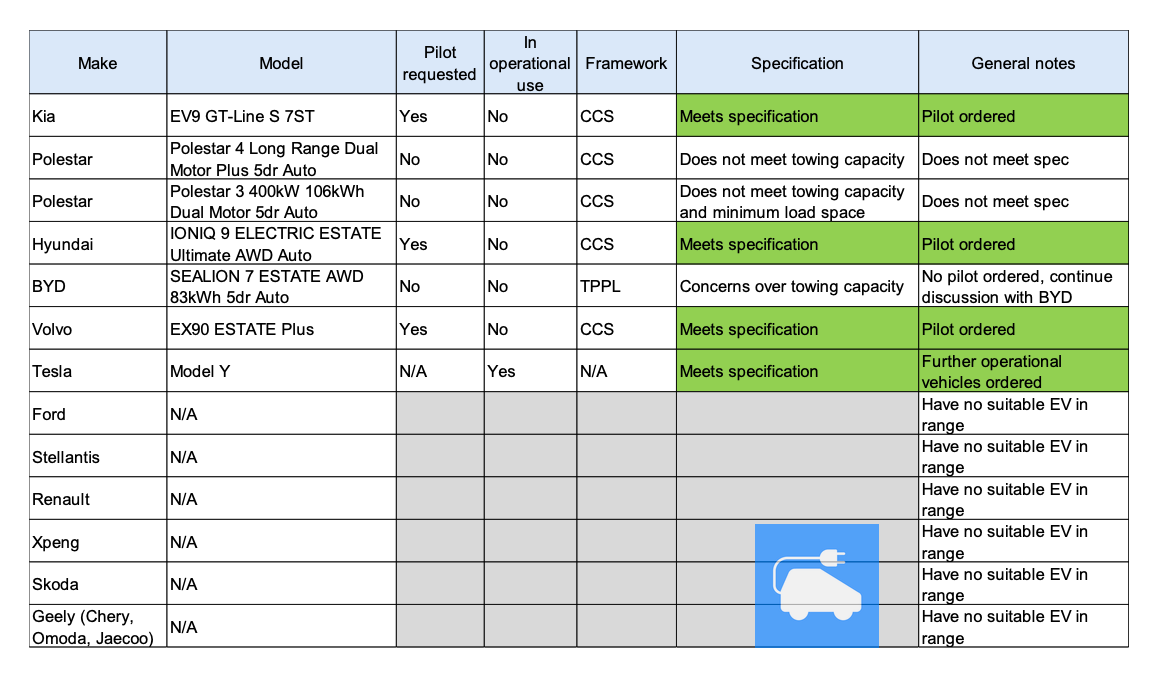
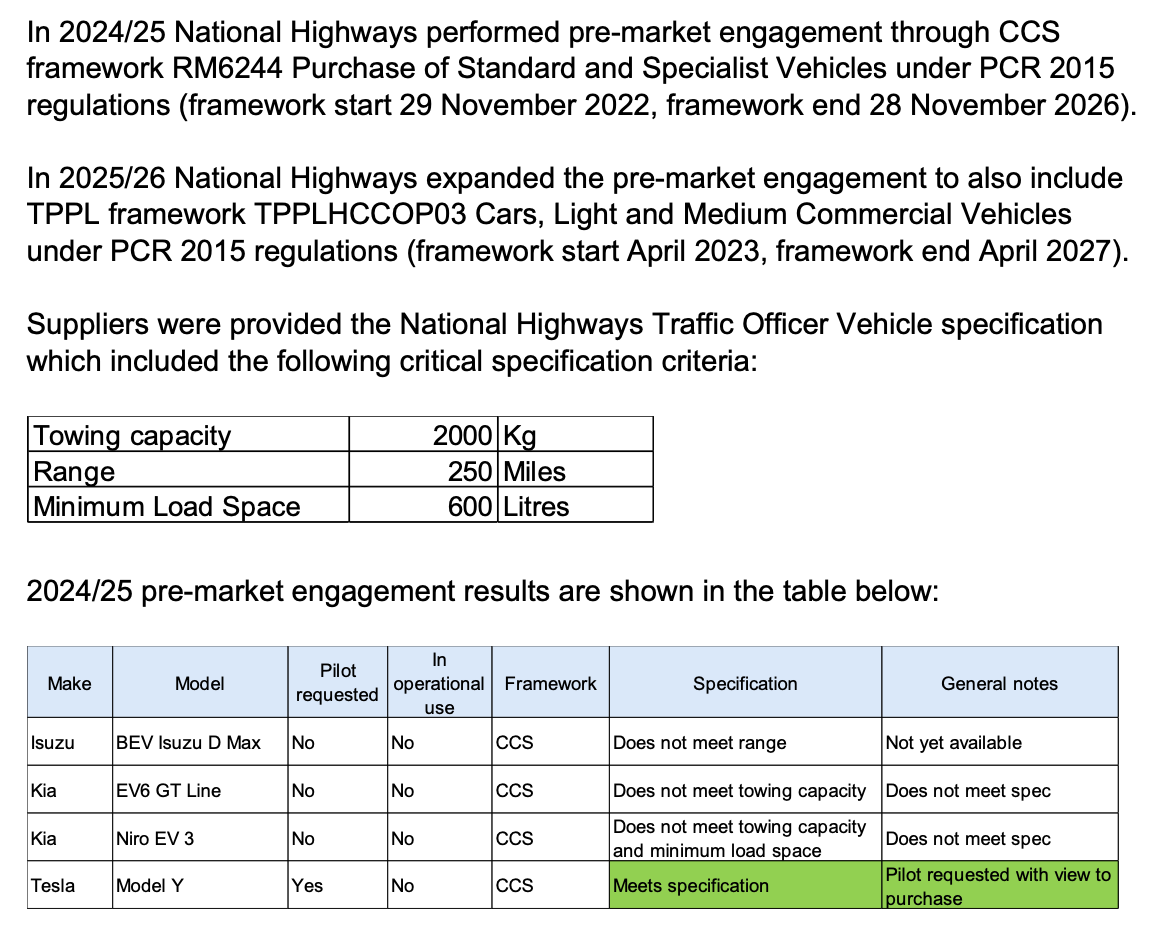
According to the obtained assessment... National Highways requires its Traffic Officer EVs to tow 2,000kg, have 600 litres of boot space, and have a range of more than 250 miles. On the official framework, the Kia EV9, Hyundai IONIQ 9, and Volvo EX90 were all identified as meeting this specification in the market assessment for the year 2025/26 (aka, the one we’re in at the moment). Other carmakers on the CCS list, including Ford, Stellantis, and Skoda, were noted as not having suitable EVs for its requirements.
Pilot cars were ordered from Kia, Hyundai, and Volvo. However, rather than waiting for pilots to complete, National Highways chose to continue expanding its operational fleet with Tesla, buying them via an intermediary at near retail price.

According to the assessment... In the year 2024/25, National Highways had only the choice of Tesla on the official framework. The notes on the document read, “Pilot requested with view to purchase.”
In the previous FOI response I received from National Highways, the body shed light on how many Tesla vehicles it purchased in the year 2024/25...
“Of the 24 vehicles procured [from Tesla] during the 2024/25 tax year 23 were new. The 24th vehicle was a long term demonstration vehicle supplied by Tesla it was placed into service as new although technically it was second hand at the point the order was placed.”
That’s a pretty large initial order... But when I asked the agency why they started with such a big pilot, an NH source disagreed, suggesting the agency purchased one Tesla Model Y to pilot before purchasing the 24 operational vehicles. Does that mean they had 25 Tesla vehicles, not 24?
Very confusing... Anyway, for comparison, I asked National Highways how many EVs it bought to pilot from the other eligible carmakers. I was told they got 4 Kias, 4 Hyundais, and 1 Volvo from the official supply list this year. As a reminder, this was at the same time they also placed an order for the 14 Tesla Model Y’s. Those other vehicles are currently going through a 12-month operational pilot programme.
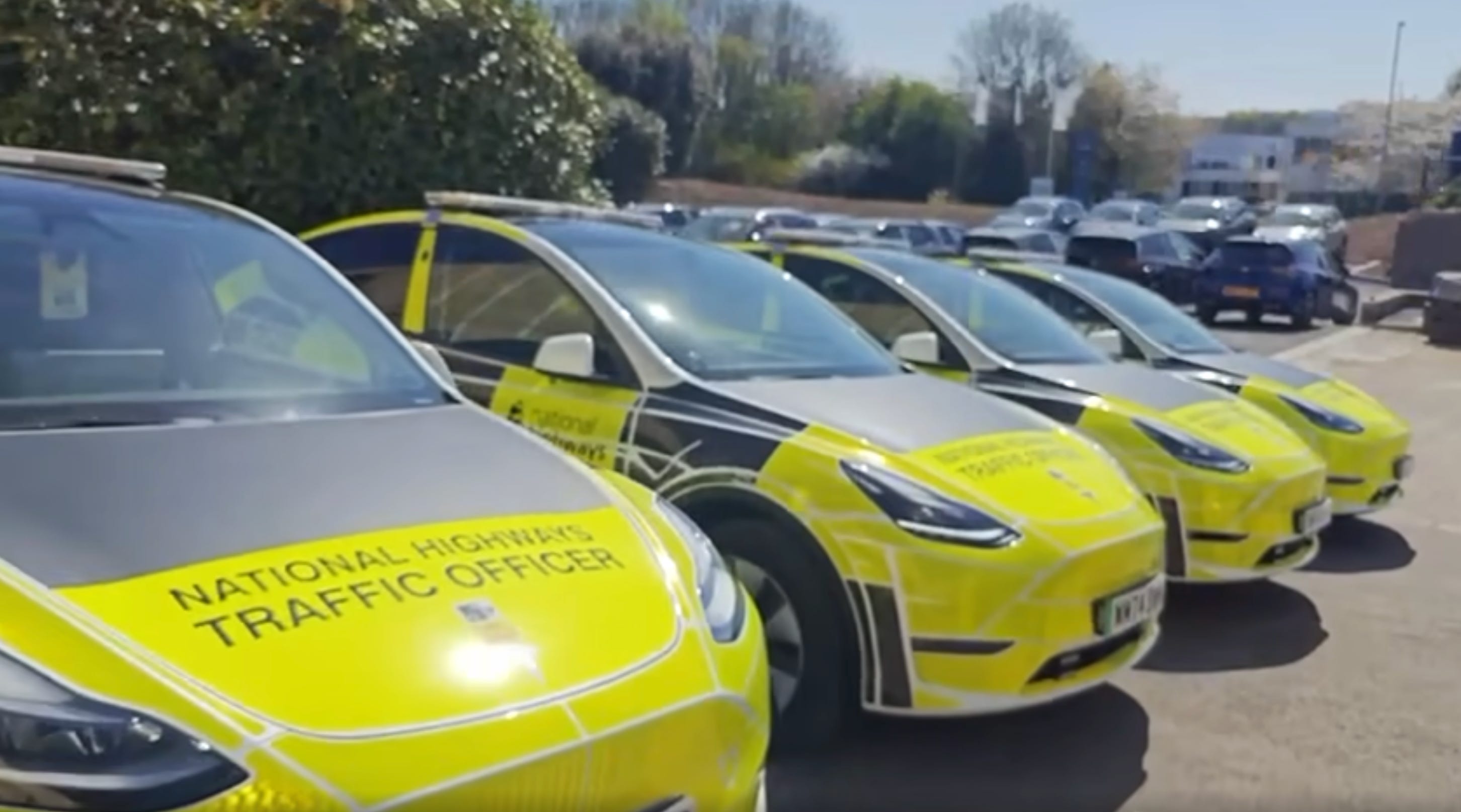
In response? When I asked why National Highways continued to buy from Tesla despite there being three other officially approved EV alternatives, a spokesperson declined to comment. I also asked if NH conducted a financial comparison when making these decisions. Again, no comment.
People may think this is a small hill to die on... But I really hate taxpayer waste. People in this country are currently busting their guts to bring home the bacon. Tax is eye-wateringly high, Freddos cost 45p, and running a business is a headache. And yet... a public body feels fine to splurge £84,000 it didn’t need to. Why is that ok?
If National Highways feels it’s being forced by the government to make its fleet electric, it surely needs to be flagging this high cost to us taxpayers.
Today’s newsletter edition is free… But the next two weeks won’t be… And I think you’ll want to read them 🤐.
Why not get a free trial?
DfT gives CPR to flatlining grant scheme
Good news: This morning, the Department for Transport announced that the charge point grant available to flat owners and landlords will be extended by a year. And the grant amounts are changing too. From April this year, people living in rented accommodation, flat owners, residential landlords, households with on-street parking, and businesses will all be able to receive higher grants of up to £500 per installed charger, rising from the previous discount of £350.
However, the amount schools can claim per charger is reducing to £2,000 per charger, compared to the previous level of £2,500. It’s good news, though I think DfT should be cautious about claiming it’s being ‘boosted’. Seems more likely to be moving existing funding around. Read more.
And how is the charge point grant scheme doing anyway? In its original format, it was available to all households and helped get hundreds of thousands of home chargers installed. Back in April 2022, the scheme was changed to focus on those without driveways to access affordable charging. But, as of the latest statistical update up to the end of October 2025 (here), only 18,222 flat owners or renters have taken advantage of the scheme since it launched nearly four years ago! In that time, it’s estimated that 1.4 million new EVs have been registered in the UK.
Even more worryingly... Residential landlords have only installed 1,505 chargers using the grant in that time. That is woefully low and quite worrying, given renters are often entirely reliant on a landlord to make changes or adaptations to where they live.
Over the years of writing this publication, I have heard numerous stories from residents who attempt to install chargers at rented properties, though get declined by their landlord. I find it quite rich, therefore, that the Chief Executive of the National Residential Landlords Association is quoted in DfT’s press release claiming, “Almost 9 in 10 landlords with a suitable property would install EV charge points if a tenant asks them to undertake this work.” Seriously? The official figures throw a lot of doubt on that.
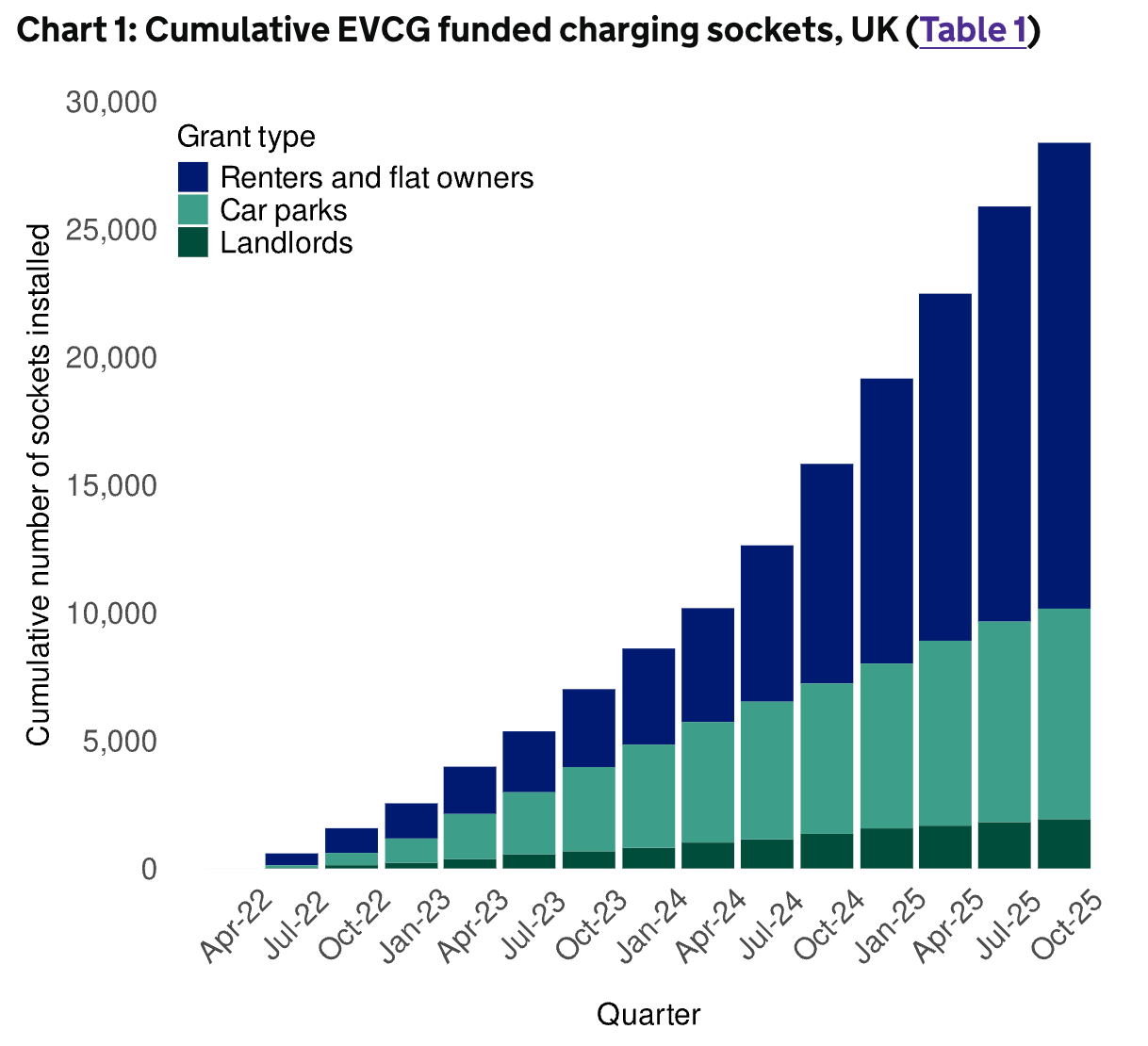
In the past 12 months... There has been a big uplift in flat owners and renters securing grants, with more than 9,600 securing sockets. But, the scheme has only ever reached past 1,000 chargers installed in one month since 2022 – and that was in November 2024. I feel it will take a lot more than simply cash-based CPR to get this scheme used. Time will tell if the government’s EV campaign helps.
The big change I believe will help... the impending arrival of new rights for renters, which is introduced from 1 May this year. I suspect that will supercharge claims being accepted, as the landlord-tenant relationship is reshaped. Landlords will have to meet much higher standards, and renters will eventually be able to dispute decisions with a new ombudsman service. Maybe that’s why the scheme has been extended?
Latest EV news...
🔋 Generational, the battery health checkers, last week published the UK’s largest analysis of EV battery conditions conducted to date, based on over 8,000 battery health assessments conducted in 2025 across BEVs and PHEVs. The analysis revealed that the average battery health was 95.15% across all vehicles tested. Even nine-year-old EVs were found to boast around 85% of battery capacity. Great to see these facts. Learn more.
👉 You may recall me writing that Leeds Council wanted to be a leading net zero city. And it seems it wasn’t just political bluster. They’ve just announced a trial for cross-pavement charging with Kerbo Charge. Read more.
👍 Elsewhere, Wandsworth Council has announced that soon residents will be able to apply for a cable channel grant. Read more.
💷 The charge point company Pod last week revealed ‘Pod Rewards’. The new programme automatically charges EVs at optimal times and rewards drivers with cash, building on over £330k already earned by Pod customers in trials. That’s some real cheddar. See here. It comes as Pod’s CEO, Melanie Lane, shared a warning to City AM about the delicate consumer confidence when it comes to EVs and their costs, especially with new taxes on the horizon.
🚘 Volvo has built a new battery pack which may allow it to bring back its famous estate car in EV format. Read more.
🇮🇹 Mamma mia, Lambo has u-turned on its fully electric supercar, instead shifting to making hybrids. Read more.
✍️ The Cardiff-based EV charging network PLUG Charging has acquired the UK and Ireland charge points belonging to Wattif. Read more.
⚡️ Transport for London has awarded Total Energies a contract to install 43 rapid chargers across the capital. Read more.
🐙 Another tentacle? Octopus has launched a new ‘fleet’ focussed business that will bring together its Electroverse product and fleet payment solutions. Read more.
🚜 Zapgo has installed two 200kW chargers covering four bays at a farm shop in Somerset. Ooh argh. Read more.
🔌 Dorset Council is set to receive 3,000 on-street charging points thanks to a new partnership with Connected Kerb. Read more.
The increase in the grant may tip the balance. £350 barely scratched the surface.