

Hello, I’m Tom Riley, and welcome back to The Fast Charge, a British EV newsletter.
Top story in today’s edition... I can reveal that the King’s supermarket of choice, Waitrose, significantly missed its EV charge point ambitions.
Elsewhere... Rumours about a VAT cut by the Treasury, Transport for London looks for someone to develop AV policies, and Polestar backs a used EV grant.
As ever, if you have any comments or feedback, please reply to this email or message me on LinkedIn.
🛒 Waitrose’s EV charger rollout stalls as other supermarkets power ahead. Why?
Summary: Four years after Waitrose pledged to install 800 charge points across 100 of its stores by 2025, the premium supermarket that holds a Royal Warrant has revealed to The Fast Charge that it significantly missed its target and is currently “assessing future opportunities” to build on its position.
Context: Back in 2021, the John Lewis Partnership, which is the parent company of Waitrose, made a big splash by partnering with Shell to install hundreds of EV chargers at stores, and to increase the number of Shell forecourts stocking Waitrose food. The pledge was for 800 devices, with press reports at the time suggesting 100 stores would each have destination hubs containing six 22kW and two 50kW chargers available to shoppers.
At the time... former Waitrose Executive Director, James Bailey, commented: “This is an important partnership for Waitrose and means we can offer even greater convenience to more of our customers. We’re also delighted to bring our customers 800 new charging points for electric vehicles, including new rapid charging capabilities, as the UK moves more and more towards a sustainable transport network.”
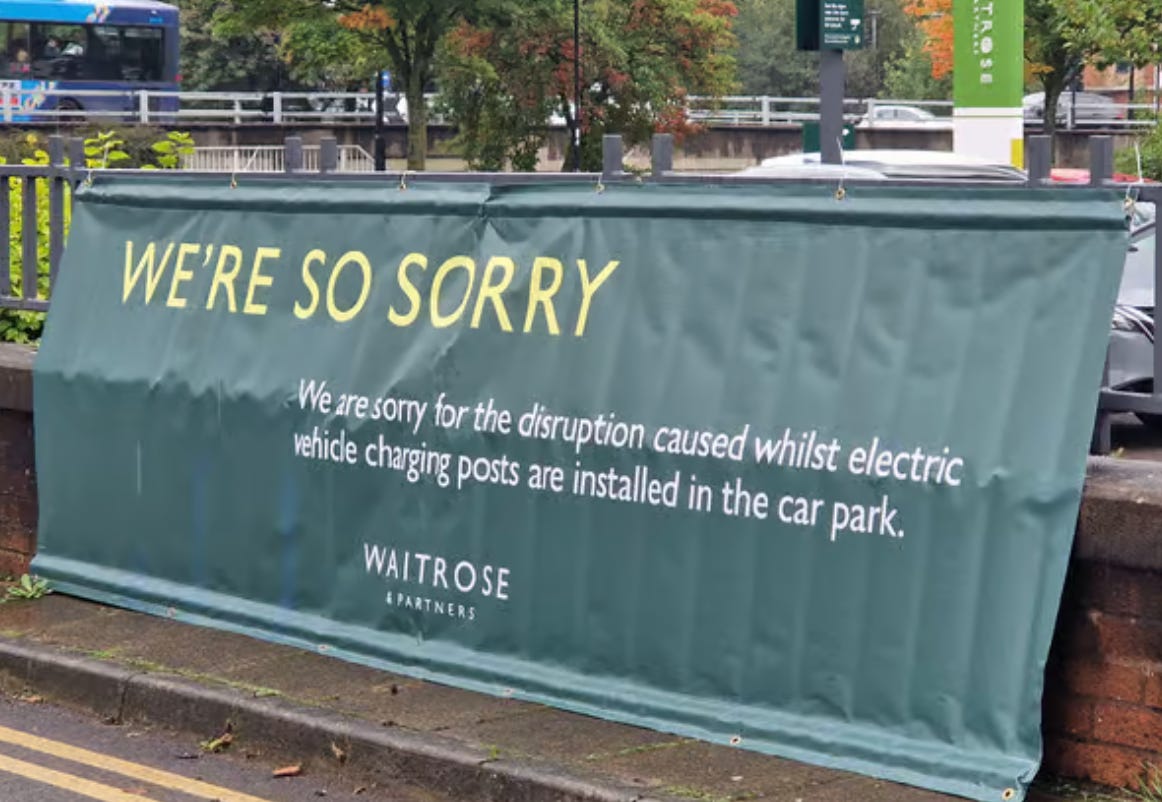
In the beginning... It looked like Waitrose was making progress. By February 2023, according to the website Electrifying.com, 21 stores boasted 138 chargers available. To save you the time, that’s 6.57 charge points per store. Clearly, a bit short of what they originally claimed but, two years ago, the charging industry was still finding its feet and did have some significant grid issues to contend with.
However... This week, I have conducted several scans of Zapmap and could only count an estimated 60 Waitrose stores listed as having charge points available. Based on what I can see available, I estimate that around 325 individual chargers exist across those stores. In any case, whichever way you cut it, they were far short of 800 chargers at 100 sites.
Additionally... During my tally, I only noted 12 stores that clearly had 8 or more chargers. By comparison, I found 27 that appeared to only host 4 or fewer.
My estimate suggests Waitrose didn’t just miss its target; its ambition seems to have evaporated. When I first approached the John Lewis Partnership about their supermarket’s progress a week ago, I was fully expecting them, being a large UK Plc, to counter my query hard. However, instead, I had to chase them five times over email and phone calls, as well as keep extending my deadline for them. I only got a response yesterday afternoon.
In a response to this story, a Waitrose spokesperson told The Fast Charge:
“We’ve made good progress in expanding our electric vehicle charging capacity, and have now installed charging points across two thirds of our planned sites. We are assessing future opportunities to develop this further.”
For the eagle-eyed amongst you... Yes, they are claiming that charge points are available at two thirds of Waitrose’s ‘planned sites’. This is similar to my own findings, though my analysis suggests they missed the target number of charge points (800) by more than half.
Important for you to know then... The company provided no background information to me outside that above statement. Nothing about how many stores currently have EV charging, how many chargers are live, or why the original ambition of 800 chargers at 100 sites by 2025 was missed. When asked directly why the target was not achieved, the spokesperson simply advised they were not able to share details about it.
So, what’s happened? At first, I wondered if their partnership with Shell may not have worked out. However, given John Lewis’s media team have made zero effort – in fact declined – to explain anything; taken together... the missed target... the slowdown in roll-out... and the refusal to explain ‘why’ raises questions over whether EV charging has been quietly deprioritised.
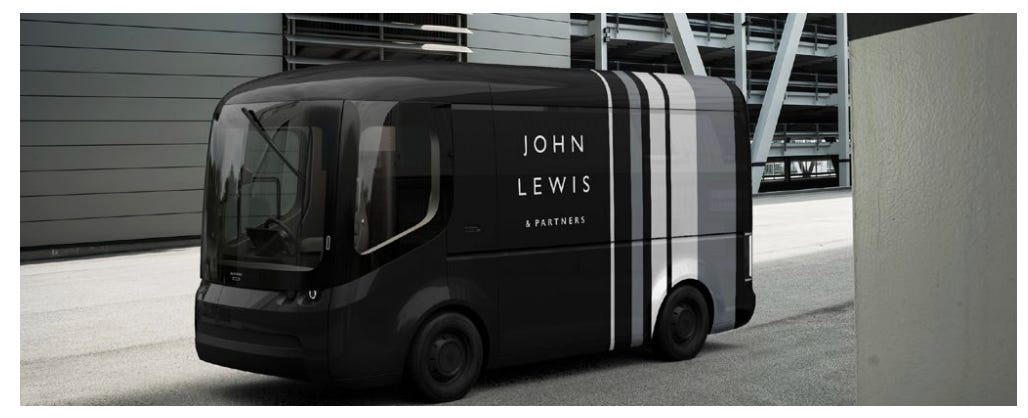
There’s evidence that this isn’t the only EV policy John Lewis has rolled back on. In 2020, within a John Lewis Ethics and Sustainability Report, the company revealed it had an ambition to have a “full-scale” roll out of electric vans within “the next two to three years”. This clearly never happened, not helped presumably by the fact that Arrival, now bankrupt, was due to supply them. Even so, the electric van target appears to have been 3,000 by 2030 during 2023. But, as of today, the John Lewis website states the aim is to have 2,500 by 2030.
Here’s what I don’t understand. A report by Zapmap and the RAC in September last year revealed UK supermarkets – from M&S to Morrisons and Lidl, Tesco, Asda, Sainsburys (even Co-op!) – have been installing chargers at a rapid pace (34% rise since the end of 2023). Meanwhile, Waitrose, which you’d think has the exact kind of customer base that may already have or be seriously considering an EV, doesn’t seem bothered. It’s just weird given all the fuss that was made about their previous pledges.
Supermarket charging hubs are clearly a winner. I’ll leave you with this fact... In January 2024, Sainsburys launched its own charging network called ‘SmartCharge’. In two years, the Sainsburys team have installed 660+ ultra-rapid charging bays at more than 80 stores. And in a clear sign of their ability to build loyalty, I’m told SmartCharge users earned a combined 21 million Nectar points in 2025 – that’s £105,000 worth. That’s a lot of cheese.
Latest EV news...
👀 VAT rumours (Pt.1). The Daily Telegraph this week has caused quite the stir amongst the EV community. According to the Telegraph, the Treasury is so worried about the impact of the 2028 road tax for EVs that, as part of its review into charging costs, it’s considering equalising the VAT rate applied at public chargers (20%) to the one applied for domestic homes (5%). A Whitehall source told the Telegraph: “The way we convince people to switch to EVs is by showing people it is easy and it is cheap. There are savings to be had here for many people.”
💷 VAT rumours (Pt.2). Like most people, I hope they do make it cheaper to run an EV. However, I’m cautious as to why they would do this now. It feels short-term. Why would you make a new tax, only to then drop another tax elsewhere? Additionally, lowering VAT is only a temporary break. Of course, immediately after a cut, there would be a very visible drop in charge point prices. But, a few years down the line, I’m sure a lot of that margin would be soaked up by operators. And if the Treasury ever wanted to change its mind, it would be politically impossible to put it back up. For me, I’ve always believed in a middle ground, offering 5% at on-street slow chargers, which is more akin to someone with a driveway. Read a report by the MailOnline here.
⚡️ Speaking of prices, a new update from Motability’s EV tracker has revealed 52% of EV drivers pick chargers based on “tariff or price”, with proximity to the charger responsible for 27% and charging speed responsible for 20%. Cost was also the most important factor for disabled drivers on the Motability Scheme, being responsible for 48% of their choice. Read more.
🏴 This may help keep charging costs stable. Yesterday, in the Scottish Government’s Budget, they announced 10 years of 100% business rates relief for EV charge points. Mirroring the Chancellor’s Budget announcement last year. Vicky Read, chief executive of ChargeUK, commented: “It is very positive to see the Scottish Government take action.”
🔌 The borough of Lewisham is going to get at least 200 new on-street chargers from Zest, who are partnering with the local council to deliver and operate chargers for 15 years. Read more.
🧑⚖️ In 2022, a driver of a Volkswagen ID.4 claimed it accelerated forward of its own accord before killing a five-year old boy and injuring his own son. A police expert could not find a fault with the vehicle; in any case, the jury cleared the driver. It turns out, other ID.4 users have had similar problems with their models, so VW may be facing a case in the US. Read more (paywall).
👍 In more positive news, despite the recent changes in the EU, the FT reports that car executives are still positive about EVs, with KIA saying they’ll remain central. Read more (paywall).
🚗 Polestar has said the UK government is missing an opportunity by not making used EV grants available. Read more.
😱 On the topic of used cars, new data from Autotrader shows the average used EV took 30 days to sell – which is five days faster than both the market average and their petrol counterparts (35 days respectively). EVs which were 3-5-year-old electric models sold in just 25 days. Read more.
👊 A new update to the ‘EV Facts’ initiative has seen the AA state that EVs are more likely to be successfully repaired at the roadside than petrol or diesel cars, with a repair rate of almost 89% versus 87.5% for internal combustion engines. Similarly, despite a third of consumers expressing concern about battery health, data from the AA reveals that the 12-volt battery in an ICE car is a more likely reason for a call out than the battery of an electric car. Great to see this myth-busting continue into 2026. Read more.
✍️ Talking of myth busting, the Transport Select Committee is examining how effectively the transition to EVs is progressing, considering the range of factors that are influencing uptake. If you have evidence, you’ve got until 30 January to submit it. Find details here.
🤖 Finally, with autonomous vehicles on the horizon in the UK, Transport for London is on the hunt for a new Vehicle Policy Manager. The role holder would be responsible for developing and producing proposals for revisions to taxi, private hire, pedicab, and autonomous passenger service vehicle licensing requirements. Apply here.