

Morning all, this is Tom Riley, and welcome back to The Fast Charge, a British EV newsletter.
I re-enter your inbox today with two items. Both about eVED.
Item no.1… The Treasury admits to me the launch of eVED will be an administrative burden – as elsewhere the Cabinet Office tells me it doesn’t hold any mileage counts for its own ministerial fleet.
Item no.2… I calculate that by 2030, eVED could mean a 529% rise in tax paid by the National Highways traffic officers annually.
These are only short stories, though hopefully they’ll offer you some light relief (or frustration) as September draws near, bringing with it the start of the Autumn slog.
As ever, please do send me any tips, texts, or gripes. To do so, please reply to this email or message me on LinkedIn.
The Cabinet Office doesn’t know its own mileage - why does HMT expect us to?
Summary: The new electric Vehicle Excise Duty, which the UK Government will be introducing from 2028, has long been criticised as being an expensive, demand-distracting administrative burden. A key criticism of the scheme is that drivers and fleet managers will have to work out and estimate their future mileage.
And that’s hard… Because what if suddenly you had a stroke, or your eyes got worse, and then you couldn’t drive as much. Or your job moved locations, so you’re driving more. In my own case, I was driving all the time, until epilepsy came along with other ideas. Working out your mileage and coming up with an estimate is tricky.
And… If you’re a business running a fleet, you are having to do that for tens, hundreds or even thousands of cars.
However… Despite more than 5,000 people feeding into a HM Treasury consultation – presumably telling the apparently bright officials that the timing of the scheme and its design is slightly moronic – they decided this Summer to push on regardless.
In the published consultation outcome… Officials acknowledged the criticism, and wrote that, based on feedback, they had made changes which “will make eVED simpler to comply with”. To this day, sources at the Treasury have repeatedly told me that the scheme will be easy to use.
Anyway… Given the continued backlash against eVED, I thought I’d see how prepared the actual government was for the changes. Specifically, I wanted to see if officials were as clued up on their vehicle mileages as they expect everyone else to be.
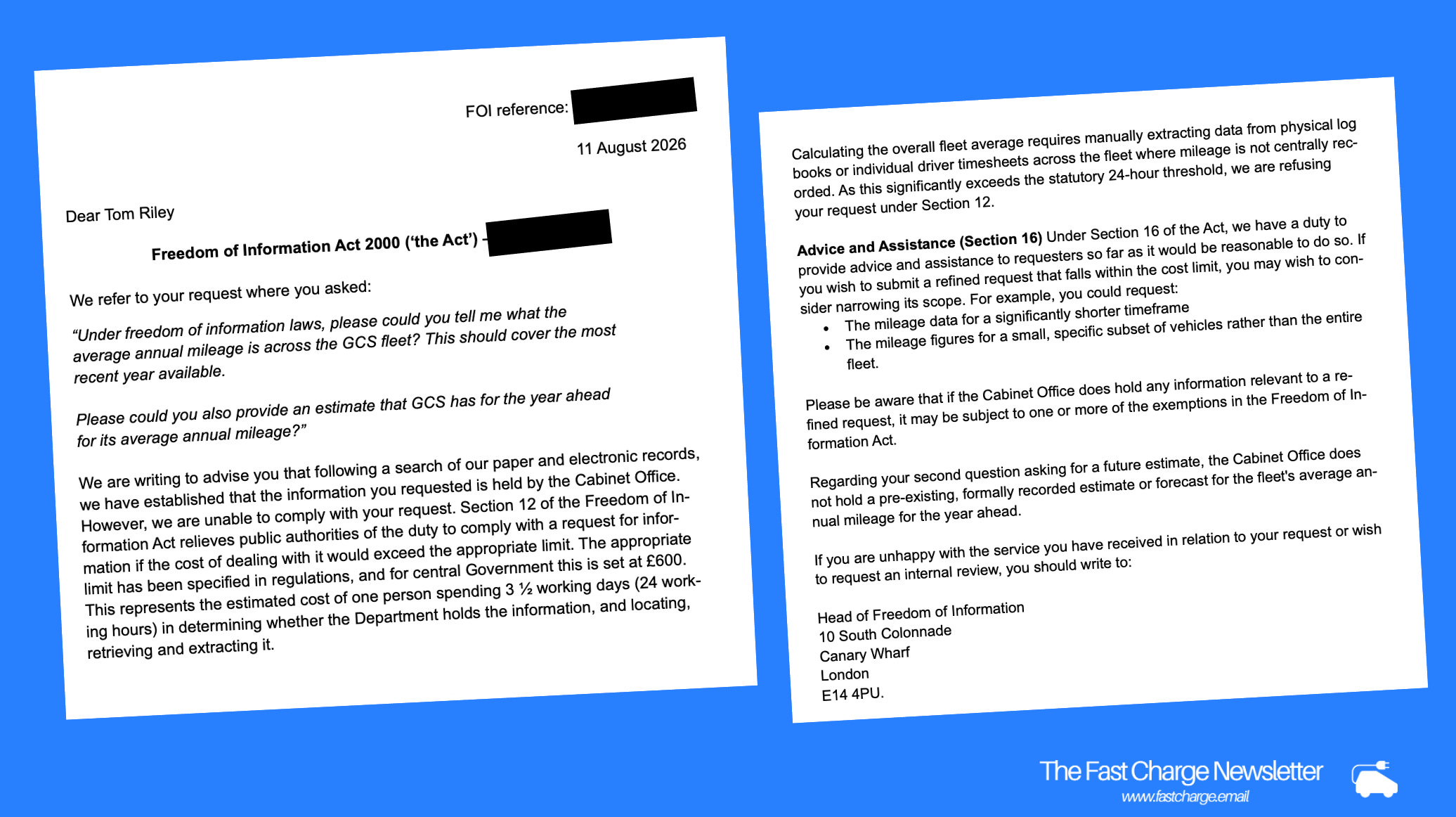
So, I asked the Cabinet Office… who run the 108-strong fleet of ministerial cars – of which 42 are fully electric, and 60 are hybrids as of 2025 – whether they could tell me what their fleet’s average annual mileage was. And, also, if they could give me an estimate for the year ahead. This was through a Freedom of Information request.
In response… The Cabinet Office told me they didn’t know.
On the first part of my request… which asked if they could provide the average mileage the ministerial vehicles currently do, they told me the ask would exceed 24 hours – which is the limit on FOI requests.
Here’s their explanation:
“Calculating the overall fleet average requires manually extracting data from physical log books or individual driver timesheets across the fleet where mileage is not centrally recorded. As this significantly exceeds the statutory 24-hour threshold, we are refusing your request under Section 12.”
And in response to my ask for a future estimate, the Cabinet Office wrote:
“Regarding your second question asking for a future estimate, the Cabinet Office does not hold a pre-existing, formally recorded estimate or forecast for the fleet’s average annual mileage for the year ahead.”
So… Based on the above, it looks like the Treasury’s changes are going to be causing lengthy and burdensome headaches for its own people, not just everyone else!
In response, HM Treasury declined to comment. However, a source at the Treasury did acknowledge eVED would bring with it an “administrative burden” when it is first introduced, though they stressed officials are working with fleets on making it as easy as possible.
eVED could supercharge traffic officers' costs by 529% a year?
Background: When I asked the Cabinet Office for its average annual fleet mileage, I also asked other public bodies. One of which was National Highways. And, amazingly, they did have some figures.
But… While I was happy to see they clearly are not still using paper and pen, as the Cabinet Office appears to, I was astounded to learn that the average annual mileage of a traffic officer vehicle is a whopping 35,241 miles. I guess they really do just spend their time going up and down the motorways.
Anyway… While sat in the terminal of Charles de Gaulle Airport recently, I decided to do some maths and make some assumptions to work out how eVED might impact this fleet financially. And I was pretty astounded by the results.
First assumption… There are 355 traffic officer vehicles, according to National Highways. They make up the largest part of their non-specialised vehicle fleet.
Secondly… We already know that the traffic officer fleet run by National Highways uses fully electric cars. If you didn’t, then please take a look at my previous reports about their penchant for a Tesla Model Y here and here. The latest published breakdown I have found for the whole fleet is from December 2024, where National Highways explained the fleet was 81% plug-in hybrid, 16% electric, with the remaining 3% diesel.
Lastly… The government has a long-standing commitment to have all its vehicles electric by 2027. Obviously, with all the exemptions and outside delays etcetera, I’m quite confident no department will meet that. However, let’s assume it may be the case by 2030 that it does.
Now… If you’re happy with all that above, here’s a table showing three scenarios of how the introduction of eVED will turbocharge the National Highways tax bill.
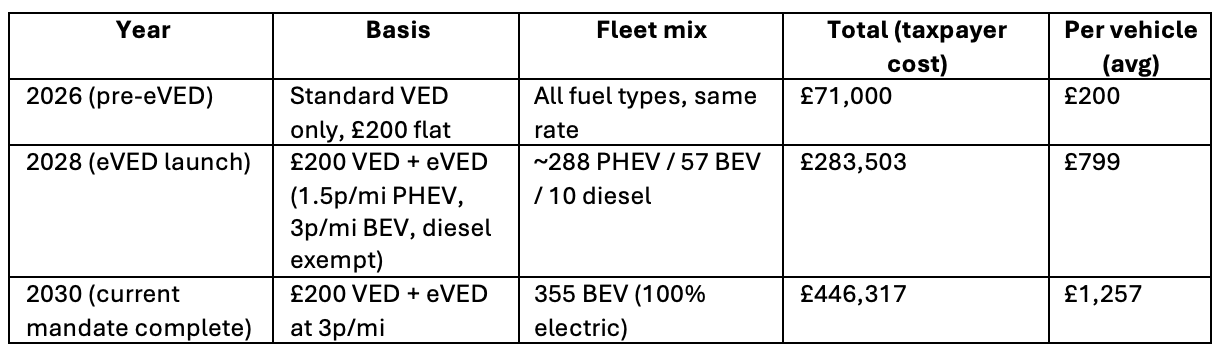
In short, the tax for the traffic officer fleet could rise by 529%… And this table doesn’t even consider whether their vehicles will exceed the Expensive Car Supplement threshold either, which is a further £440 a year on top of VED.
I appreciate this fleet is an extreme example… But I think it demonstrates how, for people doing a much higher than average mileage, having an EV is really going to propel their costs. And I’m not sure that will persuade people to get into them.
In response… The Treasury did not challenge the figures, though a source explained that EV drivers pay no fuel duty, while petrol drivers pay around £480 a year, which is “not fair”. The source explained that “under the new system, EVs will pay half the duty of petrol cars – still the cheaper, greener choice.”