

Hello, I’m Tom Riley, and welcome back to The Fast Charge, a British EV newsletter.
Top story today is a biggie… I have obtained private letters from carmakers to the UK government that reveal their true ZEV mandate intentions, including:
Ford, Nissan, BMW and Toyota lobbying to allow new fully internal combustion vehicles to remain on sale after 2035
Stellantis blaming Labour’s “welcome” approach to China for an “intolerable” impact on its sales
And the trade body group SMMT threatening job losses and deindustrialisation without an urgent trajectory review.
The exclusive correspondence and my analysis are below. If you use or share these letters, please do link to this newsletter.
Elsewhere… Burnham’s first few days, Moto Charge bolsters Exeter Services, and remember to thank Rachel Reeves.
As always, if you have any comments or feedback, please reply to this email or message me on LinkedIn.
Revealed: Major carmakers ask ministers to allow sales of combustion engines after 2035
Summary: Carmakers have been heavily lobbying for a review of the ZEV mandate, alongside other demands to shore up their businesses, including calls to keep combustion engines on sale beyond 2035, according to newly obtained correspondence published today by The Fast Charge Newsletter.
And no… The carmakers don’t mean plug-in hybrids. They don’t even mean mild hybrids, which still use a small battery. As you will see in the correspondence, they mean allowing full combustion-powered vehicles that are “efficient” or utilise ‘sustainable’ materials or fuel to stay on sale after the date when, under current rules, only new electric cars will be able to be bought.
As I’m sure everyone will agree, however ‘free range’ you make an engine… it is still an engine burning fuel. The demand was made by Ford, Nissan, BMW, Toyota and the parts maker, Bosch, in April this year. It is the most brazen ask I’ve seen from the UK automotive industry about the EV transition. It would effectively end the 2035 ban on petrol and diesel cars.
Elsewhere in the letter… the group explained they represented 30,000 jobs in the UK, and more in the supply chain. Alongside their demand for an ‘Open Technology Approach at 2035’, which they indicated would follow the EU’s recent change in approach, the group also called for bringing forward a review of the ZEV mandate to adjust the trajectory, despite the flexibilities and grants already made available.
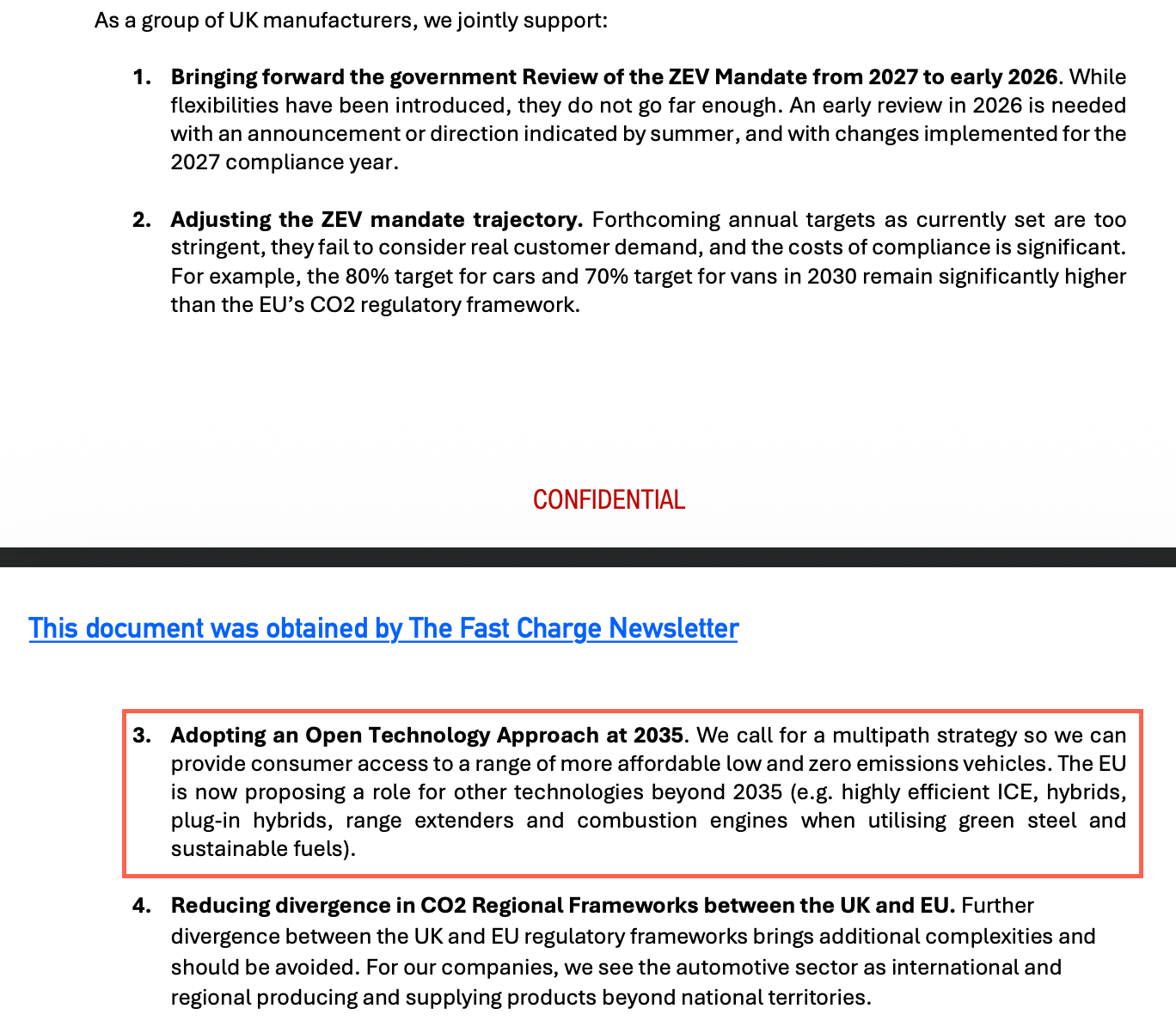
I obtained this letter from the Department for Transport. However, interestingly, the letter itself was sent to the three Secretaries of State for Scotland, Northern Ireland, and Wales – this suggests it was forwarded onto DfT. The letter’s date is also intriguing: 10 April 2026. This is just a month after the SMMT Electrified event where carmakers made public their demands for a faster ZEV mandate review.
Has there been a Whitehall pincer movement?
It could be so… As in a separate letter I’ve obtained from Mike Hawes, the CEO of the Society for Motor Manufacturers and Traders, to the EV Minister Keir Mather MP after the event, which the latter spoke at, Hawes thanks Mather for joining but notes: “I recognise you were not in a position to respond positively to the industry’s request for an earlier review of the ZEV Mandate and the wider transition, but your commitment to continue to work with us was welcome.”
As a reminder… at the time of the conference, it was quite clear that DfT were content with the mandate’s progress and did not commit to an earlier review. Instead, they advised that a review was already baked into the existing arrangements for 2027. And they also published analysis on the day claiming carmakers had met the mandate during its first year.
So… Having failed to get a positive result by going head-on, have SMMT and its members gone ‘around the back’ to pressure others on the mandate instead? We already know that Unite the Union was put to work lobbying Starmer, and dealers like Vertu have been hitting up MPs, so I wonder if the lobbying was taken even wider across Whitehall to make the point too.
There’s evidence to suggest this. In a second letter to the Transport Secretary, Heidi Alexander MP, on 12 June, one day after Unite’s public call on the mandate, Hawes wrote asking for an urgent review of the ZEV trajectories, including making serious claims on what will happen without action in this calendar year. In one line, Hawes suggests that having no review would “likely determine the future of the UK as an automotive manufacturing hub.” He adds, “I do not make that claim lightly, but it is the reality.” This letter was copied to five ministers, including the Business Secretary and Chancellor, as well as Varun Chandra, Downing Street’s Chief Business, Investment and Trade Advisor.

Clearly… The lobbyists have been at work. We won’t understand the true scale until the next set of transparency documents are released. Though we already know from the recent batch – covering January to March – that carmakers have been throttling up meetings with officials and ministers. (See that previous article below).

Naturally… Since coming to power this week, Burnham has since replaced much of the Cabinet, including appointing a new Chancellor (John Healey MP) and Business Secretary (Jonathan Reynolds MP, who previously had the role before the outgoing Peter Kyle). It’s known that Hawes and Reynolds previously had a good relationship before the latter was demoted. One might imagine meetings between the two are already in motion. Heidi Alexander MP has remained as the Transport Secretary, and the previous Transport Secretary, Louise Haigh MP, is now effectively Burnham’s deputy in the Cabinet Office.
China as the fall guy
It has not just been Nissan, Ford, BMW and Toyota lobbying for more change; Stellantis has been at it as well. And, based on a letter I’ve obtained from them to Peter Kyle and Heidi Alexander in late April, their tone is certainly the most aggressive I’ve seen before.
Written by Eurig Druce, UK Group Managing Director for Stellantis UK… The carmaker blames its “intolerable” commercial position not just on the existing ZEV policy, but also on Chinese imports to the UK.
In an extremely spicy accusation… Druce writes the impact of the legislation on Stellantis has been “exacerbated by the Government’s position to welcome likely heavily subsidised Chinese products into the UK.”

Later in the letter… Druce appears to ask that mild hybrids be considered the same as plug-in hybrids and cites analysis from the NGO Transport & Environment. The letter ends with Druce claiming manufacturers like Stellantis are “the backbone of the UK industry having delivered economic growth and inward investment for decades.”
Much like the other letters… This one was copied to ministers and other departments, including the Downing Street business team and DESNZ.
Conclusion
Nobody wants to see job losses. Nobody wants to see less investment in the UK. But where do you draw the line? When does a business’s profitability overtake the health and energy security of a nation? Yes, these car marques have been here for a long time, though they are not the only car brands in the UK now.
These letters reveal what we’ve always known: many carmakers do not want the status quo to change. And it pains me to write it, but I cannot envisage a scenario where Andy Burnham doesn’t keep supporting them. Though, I suppose at least then he’ll have something in common with carmakers: neither will have a real mandate.
📬 Here are all the letters I obtained via Freedom of Information requests
12 January – Lisa Brankin, Chair of Ford UK, raises concerns about the ZEV mandate and van sales to the Transport and Business Secretaries. [Link]
13 March – Mike Hawes, CEO of SMMT, thanks Keir Mather MP for attending the Electrified conference and asks for further talks on the mandate. [Link]
10 April – Senior executives at BMW, Bosch, Ford, Nissan and Toyota set out their four demands, including calling for internal combustion to be allowed after 2035. [Link]
21 April – Eurig Druce, the UK Group Managing Director of Stellantis UK, writes to Peter Kyle and Heidi Alexander to raise “significant concerns” about the ZEV mandate legislation, alongside blaming “subsidised” Chinese imports. [Link]
12 June – Mike Hawes, CEO of SMMT, calls on the Transport Secretary to have an urgent review of the ZEV mandate, saying “the cost of doing EV business is costing jobs, profitability and, most worrying, has created a significant risk to UK investment.” [Link]
Latest EV news…
👉 Andy Burnham is now Prime Minister. As written above, many Cabinet Ministers have been reshuffled. As of yet, I have not heard or seen anything to suggest that the EV Minister, Keir Mather, will move. He was a supporter of Burnham, and campaigned for him in Makerfield, so maybe he’s hoping for a promotion. We’ll have to wait.
👓 Speaking of Burnham… If you haven’t read my write-up of his family links into the EV sector, you can find that here.
🤨 Sticking with the new PM… One of his first acts has been to take VAT on domestic electricity from 5% to 0%. A small help for households, though especially so for people with driveways and electric cars. However, by doing this, Burnham has actually made the price gap between those without driveways even bigger. As Vicky Edmonds, Chief Executive Officer of EVA England, says: “The transition cannot be fair while people pay substantially more simply because they cannot charge at home.” Read more.
☀️ Last week I was thrilled to join The Summer Celebration hosted by the 49 Collective, the campaign group supporting women across the EV sector. It’s not even six months old, yet the event was packed. If you haven’t checked them out yet, please do. Or why not consider signing their Charter. See the website here.
😯 A new report by Clean Cities UK has suggested London will need 98,000 EV chargers by 2035. That’s up from the estimated 27,700 at the moment. Read more.
⚡️ Speaking of chargers, West Northamptonshire has chosen Char.gy to install 3,000 chargers under the LEVI scheme. Read more.
💷 Shell has launched a ‘Summer Midday Saver’ where drivers with the app charging between 12-3pm can charge up on one of their rapid chargers for only 60p per kWh. Take a look here.
🔌 Moto Charge, the charging network set up by the motorway service provider Moto, has installed 100 ultra-rapid charging bays at Exeter. It’s great for people travelling down to Cornwall for Summer, as these chargers are at a site which already has 32 Tesla and 44 Gridserve rapid chargers. However… One thing that does stand out with these chargers is the location. They are nearer to the building entrance than the other networks, and presumably that is deliberate – why would drivers want a longer walk? Then again, at 89p per kWh, I think I’d choose the walk. Read more.
👏 After a 20 year stint, Jonathan Murray has been appointed as the new Managing Director of the Zemo Partnership. Read more.
📈 EV sales are up across Europe by 57% compared to this time last year, according to the International Council on Clean Transportation. See here.
😅 Finally, a story in Autocar highlights how the Fiat 500e is now one of the cheapest EVs to buy at £17,245 due to getting the Electric Car Grant. A nice story. However, what made me laugh is that the article has zero references to the recently departed Chancellor, Rachel Reeves, because why would there be? Yet, when you search for the article on Google, the headline is “The Fiat 500e just became one of the UK’s cheapest cars – and you can thank Rachel Reeves”… is this a statement or a demand? Anyway, cheers, Rachel!

What a great scoop. Congrats. My thoughts... at this stage the incumbent car makers are wasting a lot of time and effort on trying to save the horses after they have well and truly bolted. Closing the gate at this stage will make zero difference to the direction of travel under open market conditions for whatever type of car drivers want to buy/lease. In fact it astounds me how these companies cannot recognise that they have to compete for the future. At this point all these companies are doing is trying to delay the inevitable that will happen anyway, mandate scrapped or not. They should focus 100% of their efforts on taking on the looming threat of China. Their mistake was not being proactive to it years ago in many cases. The mandate should not be scrapped because, I suspect, it's the one thing that might actually save these companies from digging their own graves at this stage.
Great work Tom. Excellent scoop.
Sorry to see BMW in that list. Genuinely think that their EV model range and build platform means they’re one of the few European manufacturers with the potential to take on the Chinese.